
Speakers Al Gore: Climate-change prophet

Once the US Vice President, then star of An Inconvenient Truth, now Nobel Peace Prize winner, Al Gore found a way to focus the world's attention on climate change. In doing so, he has invented a new medium -- the Keynote movie -- and reinvented himself.

Why you should listen to him:

Unlike some in public office, Al Gore always intended to get something done, and since leaving Washington, DC -- following the tumultuous 2000 election -- he's still at it. In fact, his campaign for alerting the world to the dangers of climate change has only gained momentum. His Oscar-winning An Inconvenient Truth is the third most successful documentary ever released at the box office. Gore's famed PowerPoint presentation has drawn in a reluctant public, with its meticulously researched content and lucid style.

Meanwhile, Gore himself has found his footing as a communicator. The once "wooden" style has given way to a warmth and humor that reveal the depth of his experience as a soldier, congressman, senator, veep, TV executive, teacher and author. Arguably, Gore is better positioned today than he has ever been to affect the future of our environment and world.

He was awarded the Nobel Peace Prize for 2007, along with the Intergovernmental Panel on Climate Change (IPCC), "for their efforts to build up and disseminate greater knowledge about man-made climate change, and to lay the foundations for the measures that are needed to counteract such change."

"The only vice president ever to mock his stiff image by [imitating] a wax-museum figure, Gore turns out to be the best professor you never had -- easygoing, knowledgeable and funny."
Rolling Stone

Email to a friend »

Blog Posts on TED

  • More TEDsters on Al Gore's talk – October 12, 2007

    unknown.jpgTwo days of sitting next to Al, with some intense ongoing conversation, proved to me that he was wholly focused on substance rather than form, and graced by a biting sense of humor, the real stuff of which leaders should be made! -- Janet M. Baker Al Gore takes climate change personally -- at TED, Al Gore looked at me directly, shook my hand firmly, remembered my email, spoke to my points and then I realized that he had done this a hundred thousand times to get this message to the world. -- James Kocis He may have lost a smaller battle, but because of it, has triumphed in a global one. Thank you Mr. Gore for shining a strong light through the collective haze. -- Robert Leslie Gore, at TED06, humbly communicated his kicks and shocks as lessons. In mythology, the Fool immediately takes over and drives the horses straight for the precipice. Gore in an auspicious manner kept still, and in attempting to heal the earth of its toxicity resurrected himself. -- Dr. Denise Phillips-Kelly I was deeply struck by how his resolute commitment to his message, over time, was beginning to be heard. -- Bruce Kelly Al: I didn’t believe it before I heard your talk -- now I know it’s true. -- Bernice Cramer More

  • Al Gore on TEDTalks – June 27, 2006

    Al Gore 

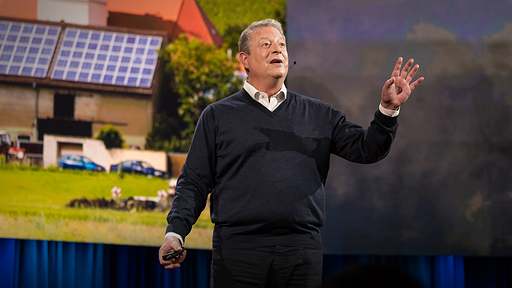
    Al Gore, in his own words, "used to be the next President of the United States of America" but has since changed professions. This talk is a follow-up to his now-famous presentation, featured in the movie, An Inconvenient Truth. In it, he outlines what we can do to avert a global climate crisis.
    [Recorded February, 2006 in Monterey, CA. Duration: 16:55]

    Subscribe_btn_1

    Download this talk: Audio (MP3) | Video (MP4)

    More TEDTalks: TEDTalks website | iTunes (audio) | iTunes (video)

    NEW: Read the transcript >>

    Blog this video: Use this code to run the video on your own site:

    More

  • Majora Carter on TEDTalks – June 27, 2006

    Majora CarterMajora Carter is the Macarthur-winning founder of Sustainable South Bronx, an organization dedicated to holistic community development, sponsoring projects that create jobs, protect the environment and bring beautiful green space to the inner city. In this charismatic presentation (which received a prolonged standing ovation), she explains her commitment to environmental justice and her vision for a renewed South Bronx. [Recorded February, 2006 in Monterey, CA. Duration: 19:14]

    Subscribe2TEDTalks.jpg

    Download this talk: Audio (MP3) | Video (MP4)

    More TEDTalks: TEDTalks website | iTunes (audio) | iTunes (video)

    NEW: Read the transcript >>

    Blog this video: Use this code to run this video on your own site.

    More

  • New thinking on climate change: Al Gore's new slideshow premieres on TED.com – April 8, 2008

    In Al Gore's brand-new slideshow (premiering exclusively on TED.com), he presents evidence that the pace of climate change may be even worse than scientists were recently predicting, and challenges us to act with a sense of "generational mission" -- the kind of feeling that brought forth the civil rights movement -- to set it right. Gore's stirring presentation is followed by a Q&A in which he is asked for his verdict on the current political candidates' climate policies and on what role he himself might play in future. (Recorded March 2008 in Monterey, California. Duration: 27:54.)


    Watch Al Gore's talk on TED.com, where you can download it, rate it, comment on it and find other talks and performances.

    Read more about Al Gore on TED.com.

    Download this talk in 480p high-def >>

    Subscribe2TEDTalks.jpg

    Embed this video: Use this code to run the video on your own site:

    More

  • Vote for your favorite public intellectuals – May 1, 2008

    Not to be outdone by the Time 100, the journals Foreign Policy and Prospect have together released a list of the Top 100 public intellectuals -- with voting. Many TEDTalks favorites appear on the list, and you can help choose the eventual top 20 by voting for your very own top 5. From Foreign Policy's site:

    Although the men and women on this list are some of the world’s most sophisticated thinkers, the criteria to make the list could not be more simple. Candidates must be living and still active in public life. They must have shown distinction in their particular field as well as an ability to influence wider debate, often far beyond the borders of their own country.

    TEDTalks speakers on this top 100 list include George Ayittey, Steven Pinker, Neil Gershenfeld, Malcolm Gladwell, Craig Venter, Al Gore, Richard Dawkins, Vilayanur Ramachandran, Larry Lessig, Steven Levitt, E.O. Wilson, Dan Dennett and Bjorn Lomborg -- and look for upcoming TEDTalks from others on this list, including Paul Collier, who spoke at TED2008 about "the bottom billion."

    See the full list of 100 >> More

  • "Gore gets it!" – October 12, 2007

    gorehandsKevinTGilbert.jpg Gore gets it! – the prize, and the crisis. Deeply rooted in science, Al Gore has established climate crisis as a moral and spiritual imperative. Now we must act with speed on an unprecedented scale. Speed and scale. -- John Doerr I have seen the VP's passion since my early days photographing him in Washington DC. He was a different person on the campaign plane than the public saw, and now the world sees him for who he is. [Above is] my favorite photo taken of candidate Gore on the campaign in California, May 2000. -- Kevin Gilbert My wife and I came to TED uncertain about Al Gore and not thrilled to hear him. He seemed fake to us in the national political election he had gone through. His presentation profoundly changed our view of him even more than his message. We bought the messages. We did not buy the message presenter. At TED, he gave a sense of his humor, three-dimensionality, commitment to the cause, ability to criticize himself. We left with a positive attitude toward him and a commitment to help. -- David and Heidi Hoffman At TED2006, Al Gore brought alive a vital and little-understood subject with humble, direct, passionate facts that were a call to action far beyond his previous resume as a politician -- bravo to a great humanist leader who made us address our history! -- Randy Antik At 60 years old, there are rare seminal moments that cut across the arc of your life that make you stand up and cheer with joy of a 3-year-old, the passion of a 16-year-old and the wisdom of a 60-year-old -- Al Gore did that at TED! -- Sandra Kulli Thank you, bless you -- Al Gore; what greater giving, what better gift to the planet, than your new dawning of insights, intelligence and calm authority in advising the world -- finally -- to what future there might be...and what future we might create anew? -- Tim Girvin Watching Al -- and Tipper -- Gore at TED was my privilege; working to reverse climate change is my responsibility. -- Stuart Gannes Continue reading >>

    Photo of Al Gore: @Kevin T. Gilbert More

  • Inspired by Al Gore: TEDTalks – October 12, 2007

    The TEDTalks archive is rich in proof that Nobel Peace Prize winner Al Gore, speaking at TED and elsewhere, truly has the power to inspire action. Producer and activist Jeff Skoll heard one of Gore's PowerPoint lectures and started the ball rolling on An Inconvenient Truth -- a film and website that became an incredibly effective way to share the message on climate change. John Doerr, the Silicon Valley financier, talks about a mind-changing conversation (like many of us had after An Inconvenient Truth) -- sitting with friends at a dinner party asking, "What can we do about what Al Gore has told us?" Doerr, it turns out, is doing quite a lot. Speaker Tony Robbins was moved by the way Gore -- after the legendary disappointment of that 2000 presidential race -- rebounded and found his passion. Look for the moment when Gore and Robbins share a high-five down in the front row. Majora Carter, meanwhile, offers new ways for Gore to share his passion -- by working with the thousands of people who are cleaning up the environment, starting in their own neighborhoods. And after hearing Al Gore's first talk at TED, Jill Sobule sat backstage and learned a new song. More

  • TEDsters talk about Al Gore's impact – October 12, 2007

    AlGoreNobelPrizeBlog.jpg As congratulations for Al Gore, 2007 Nobel Peace Prize winner, pour in from the TED community, we asked people who saw Gore's TED2006 presentations to talk about the impact his talks had on them. This is the first in a series, to be posted throughout the day. Al Gore's talk at TED 2006 was a turning point in my life. -- David S. Rose I was actually crying for most of it; I could not believe I didn't know that our world was in jeopardy, I couldn't believe how much had already gone wrong without me knowing about it. -- Will Shipley Al Gore’s talk at TED opened my eyes to what I needed to do for my grandchildren’s generation, and I now consider the impact we have on our earth in every venture we undertake. -- Howard L. Morgan Gore's TED presentation on the climate crisis was at once riveting and inspiring -- his passion was so evident -- it prompted me to share the talk with our children, and our eldest, Charlie, now 11, has become a one-man global warming marketing machine. Charlie has created his own PowerPoint presentation, which he shares with virtually everyone he meets. -- Jeff Levy Al Gore was the first to complement our work on Stormblade at his breakfast meeting, which was hugely encouraging and that really spurred me on to persevere, as a result of which we eventually got funding to continue the project which will in the end play a huge role in reducing global carbon emissions. -- Viktor A. Jovanovic Al Gore's passion for spreading the word about man-made climate change is a signal that humanity still has a chance. -- Ann Willoughby No one instance in my previous 53 years has clarified my thinking and simultaneously called me both to action and to an appreciation of the momentous importance of an issue like the TED night two years ago when Al Gore gave his Inconvenient Truth presentation. -- Jeff Studley More

  • Gore's call for a carbon/jobs Marshall plan – October 1, 2007

    Al Gore (TED2006 speech) at last week's Clinton Global Initiative: "The key to fighting global poverty is to have the wealthy nations and the developing nations join together to reduce global warming ... What we need is a global Marshall plan to make the creation of jobs around the reduction of carbon the central principle for how we develop this." (From the FT) More

  • TED2008: Days 3 and 4 in Quotes – March 2, 2008

    GeldofHeavens.jpg
    Photos: Andrew Heavens

    “Imagine Martin Luther King saying, ‘I have a dream ... But I don’t know if the others will buy it.’” - Boston Philharmonic conductor Ben Zander, on the importance of persuasive leadership "Human progress depends on unreasonable people. Reasonable people accept the world as they meet it; unreasonable people persist in trying to change it. Well, I’m Bob and I’m an unreasonable person. And if TED is anything, it is the olympics of unreasonable people." - Musician and activist Bob Geldof (above) “Why are we ignoring the oceans? Why does NASA spend in one year what NOAA will spend in 1600 years? Why are we looking up? Why are we afraid of the ocean?” - Ocean explorer Robert Ballard "I think it's the dopamine." - Anthropologist Helen Fisher, explaining to Chris Anderson why she's still optimistic about love, despite understanding its chemical and biological basis "Relative to the universe, it's just up the road." - Physicist Brian Cox, after referring to Chicago as 'just up the road' from Monterey, CA “If you think half of America votes badly because they are stupid or religious, you are trapped in a matrix ... Take the red pill, learn some moral psychology and step outside the moral matrix.” - Jonathan Haidt, author of The Happiness Hypothesis “If you want the truth to stand clear before you, never be for or against. The struggle between 'for' and 'against' is the mind’s worst disease.” - Jonathan Haidt, quoting Sent-ts’an, from 700CE China "The job of the C is to make the B sad." - Boston Philharmonic conductor Ben Zander, deconstructing a piece by Chopin “How do we give credible hope to the billion poorest people in the world? It requires compassion to get ourselves started, and enlightened self-interest to get serious... If economic divergence continues, combined with global integration, it will build a nightmare for our children.” - Paul Collier, author of The Bottom Billion “In order to solve the climate crisis, we need to solve the democracy crisis.” - Al Gore, urging citizen involvement not only on a personal level, but also on a political level “How dare we be pessimistic? Maybe the future is better than it used to be.” - Peter Schwartz, co-founder of the Global Business Network “It's important to leave the security of who we are, and go to the place of who we are becoming. I encourage you to let yourself out of any prison you might find yourself in. Because we have to do something now. We have to change now.” - Environmental advocate John Francis (below), who went 17 years without speaking

    FrancisHeavens.jpg More

  • A taste of TED, or two – June 14, 2007

    Watch here a new "taste of TED" video documentary shot at this year's conference, in March. In 7 minutes it gives a great sense of the atmosphere at TED and of the content of the conference. It is also available elsewhere on this site, and you can download it here (158 Mb).

    Another documentary about TED, "The future we will create: Inside the world of TED", which was filmed at TED2006, is been shown this coming Saturday night at the Maui Film Festival. Producers Daphne Zuniga and Steven Latham got full access to the conference, and used it wisely to take the viewers behind the scenes -- on top of showing speakers ranging from Al Gore to Peter Gabriel. The full-feature documentary (74 minutes) had a premiere screening in New York a few weeks ago and later in Los Angeles. It has been released on Netflix (US only) last week.

    More

  • Web-based ways to make a difference – January 1, 2008

    To help those of us making resolutions this week, here is a sampling of web tools for making a difference, inspired by TEDTalks speakers: + Share Ron Eglash's cool math tools, for studying math via breakdancing, Latin beats and cornrow braids + Dive into Richard Baraniuk's Connexions, a massive repository of open-source class materials + Visit Phil Borges' Bridges to Understanding site, which rounds up student films from all over the world + Browse Erin McKean's booklist "So You Want to Be a Lexicographer?" + Check out the beta of Gapminder World, powered by Hans Rosling's Trendalyzer software + Watch video and take action at The Hub, a platform for human rights media and action -- presented by Peter Gabriel's WITNESS + Discuss sustainable design and materials on the Cradle to Cradle forums, inspired by the work of William McDonough + Learn more about Nicholas Negroponte's One Laptop per Child + Catch up with Majora Carter's Sustainable South Bronx -- or make a specific gift to SSBx via Changing the Present + Calculate your personal CO2 production -- and start helping the planet -- at the website for Al Gore's An Inconvenient Truth, produced by Jeff Skoll TEDTalks is full of ideas for making change for oneself and for others -- many more than we can list here. Please share your suggestions for other TEDTalks-inspired change! More

  • TEDsters' Films Nominated for 4 Academy Awards – January 24, 2007

    Lcl_monsterhouse_1Today's early morning announcement of the nominations for the 79th Academy Awards bore fruit for TEDsters, including Producer Lawrence Bender and "Talent" Al Gore, whose film, An Inconvenient Truth was nominated for two Academy Awards, Best Documentary Feature and Best Original Song (by Melissa Etheridge.) Jeff Skoll, whose Participant Productions financed the global warming movie, will speak at TED for the first time in March.

    Inconvenientruthonesheet_1 Meanwhile, over at Sony Pictures Digital's Imageworks animation and visual effects studio, they also popped open the champagne: Monster House was nominated for best animated feature, and Superman Returns was recognized for Sony's breakthrough character animation of the title character, and the amazing Space Shuttle action scene, among the myriad effects. Congratulations to TEDsters Yair Landau, Tim Sarnoff, Don Levy, Bill Villareal and George Joblove.

    "Monster House" Gil Kenan (Columbia Pictures; Sony Pictures Releasing)

    "Superman Returns" Mark Stetson, Neil Corbould, Richard R. Hoover and Jon Thum (Warner Bros.)

    "An Inconvenient Truth" Davis Guggenheim; A Lawrence Bender/Laurie David Production (Paramount Classics and Participant Productions)

    "I Need to Wake Up" from "An Inconvenient Truth," music and lyric by Melissa Etheridge (Paramount Classics and Participant Productions)

    Superman_returns_banda_sonora

    More

  • Al Gore wins the Nobel Peace Prize – October 12, 2007

    AlGore-breakfastForBlog560x480.jpg

    This morning, Al Gore and the Intergovernmental Panel on Climate Change (IPCC) were awarded the Nobel Peace Prize for 2007, "for their efforts to build up and disseminate greater knowledge about man-made climate change, and to lay the foundations for the measures that are needed to counteract such change." Gore will be sharing his prize money with the Palo Alto-based Alliance for Climate Protection.

    At TED2006, Gore delivered to a rapt audience the seminal slide show that would later that year form the core of his blockbuster documentary An Inconvenient Truth. He followed it up with a second talk at the end of the conference showing ways of turning climate concern into action. Throughout the day we'll be offering tributes to the impact of that speech on those present at TED2006 -- and the way the impact has spread throughout the world. More

  • TED2008: How dare we be optimistic? – March 1, 2008

    (Unedited running notes from the TED2008 conference in Monterey, California. Session eleven.)

    Ben Kaufman, founder of Kluster, goes on stage to tell what he and his team have been doing -- with the help of TED attendees and 1200 people around the world -- since the beginning of the conference. Kluster is an online collaboration and decision-making platform. Klustergame They set out Wednesday morning to develop a product, with some basic guidelines but "we didn't know what it would be". They set up a studio in the conference's venue, and got 208 ideas submitted in 24 hours. Collaboratively, it was decided that it would be an education board game; the content for it was developed; a name chosen ("OverThere" -- the logo was submitted by a participant online); the rules set; a tagline developed; a full prototype developed (photo). 72 hours, 1200 participants, a board game "of social awareness" collectively invented, developed and prototyped: a pretty awesome piece of work.

    Johnny Lee does research on human-computer interaction at Carnegie Mellon University -- and explains it via videos on YouTube. He goes on stage for a short talk explaining how at the tip of the Nintendo Wii remote controller there is a rather sophisticated infrared camera, and Johnny shows how, by pointing it to a projection screen or LCD display, you can create a low-cost white board; because the camera can see multiple dots, it becomes a multitouch screen as well. The audience goes: "wow!", and indeed what Johnny does is really cool. See the demos on his site.

    Bottombillion Economist Paul Collier has written one of the most interesting books of last year, "The Bottom Billion", identifying the traps that keep many countries in poverty and outlining new ways to development through a mix of direct aid and investment. He is the director of the Center for the Study of the African Economies at Oxford.
    A billion people have been stuck living in economies that have been stopped for 40 years. So the question is: how can we give credible hope to that billion people. That's in my mind the fundamental challenge of development. Two forces that change the world for good: and enlightened of self-interest. Compassion because a billion people are living in societies that can't offer credible hope; enlightened of self-interest because of that economic divergence continues for another 40 years it will lead to disaster.
    What does it mean to get serious about providing hope for the bottom billion? A good guide is: what did we do last time the rich world got serious about developing another region of the wold? That goes back to the 1940s: the Marshall Plan and the reconstruction of Europe, financed by the rich US. It was not only compassion: it was also enlightened self-interest by America, because in Europe country after country was falling into the Soviet sphere of interest. What else did America do? Before the war the US had been very protectionist; after the war, total reversal of trade policy with the general agreement on tariffs and trade. Before the war, US had an isolationist security policy; after the war, posted troops in Europe. Before the war, the US treated national sovereignty so stringently that it didn't even want to join the League of Nation; after the war, position reversed.
    Aid, trade, security, and governance. That frontier is still there. We need to be at least as serious as we were there.
    Let's focus on governance. The opportunity we're going to look to is a genuine basis for optimism about the bottom billion: the commodity boom. It's pumping an unprecedented amount of money into many -- not all -- of the countries of the bottom billion. Partially because community prices are high, partly because there is a range of new discoveries and explorations. Between them, these new revenue flows dwarf aid. How is that gonna help development? What is the relationship between high commodity prices of exports and the growth of commodity-exporting countries. In the short time, the first 5-7 years, it's great. Everything goes up. But in the long run, it reverses -- "the resource curse". The critical issue is the level of governance. In fact, if you got good enough governance, there is no resource curse: you go up in the short term, and even more in the long run. Nigeria is worst off than if it never had oil. There is a threshold level of governance. Is the bottom billion above or below that threshold? Maybe we can be more optimistic
    Democracy makes even more of a mess of the resource boom that autocracies. There are two distinct aspects of democracy: electoral competition, that determines how you acquire power, and checks and balances which determines how you use it. What the countries at the bottom billion need is very strongly checks and balances. They have elections, but not c-and-b. We should have some international standards, which would be voluntary but would spell out the basic needs. We know these standards because we already have one: the international extraction revenues transparency. It requires that governments report to their populations the revenues of extraction.
    What would the content be of these international standards? How to take the resources out of the ground, how to sell the rights for resource extraction. Now, a company flies in, make a deal with a minister, that's great for the company and often for the minister, but rarely for the country. There is a piece of institutional technology that can work: verified auctions. Like the British Treasury sold wireless 3G licenses back in the early 2000 (the full story of that auction here - PDF). If we can create such standards, we can help the people in these societies.
    And yet, we've not got these rules. If you think about, the cost of promulgating international rules is very low. Why are they not there? Because until we have a critical mass of informed citizens in our own societies, politicians will get away with gestures -- things that look good but don't work. We have to go through the business of building an informed citizenry. That's why I wrote an economic book that you can read on a beach.

    Eric Kuhne, architect and planner from London, gives a short talk about a new city project in the Middle East, where symbolism and urban planning interact. Architecture has become a new diplomacy. We want to restore the storytelling qualities of cities. A city has been and always will be the greatest work of art.

    Singer-songwriter-producer-activist Nellie McKay is next, toying with antique genres yet producing music that's unequivocally contemporary.

    Three-minutes speech by Andy Hobsbawm is one of the founders of The Green Thing, a London-based online community that encourages people to behave more sustainably, one small step at a time, through information and fun. I've already blogged it here and here.

    Last year was quite a year for former US vice-president Al Gore. He was awarded the Nobel prize for Peace (together with the IPCC), won an Oscar for his documentary "An Inconvenient Truth", and saw the theme of climate change gain center stage in the political and social discussion. He has spoken previously at TED, in 2006 (watch the video).
    He has a new speech related to his last book, "The Assault On Reason", which will also be turned into a documentary.
    "I was reminded by Karen Armstrong's presentation that if religion is not really about belief but about behaviour, maybe we should say the same thing about optimism. Optimism is often represented as an intellectual posture -- Gandhi's "You must be the change you wish to see in the world". But when we change our behaviour in our daily lives, we sometimes leave out the democracy and citizen part. In order to solve the climate crisis, we have to solve the democracy crisis, and we have one. There is a bridge between the climate crisis and the crisis of extreme poverty in our world. We have to find a unified Earth theory. The struggles of climate change and extreme poverty and diseases are connected to the problems of overconsumption, wastefulness, economic transformation. We have to approach this as a unified challenge. Local, regional, global conflicts: each level requires a different allocation of resource, organizational model, etc. The climate crisis is the rare and strategic global conflict, we have to organize our response accordingly (BG: I partially disagree). What we do with the poorest countries matters to all of us. We have to act. Since that post-war economic boom, one aspect of the engine of economic growth was a pattern of consumption that morphed into overconsumption. The solution to the climate crisis requires that we replace that engine -- consumption without overconsumption. We need a worldwide movement. But the political will needs to be mobilized in order to mobilize the resources.
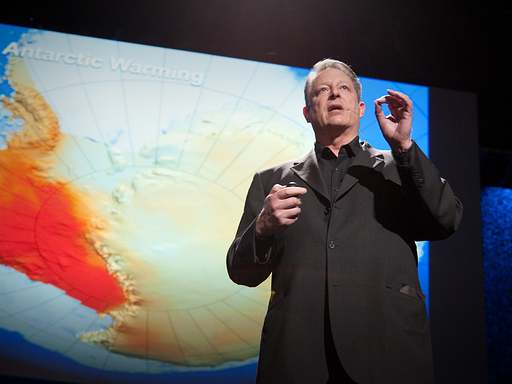
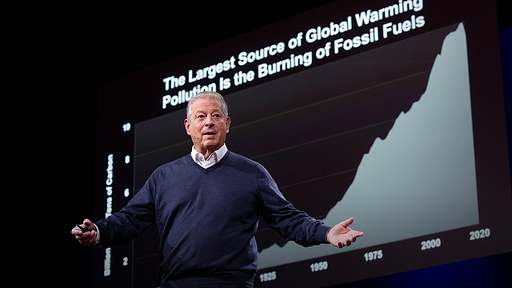
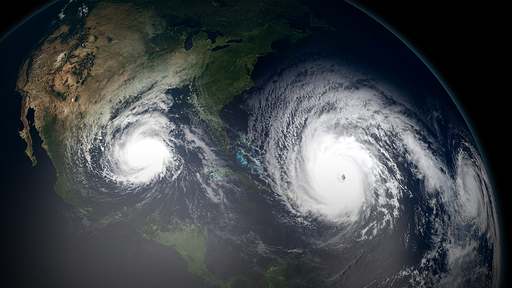
    Gore discusses (and shows convincing images about) the melting of the Arctic icecap and the thawing of permafrost in the North; peak fishing; emissions.
    Venus and the Earth have roughly the same size. On Earth, carbon is trapped. On Venus, it's in the atmosphere -- and temperatures reach 855 degrees F.
    Algore1 The majority of Americans now think that climate change is a problem, that warming is real. But there still isn't a sense of urgency. (He shows a video -- a frame at left -- with elephants falling from the sky, "every year the US emits CO2 for the equivalent weight of 1.2 billion elephants: It's time to stop ignore 1.2 billion elephants in the room").
    Solution: put a price on carbon. We need a CO2 tax, revenue-neutral, to replace taxation on emplomyent, which was invented by Bismarck and some things have changed since. In the poor world we have to integrate responses to poverty with solutions to the climate crisis. Responses can make a huge difference. Think of the "energy super grid" with solar energy produced in North Africa by solar and the energy sold to Europe (picture below). If you invest in tar sands, you have a subprime portfolio.

    Energysupergrid

    780 US cities are now supporting Kyoto.
    We heard a couple of days ago about the value of making individual heroism so commonplace that it becomes banal routine. What we need is another hero generation. Those of us who are alive in the US today, but also in the rest of the world, have to somehow understand that history has presented us with a choice. Just as Jill Taylor was figuring out how to save her life while she was distracted by the amazing stroke that she was witnessing.We now have a culture of distraction but we have a planetary emergency. We need to find a way to create a sense of generational mission.   We have the capacity to do it. I'm optimistic, because I do feel very deeply that the kind of moving spirit that is celebrated in so many of the sessions that we've all been moved by here is alive in all of us. I believe we have the capacity at moments of great challenge to set aside the causes of distraction and rise to the historic challenges. Sometimes I hear people respond to the disturbing facts of the climate crisis by saying "this is so terrible, what a burden". Let's reframe that: how many generations in all of human history have had the opportunity to rise to a challenge that is worthy of our best efforts, a challenge that can pull from us more that we knew we could to. We ought to approach this challenge with a sense of profound joy and gratitude that we are the generational about which 1000 years from now orchestras and poets and singers will celebrate by saying: they swere the ones that found within themselves to solve this crisis and lay the basis for a bright and optimistic human future. Let's do that.
    Chris Anderson asks Gore whether he is excited by Hillary Clinton and Barack Obama's environmental plans. Gore: We should feel grateful that both of them and John McCain, all three have a position on the climate challenge, have offered leadership and an approach very different from the current administration. But the campaign dialog -- often sponsored by the "clean coal" industry btw -- has not laid the basis for the kind of bold initiative that is really needed. They're saying the right things, and whoever of them is elected may do the right things. But when I came back from Kyoto in 1997 with a great feeling, and then confronted the US Senate and only a handful were willing to ratify that treaty: whatever the politicians say needs to be alongside what people say. The climate challenge is part of the fabric of our life. Changing the pattern is beyond anything we've done in the past. Change light bulbs, but change the politics too. I do believe that between now and November it is possible that the debate will get bolder. We can change things, actively. What's needed really is a higher level of consciousness, and it's hard to create, but it's coming. As the African say: if you want to go quickly go alone, if you want to go far go together. We have to go far quickly.

    More

  • Introducing TEDTalks – June 27, 2006

    Tedtalks_170x170_2Today, for the first time ever, we're thrilled to present some of the most remarkable talks from TEDs past. We launch with six from this year's conference — Al Gore, Tony Robbins, David Pogue, Majora Carter, Hans Rosling and Ken Robinson — with more coming weekly. All the talks are downloadable as audio or video, searchable and free. It's a big moment for us: Until now, the TED experience has been limited to 1,000 people each year. But we believe passionately that these talks deserve a much wider audience. Now — thanks to the maturation of online video and podcasting, and a visionary sponsorship from BMW — we can share them for the first time. TEDTalks are designed to fit into your life: You can subscribe, to easily receive updates each week. There's an audio series (produced with WNYC/New York Public Radio) that commutes well, as well as the video series, offered on this blog and TED.com, and downloadable through iTunes. Plus, the talks are fully searchable, so you can always find exactly what you're looking for. Our intention here isn't to draw attendees (TED2007 already has a long waiting list), but simply to share these profound talks — which have had such great impact on us — with the widest possible audience. They're ideas worth spreading. So whether you're a TED veteran or virgin, we encourage you to clear your schedule and watch at least three talks, back to back. They have a cumulative effect ... — Chris More

  • Gore's SOS -- Save Our Selves – February 16, 2007

    Along the social absorption route, there is always a point where complex issues and inconvenient messages percolate into the pop-culture sphere and start being considered self-evident, possibly triggering changes in behavior and other individual or collective responses.

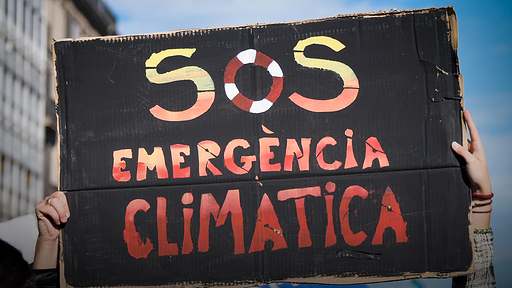
    For the climate crisis that point may be nearing. It may even have a precise date: this year's 7th of July (7/7/7). A group of environmental activists surrounding former US vice-president Al Gore (see his speech at TED2006) has just announced plans for a worldwide event, called LiveEarth, featuring big live concerts in cities on seven continents (another "7") broadcast on television, radio, online (by sponsor MSN) and on cell phones (yes, one of the concerts will be broadcast from Antarctica, that will be a first) to mobilize global action to face the climate crisis. 777liveearth The initiative will use as its identifier the international SOS Morse code (three dots, three dashes, three dots - see logo at right), re-interpreting it as a continuous distress call where SOS stands for "Save Our Selves". "The climate crisis will only be stopped by an unprecedented and sustained global movement", Gore said announcing the initiative (watch the video), which he called "a mass persuasion campaign" that will also outline (through the websites) ways in which individuals, companies and politicians can take action.

    LiveEarth is of course modeled on the 1985 LiveAid (to raise funds for famine relief) and the 2005 Live8 (to raise pressure for debt relief and eliminating poverty) international concerts. It was imagined by Kevin Wall, who produced Live8. More than 100 artists will appear - including Sheryl Crow, Bon Jovi, Red Hot Chili Peppers, local acts (to attract local audiences), etc.

    For Gore, LiveEarth will be a spectacular way to extend the message of his film "An Inconvenient Truth" (which is nominated for an Oscar later this month) and of his Climate Project (training volunteers to give his slide show). But of course it won't go without controversies -- starting with the question of whether he's just building up a run for US President in 2008 (which he dismisses: "I have no intentions of running"). The other focus of criticism will be the environmental impact of the multicontinental concert (air travel, mass audiences producing mass waste, energy consumption, etc). Wall and Gore say they're using LiveEarth to design a "Green event standard" that could become a "model for carbon-neutral concerts and other live entertainment events".

    (Cross-posted on LunchOverIP)

    More

Al Gore on the Web

Bookmark this speaker

Related Speakers

Related themes

Conferences

  • TED2006