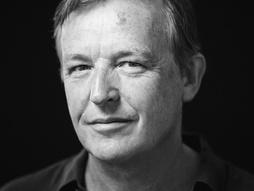
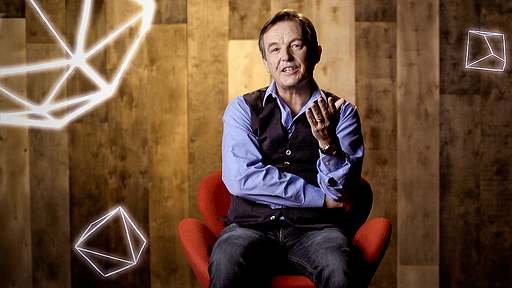
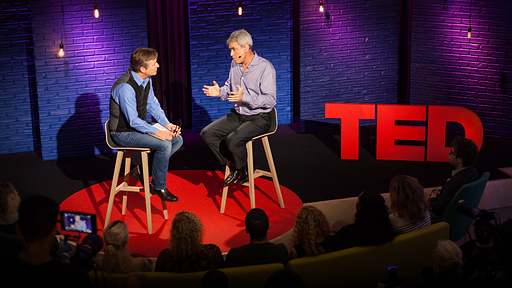
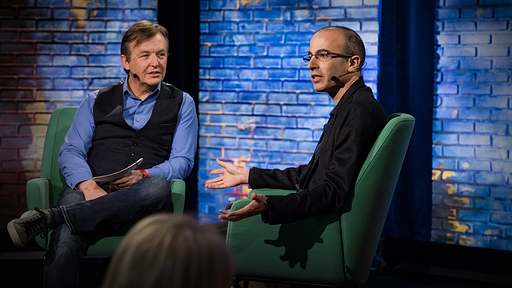
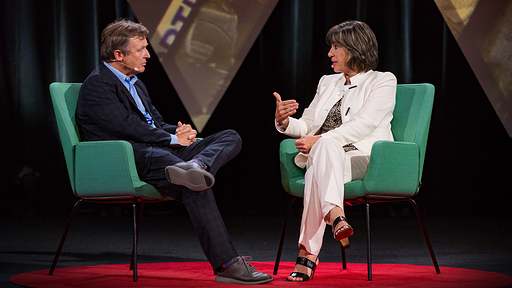
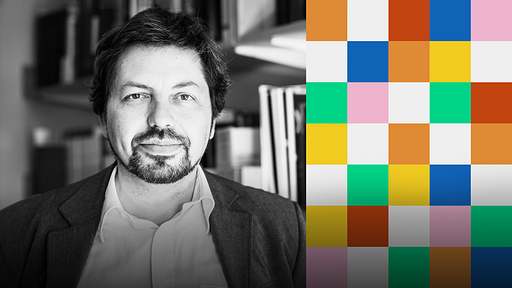
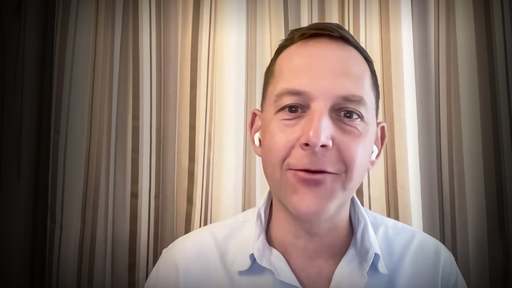
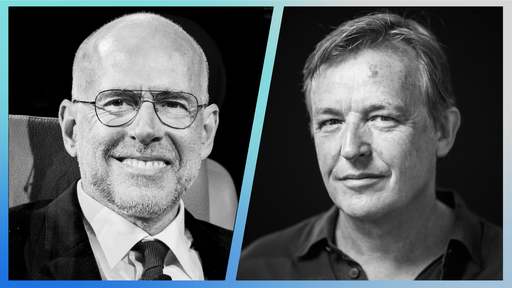
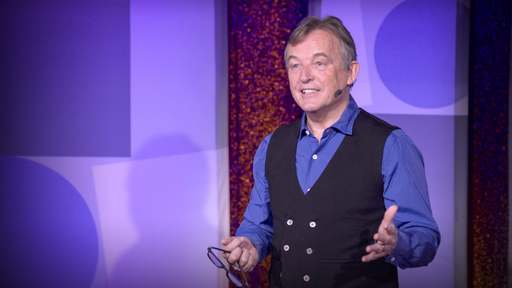
After a long career in journalism and publishing (during which he launched Business 2.0 and the games website IGN), Chris Anderson became the Curator of the TED Conference in 2002.
Why you should listen to him:
TED's Chris Anderson was born in a remote village in Pakistan, and spent his early years in India, Pakistan and Afghanistan, where his father worked as a missionary eye surgeon. He graduated from Oxford University with a degree in philosophy, and then trained as a journalist. After several years at newspapers and radio stations, he got hooked on the strange new "home computers" which had just started appearing. He became an editor at one of the UK’s early computer magazines, and a year later, in 1985, formed a tiny start-up to launch his own magazine. Its unlikely success led to more launches, and his company Future Publishing grew rapidly under the moniker "media with passion."
Anderson expanded to the United States in 1994, where he built Imagine Media, publisher of Business 2.0 magazine, and creator of the popular games website IGN. The combined companies eventually spawned more than 100 monthly magazines, employing 2,000 people. And they allowed Anderson to create a private nonprofit foundation, the Sapling Foundation, which hoped to find new ways of tackling tough global issues by leveraging media, technology, entrepreneurship, and most of all, ideas. Sapling acquired the TED Conference in 2001, and Anderson then left his businesses to focus on growing TED. (He is not to be confused with his super-smart friend, the Chris Anderson who edits WIRED magazine and wrote The Long Tail.)
"I'm an idealist. I really think people can change the world ... "Chris Anderson interviewed on CThings
Blog Posts on TED
-
TED curator Chris Anderson interviewed on Charlie Rose – February 18, 2008
Charlie Rose interviews TED's curator, Chris Anderson, on his show set to air tonight, February 18. The Charlie Rose Show will be broadcast on PBS affiliates throughout the country; check local listings. (In New York, the show plays at 11 pm on Channel 13.)
Update: Click here for video of the show >>
And here's the book Chris mentioned during the conversation: Jonathan Haidt's The Happiness Hypothesis.
-
New thinking on climate change: Al Gore's new slideshow premieres on TED.com – April 8, 2008
In Al Gore's brand-new slideshow (premiering exclusively on TED.com), he presents evidence that the pace of climate change may be even worse than scientists were recently predicting, and challenges us to act with a sense of "generational mission" -- the kind of feeling that brought forth the civil rights movement -- to set it right. Gore's stirring presentation is followed by a Q&A in which he is asked for his verdict on the current political candidates' climate policies and on what role he himself might play in future. (Recorded March 2008 in Monterey, California. Duration: 27:54.)
Watch Al Gore's talk on TED.com, where you can download it, rate it, comment on it and find other talks and performances.
Read more about Al Gore on TED.com.
Download this talk in 480p high-def >>
Embed this video: Use this code to run the video on your own site:
-
TED2008: Is beauty truth? – February 28, 2008
(Unedited running notes from the TED2008 conference in Monterey, California. Fourth session.)
After music by Jill Sobule live from Aspen, and by Thomas Dolby's band in Monterey, the TED's fourth session, hosted by Director of TED MediaJune Cohen, is on "What is beauty?", on the existence and the hidden meanings of beauty.
Anchor speaker Nancy Etcoff, evolutionary psychologist and author of "Survival of the prettiest", had unfortunately to cancel because of a flu. June introduces the session by summarizing Etcoff's views: Beauty matters to us. We are constantly scanning for it, evaluating it, responding to it. But what do we find beautiful and why? Etcoff contends that beauty is an evolutionary advantage and argues that not only culture determines what is beautiful, but that we have an innate understanding of it, and the perception of beauty is therefore a human universal.
Designer
Isaac Mizrahi is probably best known for bridging the gap between
"high" and "low", for creating couture collections (sketch at left) for
both luxury brands (Liz Clairborne) and affordable retailers (such as
the US' Target). He's also a performer, talk-show host, designer of
theatre and opera costumes, and much more. He has written a book that
will be out in a few months, "How to have style", where he expounds on
his belief that inspiration leads to creating a personal style.
"I'm gonna talk about my process, but it's difficult, I don't know where it started. Process has alot to do with physique: who you are physically. I dont' sleep much, for years I've been sitting up, and i think that my creativity is greatly motivated by this kind of insomnia. I lie awake, I walk around -- actually I also walk during the day and follow people that are interesting. As a matter of fact, a lot of my design comes from the tricks of the eye. I don't know where inspiration comes from: it comes from lying awake and thinking. For me, it doesn't come from research. One of the funniest things I've always done it was this past Christmas, at the Guggenheim in NY, I read "Peter and the Wolf" with kids, and that's my own kind of research. I'm really lazy about research. Your creativity should be like a bodily function. Sure, if I'm commissioned to do costumes for an opera, I do research, because it's interesting. I watch alot of movies, and trying to find balance of irony and earnestness. Balance is really what it is about, that's part of my process. I go back to color all time. Natural colors are just so beautiful. How can I ever make anything that is as beautiful as Greta Garbo? That's what makes me lie awake at night. I also go to astrologers and tarot readers, and do what they tell me to do. If I only do one thing at a time, I get bored very easily, so I do alot of things, and try not to look back.Sigfried Woldhek calls himself a "dreamcatcher". He gets three minutes on stage to tell about a discovery that he made about the face of Leonardo da Vinci. "We know all about Leonardo's research, but we don't know his face. There is controversy even about his self-portrait. I looked at all of his drawings, several hundreds, searching for self-portraits. By elimination, I shortened down the list to three: the self-portrait, the young "Musician", and the "Vitruvian man". If you zoom into these three faces, and map them chronologically, and compare them with the Verrocchio statue for which Leonardo posed as a teenager, the evidence is compelling: This is the face of Leonardo:
In museum circles, the director of the Guggenheim Foundation Thomas Krens has a controverisial reputation. He has challenged the definitions of high art with exhibits such as "The art of the motorcycle" (1998), rewritten the book on how to run a museum, and transformed the Guggenheim into a global brand, with currently five museums (NY, Venice, Las Vegas, Berlin and the Frank Gehry Bilbao museum) and one to be added in Abu Dhabi.
He picks 27 more-or-less random images that demonstrate that beauty is truth: an Egyptian sculpture, a Chinese bronze, Michelangelo, paintings by Leonardo, Rubens, Picasso, Matisse, Vermeer, Warhol, sculptures by Beecroft, Richard Serra, and more. All these are objects of beauty: how do you tie them together? How do we experience art, truth and beauty? How do we consume culture? How do we contain/communicate the richness of our culture? Truth and beauty don't reside in the objects themselves, but in the nature of the communication between the object and the viewer. The public art museum is an 18th century idea, the idea of an encyclopedia, presented in a 19th century box, an extended palace, that more or less fulfils its structural destiny sometime toward the end of the 20th century. André Malraux (1952): "Our museums conjure up for us a Greece that never existed". So the museum was an artificial space. Moreover, until recently most art museums have focused only on European and American art. Museums have to understand that all institutions change. Cultural narrative are infinite and endless. There is also a political dimension: museums need to become cultural agitators, while keeping being curators of collections. Plus: audience matters; art is for the masses. We need to make sure that the objects can tell a story and that story can be communicated. At the Guggenheim we think of museums as platforms and networks of exchange. Our buildings are based on the idea that 1+1=3. (Krens also talks about the Guggenheim projects for new museums that weren't built). The current Guggenheim proposition: bridges to the Middle East, with the Abu Dhabi project. AD is mostly desert, but unlike Dubai is made of many islands, and the local government is planning to develop one with a big cultural district "that will become one of the biggest concentrations of culture in the world". There will be a Guggenheim, a Louvre, a performing art center, various other museums, a Yale University campus, a Biennale platform, etc built by star architects (Gehry, Zaha Hadid, Jean Nouvel etc). There are also plans to extend the concept of the museum out into the desert.
June Cohen gives an update on TED.com, the platform through which TED distributes since mid-2006 the videos of the conference's speakers. It's currently running at over 3 million video views a month -- that's 100'000 a day. June announces new channels: Miro, Adobe's Media Player, and soon even on the inflight entertainment system of Virgin Atlantic. The pace of release will also be increased to daily, and sometimes later this year TED talks will be available with subtitles.

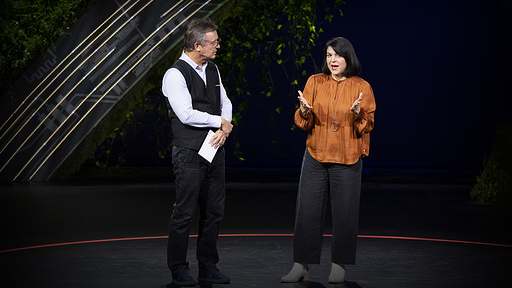
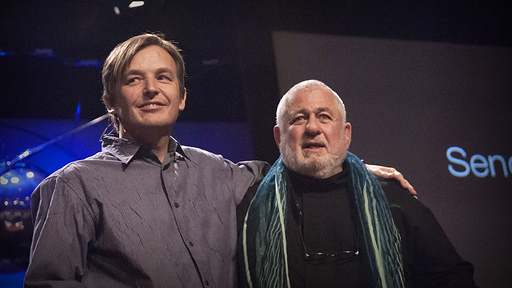
Next year, TED will celebrate its 25th anniversary. It was founded in 1984 by designer and information architect Richard Saul Wurman, who sold it a few years ago to Chris Anderson. Chris now runs it as a non-profit. The two men go on stage. It's a very emotional moment for them and for the TED community. Wurman retells how the idea for a conference about the convergence of technology, entertainment and design came to be, how the format of the event evolved over time, etc. He then introduces his new project: 192021.org, a study (leading to books, exhibits, and more) of 19 cities in the world that will have over 20 million people in the 21st century with a common methodology -- because although today the world is more a network of cities than of countries, there is no way currently to gather comparable data on global cities.The final speaker in the session is Garrett Lisi. Most of the year, he is a surfer. But last year he published online an "Exceptionally simple theory of everything" that has attracted lots of controversy -- his work is clearly on science's speculative outposts -- but also lots of diligent attention in the scientific community. This is the first time he talks publicly about his theory.

Here is the abstract of the theory, that tries to give a coherent, beautiful (Murray Gell-Mann, at TED last year, pointed out that in fundamental physics, beauty is a successful criterion for choosing the right theory) and unified explanation of all known fundamental interactions in physics:
"All
fields of the standard model and gravity are unified as an E8 principal
bundle connection. A non-compact real form of the E8 Lie algebra has G2
and F4 subalgebras which break down to strong su(3), electroweak su(2)
x u(1), gravitational so(3,1), the frame-Higgs, and three generations
of fermions related by triality. The interactions and dynamics of these
1-form and Grassmann valued parts of an E8 superconnection are
described by the curvature and action over a four dimensional base
manifold".
E8 is a mathematical shape with 248 symmetries -- a large, complex but elegant bundle (at left an illustration from Lisi's paper). Lisi believes that the relationships between the symmetries represent known particles and forces, including gravity, and hopes that the Large Hadron Collider, the new particle accelerator at CERN in Geneva that will go online later this year (Brian Cox will talk about it tomorrow) may offer indications on whether his theory has legs. I am not sure that I fully understand it. If you're like me, refer to the Wikipedia page, or to the full paper (31 pages, PDF).
-
Life at 30,000 feet: Richard Branson on TED.com – October 9, 2007
When Richard Branson was at school, his headmaster predicted he would wind up either a millionaire or in jail. Since then, he's done both. He talks to TED's Chris Anderson about the ups and the downs of his career, from his multibillionaire success to his multiple near-death experiences, from Virgin's line of spacecraft to the failure of the Virgin condom. He also reveals some of his (very surprising) motivations. (Recorded March 2007 in Monterey, California. Duration: 30:44.)
Watch Richard Branson's talk on TED.com, where you can download it, rate it, comment on it and find other talks and performances.
Read more about Richard Branson on TED.com.
Embed this video: Use this code to run the video on your own site:
-
Announcing TEDAfrica 2008! – November 26, 2007
Chris Anderson and Emeka Okafor write:
We're delighted to tell you that there will be another TED conference in Africa next year, and that we hope to make it an annual event on the continent!
TEDAfrica will be held in Cape Town, South Africa, September 29-October 1, 2008 (save the date!), and will follow the format of this year's TEDGlobal conference in Arusha, Tanzania.
The conference will be organized by a wonderful local team, including TED Fellow Kelo Kubu, and the conference will be operated out of a new South Africa-based nonprofit organization devoted to promoting a better future for the continent, the TEDAfrica Foundation. TED will be supporting the foundation both financially and logistically, to help ensure that the event maintains and builds on the quality and success of the Arusha event.
We hope to see you in Cape Town!
And team member Kelo Kubu writes:
It has been an honor and a privilege to be part of the TEDAfrica process . The team is naturally excited to be hosting TEDAfrica 2008, and we look forward to the challenge of generating the usual TED cocktail of inspiration and magic. The task is undoubtedly a daunting one, but Africa provides the perfect platform and Cape Town the ideal location for yet another memorable event.
We look forward to welcoming the world to the southernmost tip of Africa to share, spread and nurture groundbreaking ideas that could open new possibilities to growth and prosperity on the continent.
Photo of Chris Anderson and Emeka Okafor onstage at TEDGlobal 2007 courtesy Soyapi Mumba/flickr
-
A vision for TED: Chris Anderson on TED.com – January 30, 2008
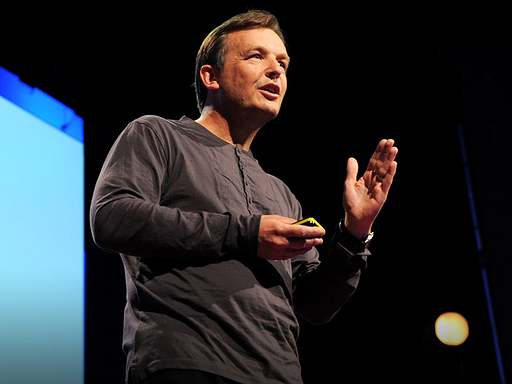
At the time of this talk, TED's future was in the balance. Its founder, Richard Saul Wurman, had just sold the conference to Chris Anderson's foundation, and had announced that this 2002 conference was the last TED he would run. Many in the audience had concluded that the conference would not survive the transition to a new owner, and few had signed up for the following year's event. This was Anderson's attempt to persuade TEDsters that the conference had a future, and that the transition from a for-profit event, to one owned by a nonprofit, could work. The talk took place five months after September 11, and at the very bottom of the dot-com stock market bust, when many in the room had lost 90% or more of their net worth. Here, Anderson shares his own story -- and his vision for what TED can become. (Recorded February 2002 in Monterey, California. Duration: 12:47.)
Watch Chris Anderson's talk on TED.com, where you can download it, rate it, comment on it and find other talks and performances.
Read more about Chris Anderson on TED.com.
Embed this video: Use this code to run the video on your own site:
-
How a TED grant helped spread a powerful ocean conservation idea – September 19, 2008
Overfishing is the number-one threat to the oceans' ability to provide food and sustain life. Under current conditions, we're closer than we think to a world of no more tuna-fish sandwiches, sushi, or protein for more than a billion people. Back in 2003, the Environmental Defense Fund's Oceans Program asked TED and its parent, the Sapling Foundation, to help spread a great idea: that the way to solve overfishing and help our oceans rebuild is to align incentives so that sustainable fishing is the most profitable way of fishing. The Sapling Foundation gave EDF a $250,000 grant to explore whether new incentive-based approaches that work with -- instead of against -- economic forces -- could transform the business and regulation of fishing. Equally as important, Chris Anderson gave EDF head David Festa a slot at TED to present this fledgling idea. Did it work? Yes: A landmark study published today, Sept. 19, in Science magazine shows that the focus of EDF’s Oceans Program -- a fisheries management system called “catch shares” -- is the only management system that prevents overfishing. In fact, the study finds, catch shares actually reverse overfishing and return fisheries to abundance.
As David Festa writes to the Sapling Foundation:
Here are few highlights of the return on your investment.
EDF's Oceans Program has turned this investment into what we now call the "Big Bet," a campaign to convert the majority of US, Canadian and Latin American fisheries to catch shares. Results from the 11 US fisheries managed this way are impressive. Typical findings from a study we released last year include:
+ Conservation: 100% compliance with fishing limits set by scientists.
+ Cleaner fishing: 40% decrease in unwanted catch thrown overboard dead.
+ Economics: 80% revenue increases per boat due to better yields and dockside prices.
Based on the strength of the work the Sapling Foundation and private TEDizens helped fund in its early years, we have been able to enlist new support including $5 million in capital pledges for a new public-private venture, the California Fisheries Fund, a $5 million partnership with University of California (funded by Paul Allen), and grants from the Gordon and Betty Moore Foundation and the Walton Family Foundation exceeding $20 million to advance catch shares and incentive-based management in the US.
Despite this progress, we're just now reaching critical mass. We have a big job ahead of us. And we can't do it alone. We need to work more closely than ever with colleagues, supporters, partners, fishermen and other stakeholders to advance this conservation agenda. It is critical that the world’s movers and shakers gain a working knowledge of our efforts to redesign fisheries.
The EDF's Oceans Program is a powerful example of how a seeding grant and a great idea can combine to make real change. The Sapling Foundation now makes grants solely through the TED Prize -- granting three people each year $100,000 and one wish to change the world. Look for some very exciting news from past TED Prize winners this fall, as their wishes -- with the help of seeding grants and assistance from the whole world -- start to come true.
-
On the verge of creating synthetic life: Craig Venter on TED.com – March 6, 2008
"Can we create new life out of our digital universe?" asks Craig Venter. And his answer is, yes, and pretty soon. He walks the TED2008 audience through his latest research into "fourth-generation fuels" -- biologically created fuels with CO2 as their feedstock. His talk covers the details of creating brand-new chromosomes using digital technology, the reasons why we would want to do this, and the bioethics of synthetic life. A fascinating Q&A with TED's Chris Anderson follows (two words: suicide genes). (Recorded March 2008 in Monterey, California. Duration: 32:52.)
Watch Craig Venter's talk on TED.com, where you can download it, rate it, comment on it and find other talks and performances.
Read more about Craig Venter on TED.com.
Embed this video: Use this code to run the video on your own site:
-
Welcome, TEDsters – October 10, 2005
Bowing to extraordinary public pressure, we are pleased to unveil the new TEDBLOG ... a little taste of ongoing TEDness for those who feel that once a year just isn't enough.
The plan is to add a few items every week... to titillate, intrigue and delight. Matters scientific, techie, creative, entertaining and... well, anything that we think might be of interest to you, our TED friends.
And, of course, we're counting on you to join in the fun -- in two ways:
- by pointing us to the good stuff each day. If it's out there, someone from TED will know about it soon enough. Please email my colleague June Cohen, who has been the driving force behind the blog. Use this address blog@ted.com
- by adding your comments to posts.
If you have your own blog, please also send the link to blog@ted.com and we'll monitor it for items to include...
All feedback welcome. No doubt we'll be on a learning curve for a while, and the learning will happen best if you help. Over to you!
- Chris