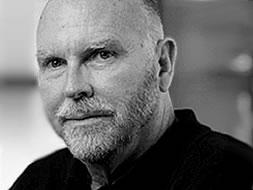
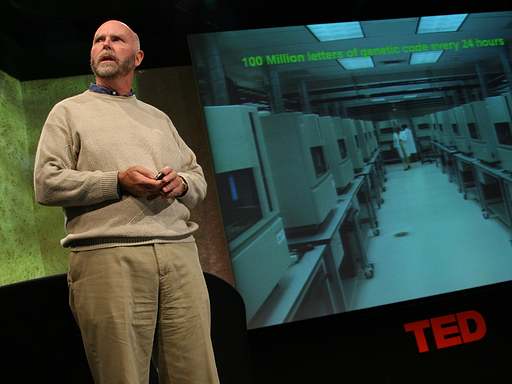
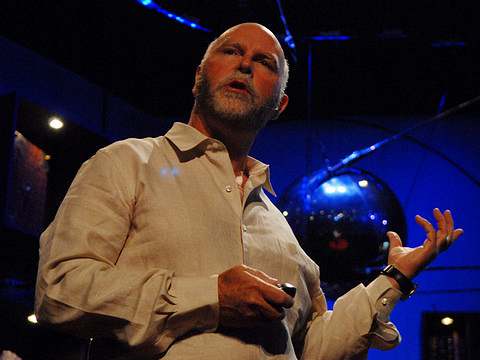
In 2001, Craig Venter made headlines for sequencing the human genome. In 2003, he starting mapping the ocean's biodiversity. Now he's working to create the first synthetic lifeforms -- microorganisms that can produce alternative fuels. And he's very, very close.
Why you should listen to him:
Craig Venter, the man who led the private effort to sequence the human genome, is hard at work now on even more potentially world-changing projects.
First, there's his mission aboard the Sorcerer II, a 92-foot yacht, which, in 2006, finished its voyage around the globe to sample, catalouge and decode the genes of the ocean's unknown microorganisms. Quite a task, when you consider that there are tens of millions of microbes in a single drop of sea water. Then there's the J. Craig Venter Institute, a nonprofit dedicated to researching genomics and exploring its societal implications.
In 2005, Venter founded Synthetic Genomics, a private company with a provocative mission: to engineer new life forms. Its goal is to design, synthesize and assemble synthetic microorganisms that will produce alternative fuels, such as ethanol or hydrogen. He was on Time magzine's 2007 list of the 100 Most Influential People in the World.
In early 2008, scientists at the J. Craig Venter Institute announced that they had manufactured the entire genome of a bacterium by painstakingly stitching together its chemical components. By sequencing a genome, scientists can begin to custom-design bootable organisms, creating biological robots that can produce from scratch chemicals humans can use, such as biofuel.
"Either he is one of this era's most electrifying scientists, or he's one of the most maddening."Washington Post
Blog Posts on TED
-
Peak oil: Chevron CTO's best guess – October 26, 2007
News.com's blog reports on how much oil we have left, in the estimate of Chevron CTO Don Paul: About 1 trillion gallons that we can extract, and another trillion that, for now, we can't. In a hallway conversation with a News.com reporter, Chevron's Paul estimated that we will have consumed half of all the oil that ever existed -- 1.5 trillion gallons, out of 3 trillion -- by 2012. From the story:
Thus, peak oil--the theory that we're about to get into declining numbers on conventional oil--is probably real. However, Paul said, "I don't think it has to be the catastrophe that other people have predicted, because there are other ways to make fuel."
Watch TED.com in the coming weeks for more on alternative fuels, including Juan Enriquez's recent talk at TED's fall Salon, on new ways to grow energy -- related to his exciting work with Craig Venter at Synthetic Genomics. Or take the point of view of TEDTalks favorite James Howard Kunstler. Near the end of Kunstler's talk on modern suburbia, he describes a post-peak-oil future that actually doesn't sound that bad: We'll work and eat locally. We'll rely on our neighbors. We'll ... walk.
More -
"My DNA is my data" – June 18, 2008
WIRED's Thomas Goetz fumes about a development in the world of genetic testing: California health regulators have demanded that several genetic testing start-ups halt operations until they prove they meet quality and reliability standards. Goetz writes,
To my mind, genetic information is a new sort of personal information that the state and even the physician community are terribly slow and old-fashioned in reckoning with. [...] This is not a dark art, province of the select few, as many physicians would have it. This is data. This is who I am. Frankly, it's insulting and a curtailment of my rights to put a gatekeeper between me and my DNA.
What does the TED community think? Discuss in the blog comment section on this blog, below, and on the forums on talks by Craig Venter and Juan Enriquez.
More -
Speaker updates: Craig Venter, Jeff Han – October 8, 2007
Updates from TED speakers: After a whirlwind of media speculation over the weekend following a story by The Guardian, biologist Craig Venter (watch his TED2005 speech) will announce today at the annual meeting of his institute in San Diego that his team has built a synthetic chromosome, using lab chemicals. "A giant leap forward in the development of designer genomes", writes the newspaper. Mr Venter's autobiography, "A Life Decoded: My Genome, My Life" is scheduled to be published in two weeks. At TED2006 computer scientist Jeff Han demonstrated his prototype of a revolutionary multitouch screen (watch video). At TED2007 he brought along a larger, wall-size version that TEDsters could try out. The interactive media wall, built by Han's company Perceptive Pixel, will be sold by Nieman Marcus in the US. Price tag: $100,000 USD. More
-
Dick Clark on Jill Bolte Taylor – May 1, 2008
Among the many TEDTalks stars on this year's Time 100 list, Jill Bolte Taylor gets perhaps the coolest biographer: Dick Clark. He writes:
Through her writings and lectures, she has done perhaps more than anyone else to explain, both to the healthy and the stricken, what a stroke is.
Read the whole list >> More -
Vote for your favorite public intellectuals – May 1, 2008
Not to be outdone by the Time 100, the journals Foreign Policy and Prospect have together released a list of the Top 100 public intellectuals -- with voting. Many TEDTalks favorites appear on the list, and you can help choose the eventual top 20 by voting for your very own top 5. From Foreign Policy's site:
Although the men and women on this list are some of the world’s most sophisticated thinkers, the criteria to make the list could not be more simple. Candidates must be living and still active in public life. They must have shown distinction in their particular field as well as an ability to influence wider debate, often far beyond the borders of their own country.
TEDTalks speakers on this top 100 list include George Ayittey, Steven Pinker, Neil Gershenfeld, Malcolm Gladwell, Craig Venter, Al Gore, Richard Dawkins, Vilayanur Ramachandran, Larry Lessig, Steven Levitt, E.O. Wilson, Dan Dennett and Bjorn Lomborg -- and look for upcoming TEDTalks from others on this list, including Paul Collier, who spoke at TED2008 about "the bottom billion."
See the full list of 100 >> More -
Why can't we grow new energy? Juan Enriquez on TED.com – November 15, 2007
Biologist and futurist Juan Enriquez talks about the potential of bioenergy. Our current energy sources -- coal, oil, gas -- are ultimately derived from ancient plants -- they're "concentrated sunlight." He asks, Can we learn from that process and accelerate it? Can we get to the point where we grow our own energy as efficiently as we grow wheat? (Less than a month after this talk, his company announced a process to do just that.) (Recorded September 2007 in New York City. Duration: 18:16.)
Watch Juan Enriquez's talk on TED.com, where you can download it, rate it, comment on it and find other talks and performances.
Read more about Juan Enriquez on TED.com.
Embed this video: Use this code to run the video on your own site:
More -
14 ways to fix the future – February 16, 2008
The National Academies' "Grand Challenges for Engineering" list, released yesterday, runs down the 14 most pressing issues we must face in the 21st century. Creating access to clean water ... restoring our cities ... engineering new medicines and new ways of providing care ... the list is vast and inspiring. Look on the Next Steps area to find out where we can go from here.
The committee that selected these 14 Grand Challenges includes TEDTalks speakers Jaime Lerner, Dean Kamen, Craig Venter, Larry Page and Ray Kurzweil.
Listen to Ray Kurzweil at the press conference, discussing the future of solar power >>
More -
Reading the books of Craig and Jim – September 12, 2007
A few days ago TED2005 speaker Craig Venter (watch his talk) announced that his lab has finished sequencing a single human's genome -- his own. At his old company, Celera, Venter worked on sequencing his genome and four other genomes all mixed together, creating an anonymous composite. He told Newsweek:
What we got this time was a diploid genome—a genome that includes both sets of chromosomes from both my parents. We were surprised at how much variation between individuals there was.
You mean there's more genetic difference between one person and the next than we previously thought?
Absolutely. It's quite comforting to me as an individualist that we're not very close to being clones of one other. (...)
Why did you choose to decode your own genome?
It goes back to the government's notion that genetics has to be secret and anonymous. But there's really nothing anonymous with your genetic sequence—it's the ultimate identifier. I thought it was showing proper leadership—to show that I don't think there's any risk in it. I don't know if there's any scientist in this field that wouldn't want to have his own genome known.
(Read the full interview)Nobel laureate (for co-discovering the double-helix structure of DNA), and fellow TED2005 speaker (watch his talk), James Watson couldn't probably agree more: he also had his genome fully sequenced three months ago. "Project Jim", as it was called, took 67 days of sequencing time and cost around USD 1 million. (More in this Newsweek story from June.) The raw sequencing data of both Watson and Venter are publicly available in the US National Center for Biotechnology Information's Trace Archive. More
-
Craig Venter on TED.com – February 20, 2007
Genomics pioneer Craig Venter takes a break from his epic round-the-world expedition to talk about the millions of genes his team has discovered so far in its quest to map the ocean’s biodiversity. More
-
BuzzWordWatch: “Epigenome” – September 15, 2005
Perhaps I didn't spend enough time chatting with Craig Venter in Oxford, because this morning was my first encounter with the word "Epigenome," defined by Wired News as the layer of biochemical reactions that turns genes on or off. Obviously. More
-
On the verge of creating synthetic life: Craig Venter on TED.com – March 6, 2008
"Can we create new life out of our digital universe?" asks Craig Venter. And his answer is, yes, and pretty soon. He walks the TED2008 audience through his latest research into "fourth-generation fuels" -- biologically created fuels with CO2 as their feedstock. His talk covers the details of creating brand-new chromosomes using digital technology, the reasons why we would want to do this, and the bioethics of synthetic life. A fascinating Q&A with TED's Chris Anderson follows (two words: suicide genes). (Recorded March 2008 in Monterey, California. Duration: 32:52.)
Watch Craig Venter's talk on TED.com, where you can download it, rate it, comment on it and find other talks and performances.
Read more about Craig Venter on TED.com.
Embed this video: Use this code to run the video on your own site:
More -
Edge question 2008: What have you changed your mind about? Why? – January 2, 2008
Many TEDTalks speakers have answered the 2008 Edge Foundation question: What have you changed your mind about? Why?
Among the more than 160 essays from leading thinkers -- scientists, philosophers, artists -- look for Wired's Chris Anderson, Nick Bostrom, Stewart Brand, Richard Dawkins, Aubrey de Grey, Juan Enriquez, Helen Fisher, Neil Gershenfeld, Daniel Gilbert, Daniel Goleman, Kevin Kelly, Steven Pinker, Carolyn Porco, Martin Rees, Michael Shermer and Craig Venter. Block out some time to sample these -- it's an addictive read.
More -
TED2008: What is life? – February 28, 2008
(Unedited running notes from the TED2008 conference in Monterey, California. Third session.)
Alisa Miller, head of Public Radio International, introduces the session with a 3-minutes talk on how America perceives the rest of the world and how the news shape the way the US sees the world. She pulls up a map of the number of minutes that American TV networks dedicated to news in January: there is basically only the US, Iraq, Saudi Arabia, Brazil and China. "The news networks have reduced the number of their foreign bureaus by half. Covering Britney Spears is cheaper. We can do better, and we cannot afford not to do so".
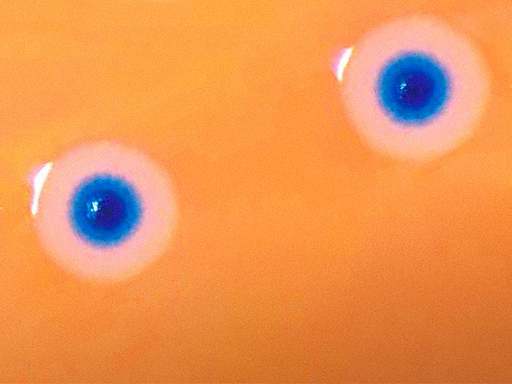
Inventor-collector Jay Walker presents some of the items displayed on stage from his private library: one of the remaining original seven Sputnik satellites; a Gutenberg Bible (picture right); a small flag that was carried to the Moon and back by the Apollo astronauts; etc. Needless to say, he's been asked by hundreds of TEDsters yesterday Craig Venter, the scientist who first sequenced the human genome in 2001, announced recently that with his team they have created the first synthetic bacterium -- "the largest man-made DNA structure" (photo below) -- along the way to create microorganisms that can produce alternative sources of enegy. Needless to say, his research is controversial.
"We've been digitizing biology, and now we're trying to go from that code to designing biology. We've tried various approaches, paring it down to basic components, digitizing it, now we're trying to ask: can we regenerate life or create new life out of this digital universe? The pace of digitizing life has been increasing exponentially. Our ability to write genetic code has been growing more slowly. Turns out synthesizing DNA is difficult. In a biological system the software builds its own hardware, but design is critical, and if you start with digital information, it has to be really accurate. How do we boot-up a synthetic chromosome? We can do a transplant of a chromosome from one cell to another and activate it. We may be about to create a new version of the Cambrian explosion, where there is massive new speciation (the formation of new and distinct species) based on this digital design. We have now a database with about 20 million genes, and we like to think of them as the design component of the life of the future. We now have techniques to do combinatorial genomics, to build a robot that can make a million chromosomes a day.
We're now focusing on fourth-generation designer fuels. Curent biofuels aren't the solution. The only way that biology can have an impact on fuel without incrising the price of food, it's to start with CO2 as the feed stock -- create new energy out of CO2, and we think we will have something within the next 18 months. Future uses of this technology: increase the basic understanding of life; replace the petro-chemical industry; become a major source of energy; enhance bioremediation. We're changing the evolutionary tree with new bacteria and species."
Follows a Q&A with Chris Anderson and with the audience:Question: With all the biodiversity out there, can't you use existing organisms rather than create new ones?
Craig Venter: We're indeed finding a lot of biodiversity. For example we found organisms in the environment that produce octane. But not on the scale that we need to cover our energy needs.
Q: Right now, is it possible on a computer to say what a
CV: We are using software to design pathways, metabolic mechanisms, so it's real biological design. We're trying to do it not only by trianl and error, but by direct design. Alot of people like to think in terms of Genesis and we're creating life from scratch. But we're really using the 3 million years of evolution, trying to take it over and take it to the next stage. We will see an increasing pace in the sophistication of the organisms.
Q: I could make the case that you and your company are the most dangerous humans on Earth. What do you do for security?
CV: It's a question that has been raised from the very beginning. Fortunately there aren't many people wanting to do harm with these tools. Very few biological agents that we work with could be weaponized.
Q: One of your slides says "suicide gene", what's that?
CV: It means that if it got out of the lab we could trigger the destruction of that organism.
Q: Can you talk about the intellectual property rights and how you fund your work?
CV: Institute has about 100 million dollars budget a year. About 70% from the government, the rest from private donation.
Q: How efficient can the photosynthesis of CO2 be?
CV: CO2 is a source of carbon. The photosynthesis we see with plants is not very efficient. Algaes are more efficient. We can engineer those to capture CO2 and instead of sequestrate it we think we can convert it back into energy.
Q: When you were asked if you were playing God, you said "we are not playing".
CV: I got very depressed being at Davos this year, it was clear that most of business executives there, buying into the CO2 issue is a pain for them, I had the impression that nothing's gonna change in the next 40 years because of entrenched interests. We're running a hell of an experiment on this planet, we need real solutions, I hope that some of these developments yield results in time, the urgency is not really there.Paul Rothemund presented some of his work at TED last year, showing nanometer-size artwork created using strands of DNA and folding them into desired shapes.
"People argue about the definition of life. Life involves computation. Take a computer program, boot it up in a cell and it will result in a person; with a small change it will result in another person, etc. There are lots of similarities between genetic programs and computer programs, including a sensitivity to small changes -- single mutations -- that result in "meaningful" large changes. Biology demonstrates the power of molecular programming. We use DNA and proteins. How small is the smallest organism that will function? How few molecules?"
Paul's approach, he calls it "DNA origami": folding DNA using long single strands of DNA and combining them with other helixes. He shows how he created smily patterns, the shape of China, all by folding DNA strands. Then he discusses an approach -- "tiles" -- to make something much bigger.Preventive medicine advocte Dean Ornish gives a short talk on recent research that shows how adopting healthy lifestyle and eating habits can affect a person at a genetic level.
"One way to change our genes is to make new ones, as Venter does The other is to change our lifestyle. When you live healthier, eat better, exercise, and love more, your brain cells actually increase. Your skin and heart and sexual organs get better blood flow. We're about to release new findings that healthier lifestyle can turn off disease-provoking genes and turn on the good ones. Our genes are not our fate. They are predispositions, but if we make these lifestyle changes we can actually change how genes are expressed."The work of British psychologist Susan Blackmore focuses on the nature of consciousness and on memes. She took Richard Dawkins intuition about memes (ideas that, like genes, that take a life of their own) and turned it into a fully-fledged theory.
"Cultural evolution is a dangerous child for every species to let loose on this planet. By the time you realize what's happening, it's too late to put it back into the box. We humans are the Earth's Pandoran species. Mimetics is founded on the principles of unversal Darwinism. His idea was so simple, and yet it explains all design in the universe. What Darwin said was something like this: if you have creatures that vary, and if there is a struggle for life such that nearly all of these species die, and if the very few that survive pass on to their offsprings whatever helped them survive, than these offsprings must be better adapted to these circumstances than their parents were. You just need those three principles: variation, selection and heredity. If you have those, you MUST get evolution, or "design out of chaos without the aid of mind". What's this to do with memes? Darwin didn't know about genes, but the principle of universal Darwinism is that everything that's copied with variation and selection will evolve. Information that's copied from person to person is information copied with variation and selection. That's a meme. A meme is not an idea, is "that which is imitated", information which is copied from person to person. If you copied an information from someone else, it's a meme. But why do they spread? They are copied if they can. Some because they're true, useful, beautiful. Some even if they're not. Here is a curious meme: you go to your hotel, check into your room, go to the bathroom, and what do you see? A folded end of the toilet paper. It's a meme that spread all over the world. What is that about? it's supposed to tell you that somebody cleaned the place. Think of it this way: imagine a world full of brains and memes using them (you and me) to propagate. Why is this important? it gives us a completely new wiew of what it means to be human. All these things that make us unique -- language etc -- are based on genes. But there are two replicators now on this planet: from the moment our ancestors began imitating, there was a new replicator, the meme, alongside the gene. And you get an arms race between the genes (which want a smaller, efficient brain) and the memes (which want a bigger brain). All other species on this planet are gene machines, we only are meme machines. We need a new word for technological memes, let's call them temes, because the processes are different. Our brains are becoming like temes, faster, etc. We are at this cusp now to have a third replicator in our planet. But it's dangerous: temes are selfish replicators, they use us to suck up more resources to produce more computers and more things. Don't think we created the Internet, that's how it seems to us. How to pull through? Two ways: one is that the temes turn us into teme-machines, with implants, merging of humans and machines, because we are self-replicators. The other: teme-machines will replicate by themselves. In that case, it woudl not matter if the planet would no longer be liveable for humans."Christopher de Charms brielfy shows some video of real-time brain imaging. He's the CEO of Omneuron, which has developed a machine that scans brain activity and allows to watch it in real time -- "I've seen inside my brain, you will be able to do it soon. When you will, what will you like to do and control? We are the first generation that's gonna be able to enter into the human mind and brain".
Documentary filmmaker David Hoffman's studio burned down 9 days ago. He lost his archive, 100+ films, most of his work is gone. "But you need to take bad and make some good out of it. I called my friends, come dig, dig it up I said, I want pieces", and turned that into his next project, a life in bits and pieces.
Historian Doris Kearns Goodwin is a US presidential biographer -- she has written books on all the great acronyms that have occupied the Oval office (JFK, LBJ, FDR) and on Abraham Lincoln. She's hence an authority on looking at history through the leses of a single person's life. Her speech focuses on Lincoln and Lindon Johnson and on some lessons that we can draw from their life.
More
"Lincoln life suggests that ambition is a good thing. Not ambition for power or office, but for making the world a better place. Lincoln was a curious boy. His mother died when he was still young, telling him "am going away and won't return", which convinced him that when we die our life is swept away; but later he realized that if you accomplish something worthy, that outlives you. During a period of depression, he said "I would die, right now, but I haven't not yet done anything that would make any human being remember me" -- he would go on to sign the emancipated proclamation. Kearns says that when he was about to put his signature on the document, his hand was trembling because he had shaken thousands of hands that morning. So he put down the pen, waiting for his hand to be steadier, because he thought that, had he signed a trembling signature, future generations would think that he had hesitated."
"LBJ: I met him when I was selected as a White House fellow, then worked in the WH. He was a great storyteller, but there was a problem with his stories: half of them weren't true. ... Because he was so sad and vulnerable, he opened up with me. From the surface LBJ should have had everything in the world to feel good: president, money, owned a spacious ranch, boats, and he had a family who loved him deeply. Yet years of concentration solely on work and individual success means that in his retirement LBJ could find no solace. It was as if the hole in his heart was so large that without work he could not fill it. He regretted not having spent more time with his children and grandchildren. He was alone when he died. Even the sphere of love requires some form of commitment. So deep was Lincoln love of Shakespeare for instance that even in the most difficult times I went to the theatre."