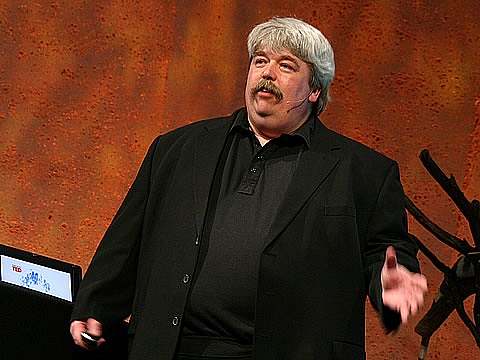
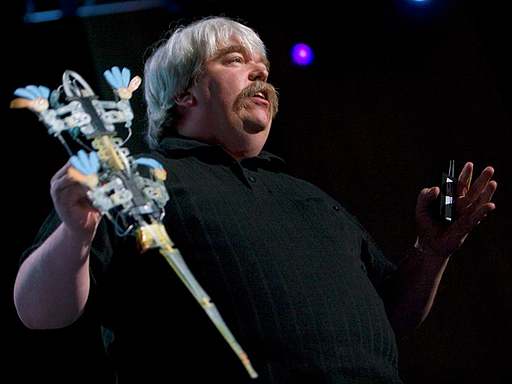
Robert Full studies cockroach legs and gecko feet. His research is helping build the perfect "distributed foot" for tomorrow's robots, based on evolution's ancient engineering.
Why you should listen to him:
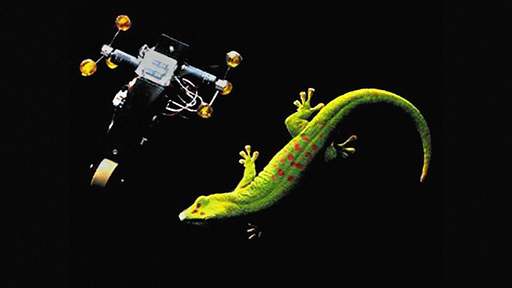
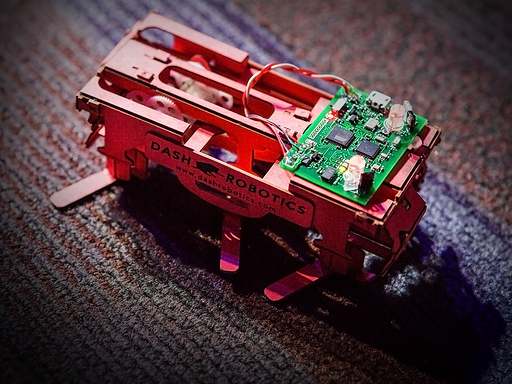
UC Berkeley biologist Robert Full is fascinated with cockroach legs that allow them to scuttle at full speed across loose mesh and gecko feet that have billions of nano-bristles to run straight up walls. He's using his research to design the perfect robotic "distributed foot," adding spines, hairs and other parts to metal legs and creating versatile scampering machines.
He's helped create robots, such as Spinybot, which can walk up sheer glass like a gecko -- and he even helped Pixar create more realistic insect animations in the film A Bug's Life.
"Dr Full cheerfully admits that some of his real-life critters can be disgusting, but they offer valuable insights into how to conquer challenging terrain."The Economist
Blog Posts on TED
-
Secrets of movement, from geckos and roaches: Robert Full on TED.com – November 27, 2007
Biologist Robert Full shares his fascination with spiny cockroach legs that allow them to scuttle at full speed across loose mesh and gecko feet that have billions of nano-bristles to run straight up walls. His talk, complete with wonderful slow-mo video of cockroach, crab and gecko gaits, explains his goal of creating the perfect robotic "distributed foot." (Recorded February 2005 in Monterey, California. Duration: 19:24.)
Watch Robert Full's talk on TED.com, where you can download it, rate it, comment on it and find other talks and performances.
Read more about Robert Full on TED.com.
Embed this video: Use this code to run the video on your own site:
More -
More slo-mo gecko video from Robert Full – March 21, 2008
Robert Full (watch his TEDTalk on gecko feet) and his team at UC Berkeley have uncovered more oddly-worth-knowing facts about geckos and how they move.
It turns out that, along with their amazing sticky paws, geckos use their tails as a kind of fifth limb to help them balance while they climb walls. The team also filmed geckos in free-fall inside a wind tunnel, and found out that falling geckos use their tails as a rudder to help them fall safely -- along the way, capturing "the most rapid, zero-angular momentum air-righting response yet measured." Watch this video report from New Scientist >>
In the abstract of the paper published this week in the Proceedings of the National Academy of Sciences and online, the team, headed by lead author Ardian Jusufi, writes that these new facts about the gecko's tail
... have provided biological inspiration for the design of an active tail on a climbing robot, and we anticipate their use in small, unmanned gliding vehicles and multisegment spacecraft.
Photos courtesy PNAS/NAS 2008. More -
Robot Gets Knocked Down (but it gets up again) – September 14, 2005
Researchers in Japan have invented a nimble humanoid robot that can regain its own footing after taking a tumble. Its secret lies in letting go of control: Rather than follow a strict set of predetermined rules, it makes on-the-fly adjustments based on body trajectory and momentum.
This approach may sound familiar ... it applies the same type of biomimicry we’ve seen in the work of Torsten Reil (03, TEDGlobal), whose NaturalMotion software allows computer-based characters to respond ‘naturally’ to unpredicted obstacles in a digital environment, and Robert Full (O3, 05), who applies his knowledge of animal feet, legs & motion to make scrambling, climbing, rolling many-legged robots well-suited to exploring new environments.
More -
Biomimicry in National Geographic and on TED.com – April 11, 2008


This month's National Geographic has a great story on biomimetics, or biomimicry, the art of studying nature's engineering. If you're inspired by this story, check out these TEDTalks for more on biomimicry. Clicking on a name (or an image above) will launch the TEDTalks player >> + Scientist Robert Full (whose work with geckos is explored in the National Geographic story) shares his obsession with animal feet + Biologist Sheila Patek plays high-speed video that captures some extreme engineering from nature -- the superefficient structures that allows a tiny shrimp to move at hyperspeed + Journalist Janine Benyus shares her top 12 designs that we can steal from nature, from self-assembly to self-smoothing paint + Oceanographer David Gallo shares some amazing animal abilities that we humans might someday want (couldn't you use a little bioluminescence?) More
-
How engineers learn from evolution: Robert Full on TED.com – June 19, 2008
Link fixed: Insects and animals have evolved some amazing skills -- but, as Robert Full notes, many animals are actually badly engineered. The trick is to copy only what's necessary. He shows how human engineers can learn from animals' tricks. Watch for robots inspired by ants and geckos -- and a key insight into animal movement that Full's team learned from A Bug's Life. (Recorded February 2002 in Monterey, California. Duration: 20:22.)
Watch Robert Full's talk on TED.com, where you can download it, rate it, comment on it and find other talks and performances -- including Robert Full's 2005 talk about gecko feet.
Read more about Robert Full on TED.com.
Embed this video: Use this code to run the video on your own site:
More