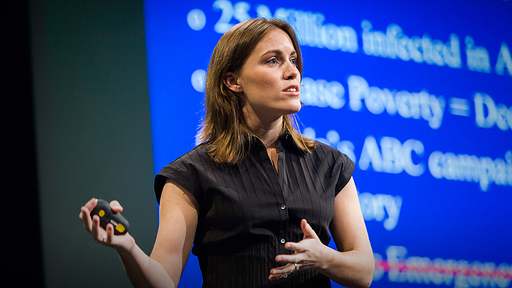

Speakers Emily Oster: Assumption-busting economist

Emily Oster, a University of Chicago economist, uses the dismal science to rethink conventional wisdom, from her Harvard doctoral thesis that took on famed economist Amartya Sen to her recent work debunking assumptions on HIV prevalence in Africa.

Why you should listen to her:

Emily Oster, a fellow at the Becker Center at the University of Chicago, has a history of rethinking conventional wisdom.

Her Harvard doctoral thesis took on famed economist Amartya Sen and his claim that 100 million women were statistically missing from the developing world. He blamed misogynist medical care and outright sex-selective abortion for the gap, but Oster pointed to data indicating that in countries where Hepetitis B infections were higher, more boys were born. Through her unorthodox analysis of medical data, she accounted for 50% of the missing girls.

She’s also investigated the role of bad weather in the rise in witchcraft trials in Medieval Europe and what drives people to play the Powerball lottery. Her latest target: busting assumptions on HIV in Africa.

"At just 26, economist Emily Oster may have the highest controversies-generated-to-years-in-academia ratio of anyone in her field."
Esquire

Email to a friend »

Blog Posts on TED

  • Emily Oster: Cable television is good for women in India – August 16, 2007

    University of Chicago economist Emily Oster went on stage at TED2007 to say that most of what we know about AIDS in Africa is wrong -- and proceeded to show data and graphs to make her case (watch the video of her speech -- or read the summary). Now she's applied her atypical lens to the effect of the introduction of cable television on gender attitudes in rural India, coming up again with surprising results.

    In a recent draft paper (full text in PDF) that she wrote with Robert Jensen of Brown University after a three-year study, she argues that "the introduction of cable television is associated with improvements in women's status" and finds "significant increases in reported autonomy, decreases in the reported acceptability of beating and decreases in reported son preferences", this last point being about sex-selective abortions (rural families prefer boys). They also found "increases in female school enrollment and decreases in fertility (primarily via increased birth spacing)."

    The effects are large, the two researchers argue, "equivalent in some cases to about five years of education" within the surveyed population.

    These changes are "accomplished despite there being little or no direct targeted appeals" such as public-service announcements. Which brings Oster and Jensen to speculate that "it may be that cable television, with programming that features lifestyle both in urban areas and in other countries, is an effective form of persuasion, because people emulate what they perceive to be desirable behavior and attitudes".

    More

  • AIDS overestimates – November 21, 2007

    The New York Times reported yesterday that the UN's agency on AIDS dramatically overestimated its count of current and new infections:

    The agency, Unaids, will lower the number of people it believes are infected worldwide, to 33.2 million from the 39.5 million it estimated late last year.
    Much of the difference comes from new reporting methods in some African countries and in India -- an idea dovetailing with the work of economist Emily Oster. Oster's 2007 TEDTalk takes a critical look at global AIDS figures -- and how they drive the world's approaches to stemming the disease. On his blog, Emeka Okafor writes, "The AIDS industry should be called to account." But these revised numbers, though lower than before, are still high. We must not lose our sense of urgency on AIDS in Africa and throughout the world. More

  • Everything we know about AIDS in Africa is wrong: Emily Oster on TED.com – July 12, 2007

    Emily Oster, a University of Chicago economist, looks at the stats on AIDS in Africa -- and comes up with a stunning conclusion: Everything we know about AIDS in sub-Saharan Africa is wrong. We look for root causes such as poverty and poor health care -- but we also need to factor in, say, the price of coffee, and the routes of long-haul truckers. In short, she says, there is a lot we don't know; and our assumptions about what we do know may keep us from finding the best way to stop the disease. (Recorded March 2007 in Monterey, CA. Duration: 15:45.)


    New: Download this talk in high resolution (480p)

    Watch Emily Oster's talk on TED.com, where you can download it, rate it, comment on it and find other talks and performances.

    Read more about Emily Oster on TED.com.

    Embed this video: Use this code to run the video on your own site:


    More