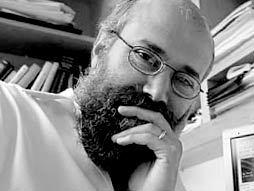
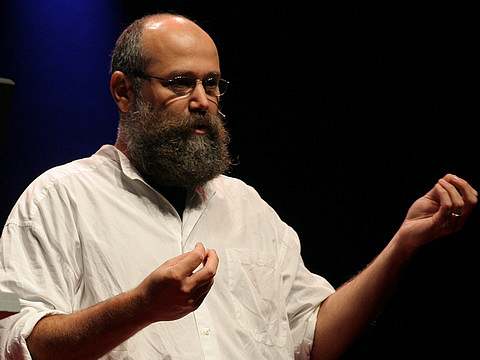
Yochai Benkler has been called "the leading intellectual of the information age." He proposes that volunteer-based projects such as Wikipedia and Linux are the next stage of human organization and economic production.
Why you should listen to him:
Larry Lessig calls law professor Yochai Benkler "the leading intellectual of the information age." He studies the commons -- including such shareable spaces as the radio spectrum, as well as our shared bodies of knowledge and how we access and change them.
His most recent writings (such as his 2006 book The Wealth of Networks) discuss the effects of net-based information production on our lives and minds and laws. He has gained admirers far beyond the academy, so much so that when he released his book online with a Creative Commons license, it was mixed and remixed online by fans. (Texts can be found at benkler.org; and check out this web-based seminar on The Wealth of Networks.) He was awarded EFF's Pioneer Award in 2007.
He's the Berkman Professor of Entrepreneurial Legal Studies at Harvard, and faculty co-director of the Berkman Center for Internet and Society (home to many of TED's favorite people).
"He has become an unlikely business guru, with a shop at the intersection of Commerce and Cooperation."Time
Blog Posts on TED
-
Open-source economics: Yochai Benkler on TED.com – April 16, 2008
Law professor Yochai Benkler explains how collaborative projects like Wikipedia and Linux represent the next stage of human organization. By disrupting traditional economic production, copyright law and established competition, they're paving the way for a new set of economic laws, where empowered individuals are put on a level playing field with industry giants. (Recorded July 2005 in Oxford, UK. Duration: 17:52.)
Watch Yochai Benkler's talk on TED.com, where you can download it, rate it, comment on it and find other talks and performances.
Read more about Yochai Benkler on TED.com.
Embed this video: Use this code to run the video on your own site:
-
Whither Web 2.0? – October 22, 2008
Via Slashdot, blogger Andrew Keen writes that economic troubles will trigger the decline of the "free" economy, collaboration, and open-source -- including communities such as Wikipedia -- and even, perhaps, the blogosphere itself.
People will be less likely to give away "their intellectual labor on the Internet in the speculative hope that they might get some 'back end' revenue," writes Keen.
But one Slashdot commenter points to Yochai Benkler's Wealth of Networks for evidence to the contrary: "For all of us, there comes a time on any given day, week, and month,every year and in different degrees over our lifetimes, when we choose to act in some way that is oriented toward fulfilling our social and psychological needs, not our market-exchangeable needs. It is that part of our lives and our motivational structure that social production taps, and on which it thrives. There is nothing mysterious about this. It is evident to any of us who rush home to our family or to a restaurant or bar with friends at the end of a workday, rather than staying on for another hour of overtime or to increase our billable hours; or at least regret it when we cannot."
Benkler's 2005 TEDTalk argues that a collaborative economy does not easily falter.
Watch other related TEDTalks:
+ Clay Shirky on why free communities are more thorough, creative and productive than formal institutions designed to accomplish the same things.
+ Howard Rheingold on way-new collaboration -- and why cooperation succeeds.
+ Chris Anderson of WIRED on tech's long tail. (He recently predicted the rise of a free economy.)
See also: Cameron Sinclair on open-source architecture, Richard Baraniuk on open-source learing, and Jimmy Wales on Wikipedia.
What do you think?

