
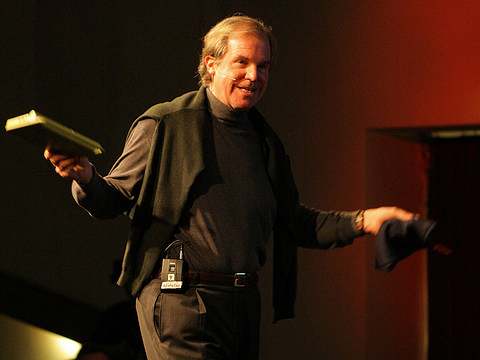
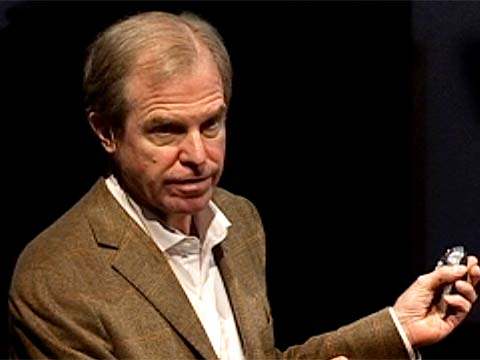
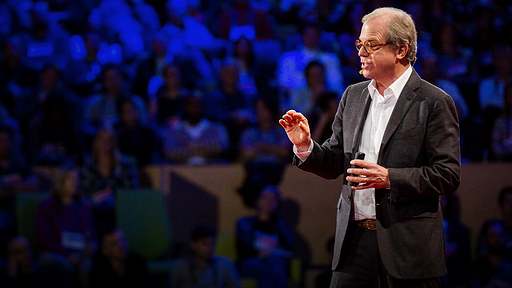
As founder of the MIT Media Lab, Nicholas Negroponte pushed the edge of the information revolution as an inventor, thinker and angel investor. Now he's the driving force behind One Laptop Per Child, building computers for children in the developing world.
Why you should listen to him:
A pioneer in the field of computer-aided design, Negroponte is perhaps best known for founding and directing MIT's Media Lab, which helped drive the multimedia revolution and now houses more than 500 researchers and staff. An original investor in WIRED (and the magazine’s "patron saint"), for five years he penned a column exploring the frontiers of technology -- ideas that he expanded into his 1995 best-selling book Being Digital. An angel investor extraordinaire, he's funded more than 40 startups, and served on the boards of companies such as Motorola and Ambient Devices.
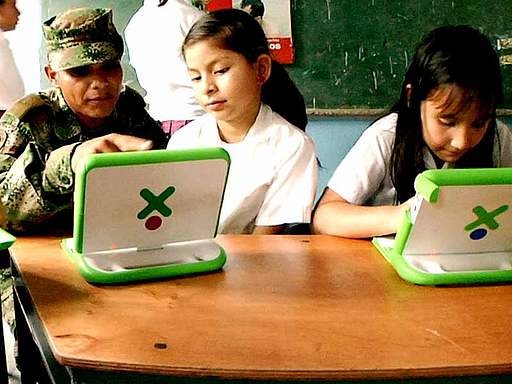
But his latest effort, the One Laptop Per Child project, may prove his most ambitious. The organization is manufacturing the XO (the "$100 laptop"), a wireless Internet-enabled, pedal-powered computer costing roughly $100. Negroponte hopes to put the first devices in the hands of the children in the developing world by the end of 2007, expanding to millions more by 2010 (see XOGiving for details on how you can help -- and get an XO for yourself).
"If Nicholas Negroponte can achieve his ambition of distributing $100 laptops to the world's disadvantaged children, he will help redefine philanthropy and see his name added to a list alongside the likes of Carnegie, Ford and Rockefeller."Technology Review
Blog Posts on TED
-
Simply John Maeda, on TED.com – September 20, 2007
The MIT Media Lab's John Maeda lives at the intersection of technology and art -- a place that can get very complicated. Here, he talks about paring down to basics, and how he creates clean, elegant art, websites and web tools. In his book Laws of Simplicity, he offers 10 rules and 3 keys for simple living and working -- but in this talk, he boils it down to one simply delightful way to be. (Recorded March 2007 in Monterey, California. Duration: 16:10.)
Watch John Maeda's talk on TED.com, where you can download it, rate it, comment on it and find other talks and performances.
Read more about John Maeda on TED.com.
Embed this video: Use this code to run the video on your own site:
More -
"100-dollar laptop" could go commercial by September – July 18, 2007
For all those who, seeing the first "100-dollar laptops," have wondered "when can I get one?" the answer is: sooner than expected.One Laptop Per Child founder Nicholas Negroponte said this week during a speech in Geneva, Switzerland, that a retail version of the laptop may be commercially available in September 2007, according to a report published by local blog GenevaLunch. Negroponte presented the laptop project at TED2006 (watch video or read summary) and had already spoken of the possibility of a commercial rollout, suggesting however a longer time-horizon. The laptop may be sold under a "buy one, pay two" model (the second going to a kid in a developing country).
Currently, 7,000 of the computers are in use, said Negroponte. He expects to see this figure grow to 1 million by the end of the year. And being the ambitious visionary we know, he believes that within five years -- if not sooner -- OLPC could account for 20 percent of the world's computer production ... Rolling out large numbers of computers could be made easier by last week's announcement that OLPC and Intel -- which until then had pursued competing inexpensive computers for developing countries (OLPC's laptop is built around a chip by AMD, Intel's main competitor) -- have agreed to work together.
More -
Nicholas Negroponte's 1984 TED Talk: 4 predictions for the future (3 of them correct) – March 11, 2008
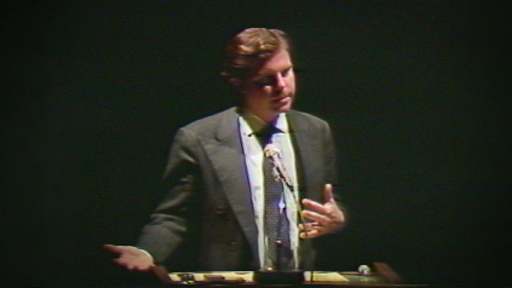
Speaking at the first TED Conference in 1984, Nicholas Negroponte waxes prophetic on the converging fields of technology, entertainment and design. Years before anyone was using the word "convergence," Negroponte was thinking about TV screens as the "electronic books of the future" and computers as the future of education. In excerpts from his 2-hour talk (this was before TED's 18-minute time limit), he foreshadowed web interfaces, touchscreen kiosks, the multitouch interface of the iPhone, and his own One Laptop per Child project. Oh, and there's also a fascinating project called Lip Service, which ... well, let's just say it's still ahead of us.
Negroponte's full 2-hour talk will be made available for download, but parts of it must be restored.
(Recorded at the first TED conference, February 1984 in Monterey, California. Duration: 25:23.)
Watch Nicholas Negroponte's talk on TED.com, where you can download it, rate it, comment on it and find other talks and performances.
Read more about Nicholas Negroponte on TED.com.
Embed this video: Use this code to run the video on your own site:
More -
Nicholas Negroponte on TEDTalks – August 1, 2006
Nicholas Negroponte is former Director of the MIT Media Lab, and founder of the non-profit, One Laptop Per Child, dedicated to making the famed "$100 laptop" a reality. In this talk, he outlines some of the challenges of getting the laptop produced, and explains why he stepped down as Media Lab director to focus on the initiative full-time, "for the rest of my life." (Recorded February 2006 in Monterey, CA. Duration: 18:21)
Download this talk: Audio (MP3) | Video (MP4)
More TEDTalks: TEDTalks website | iTunes (audio) | iTunes (video)
Blog this video: Use this code to run the video on your own site:
Subscribe to TEDTalks for free, automatic updates.
More -
Opening the TED archive (beginning with Negroponte, circa 1984) – March 11, 2008
Today we're throwing open the door to our back archive, beginning with Nicholas Negroponte's talk from TED 1. Yes, TED 1. 1984. TED founder Richard Saul Wurman had the foresight to record every conference he held. And I can't tell you what a thrill it was to see the full archive for the first time: Richard had transferred all the original (Beta) tapes to DV; nearly all the talks -- hundreds of them -- were still intact. What a treasure trove! Some of the footage requires restoration; and of course, the quality on the earliest talks isn't what it is now. Still, what a thrill! To watch Frank Gehry's talk from 1990, before the buildings he's known for had been built ... when he was still defending his work. Or to watch Nicholas Negroponte in 1984, before the MIT Media Lab had a proper home, before anyone was uttering the word "convergence." Negroponte's talk -- which hasn't been seen for 24 years -- was particularly meaningful for me to watch. Speaking for a full two hours (the famous 18-minute rule didn't evolve till later), he waxed prophetic on our computer-mediated future, strongly foreshadowing CD-ROMs, websites, service kiosks, voice-recognition technology, computer-generated animation, the touchscreen interface of the iPhone, and his own One Laptop per Child project. Though the technologies he referenced are largely defunct (optical discs, etc.), the concepts are shockingly relevant. The other shock in Negroponte's talk -- for me anyway -- was to realize just how advanced his team's work was at MIT in the '80s, and how unaware we were of it elsewhere. Watching Negroponte's talk put my own career in context: I worked on a few prominent projects in the early '90s (one of the earliest multimedia magazines in '91; HotWired.com in '94), and many of us were shockingly unfamiliar with the early work that had been done at MIT. But then, we had few ways of learning about it. We didn't have the web in the '80s and early '90s; we didn't even have Wired magazine yet. No wonder the world needed TED. And now, for those of us who didn't get to attend those early, formative years -- and even for those of you who did -- we're bring the TED archives alive. Today, we're releasing Negroponte's first TEDTalk, from 1984 (actually, we're releasing 25 minutes of key excerpts; the full two-hour talk will ultimately be made available for download, but must be restored in places). Later in the week, we'll release Frank Gehry's 1990 talk. And over time, look for more of the legendary talks that made TED what it was -- and is: from Benoit Mandelbrot to Billy Graham, Herbie Hancock to Kai Krause. We hope you're looking forward to it as much as we are! More
-
Web-based ways to make a difference – January 1, 2008
To help those of us making resolutions this week, here is a sampling of web tools for making a difference, inspired by TEDTalks speakers: + Share Ron Eglash's cool math tools, for studying math via breakdancing, Latin beats and cornrow braids + Dive into Richard Baraniuk's Connexions, a massive repository of open-source class materials + Visit Phil Borges' Bridges to Understanding site, which rounds up student films from all over the world + Browse Erin McKean's booklist "So You Want to Be a Lexicographer?" + Check out the beta of Gapminder World, powered by Hans Rosling's Trendalyzer software + Watch video and take action at The Hub, a platform for human rights media and action -- presented by Peter Gabriel's WITNESS + Discuss sustainable design and materials on the Cradle to Cradle forums, inspired by the work of William McDonough + Learn more about Nicholas Negroponte's One Laptop per Child + Catch up with Majora Carter's Sustainable South Bronx -- or make a specific gift to SSBx via Changing the Present + Calculate your personal CO2 production -- and start helping the planet -- at the website for Al Gore's An Inconvenient Truth, produced by Jeff Skoll TEDTalks is full of ideas for making change for oneself and for others -- many more than we can list here. Please share your suggestions for other TEDTalks-inspired change! More
-
Time to get your XO laptop, and to give one – November 15, 2007
Since Nicholas Negroponte presented his idea for a "100-dollar-laptop" at TED2006, the project has been going through many ups and downs, enthusiasms and criticisms, and had occupied a lot of media space.
The XO laptop is now here. The cost at this stage is nearly double, but the machine is awesome. Mass production started earlier this month in a Quanta manufacturing plant near Shanghai, and while a few countries such as Uruguay and Mongolia will buy them bulk and distribute them in schools, you -- but only if you live in the US and Canada -- can also buy one until November 26. Actually, two: you can get one if you donate another one to a child in a developing nation. Smart idea. Total cost: $399 plus shipping, with $200 considered a tax-deductible donation. Go to the Give One Get One site. Twelve days to go. Expectations are that the first release of 25'000 will sell out pretty fast.
More -
SimCity plays with One Laptop per Child – November 9, 2007
Game publisher Electronic Arts has donated the original SimCity, Will Wright's groundbreaking 1989 computer game, to Nicholas Negroponte's One Laptop per Child initiative.
It's a wonderful example of using games as tools for learning. As EA's Steve Seabolt said in yesterday's press announcement, "SimCity is entertainment that’s unintentionally educational." Back in March, OLPC's SJ Klein talked to game developers about how important games are to the OLPC platform:
"Kids without games can certainly learn," confessed Klein, "but the first way children learn is through gaming... by seeing how things work and remaking their world... Let's give them useful worlds to make."
For more on the vision behind One Laptop per Child, watch Nicholas Negroponte's TEDTalk, given in the days after he stepped down as chair of MIT's Media Lab to work on OLPC "for the rest of my life."
Contact One Laptop per Child here >>
Watch SimCity designer Will Wright's 2007 TEDTalk to see a preview of his next game, Spore. Fresh details on Spore emerged in the UK press late last month, while Wright was in London accepting his BAFTA Fellowship: On the BBC's Radio 5 Live, he said that Spore is now fully playable, and a release is only six months out.
Image is borrowed from the unofficial OLPC news blog, One Laptop Per Child News.
More -
$100 (lime green) laptop unveiled – November 18, 2005
MIT Media Lab Director Nicholas Negroponte unveiled the first working prototype of his famed $100 laptop yesterday at the UN Net Summit in Tunisia. UN Secretary General Kofi Annan called it an "expression of global solidarity," and the Linux-based, lime-green machine by all accounts stole the show. (Though it's not without detractors.) Other than the color — which was a surprise — it seems to match closely with the bold concept Negroponte's been pitching since the World Economic Forum in Davos last January: a simple, durable, cheap laptop, which can be placed in the hands of every child in the developing world. Electricity is supplied through a hand crank, and scarce Internet access can be shared through 'mesh networking'. Negroponte has created a new non-profit, One Laptop per Child, to manage the program, which plans to have millions of the laptops in production next year. [Full reports from the BBC and Wired News.]
More -
Catching up with One Laptop Per Child – August 31, 2007

Update: OLPC has announced that, starting Nov. 12, it will begin selling the XO laptop to consumers through its Give 1 Get 1 program. From the site:
For $399, you will be purchasing two XO laptops—one that will be sent to empower a child to learn in a developing nation, and one that will be sent to your child at home.
Or, right now, you can donate $200 to send a laptop to a child in a developing nation.
[This summer], the US news show 60 Minutes rebroadcast its segment on Nicholas Negroponte and his One Laptop Per Child (OLPC) initiative. As Bruno Giussani has reported on the TED Blog, much news has emerged since that segment first aired in May:
More
+ OLPC and Intel have agreed to work together, not compete, to put laptops in the hands of every kid on the planet.
+ OLPC's chief technology officer, Mary Lou Jepsen, said last month that a retail version of the laptop may be commercially available by this Christmas.
You can see more from Nicholas Negroponte here on TED.com -- he gave a rousing talk at TED2006, just days after he took a leave of absence from MIT's Media Lab to devote himself fully to One Laptop Per Child. Watch the TEDTalk and join the conversation >>
To contact Nicholas Negroponte's One Laptop Per Child project, visit the OLPC website's Contacts page >>


