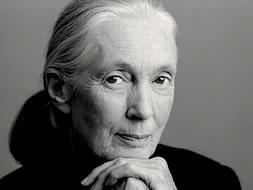
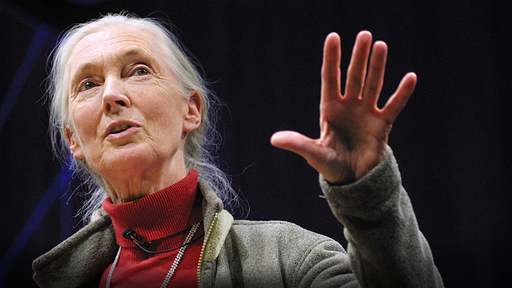
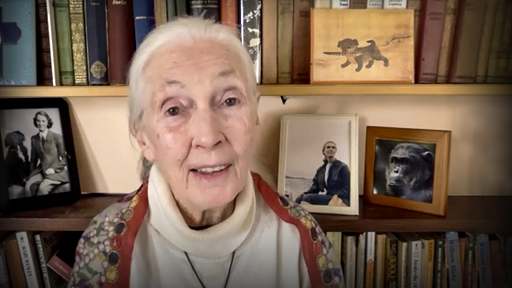
Speakers Jane Goodall: Primatologist; environmentalist

Jane Goodall, dubbed by her biographer "the woman who redefined man," has changed our perceptions of primates, people, and the connection between the two. Over the past 45 years, Goodall herself has also evolved -- from steadfast scientist to passionate conservationist and humanitarian.

Why you should listen to her:

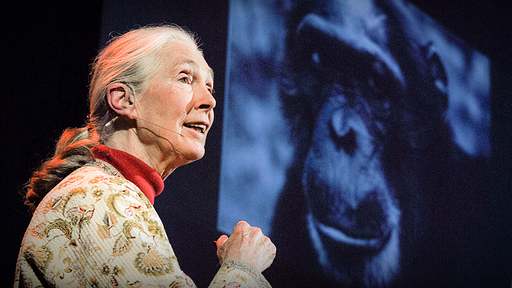
Jane Goodall hasn't exactly found the missing link, but she's come closer than just about anyone else on Earth. Her extensive research into the behavior of chimpanzees, which started in Africa in the 1960s and continues today, fundamentally altered scientific thinking about the relationship between humans and other mammals.

Goodall, who founded a research institute in her name in 1977, is an internationally recognized authority on the primate world. She's written books for adults and children, contributed to documentaries, and serves as a National Geographic explorer-in-residence, a United Nations peace messenger, and the president of Advocates for Animals. For her efforts to observe and preserve all species, Goodall has received honors and accolades from governments, nonprofits, universities, and professional organizations, including a medal from UNESCO and the French Legion of Honor in 2006.

"Goodall's detailed, engaging descriptions of chimpanzee society transformed our notions of what it means to be a primate -- and what it means to be human."
Sierra Magazine

Email to a friend »

Blog Posts on TED

  • On Communicating – October 27, 2005

    A special report from Forbes.com covers the broad topic of Communicating in some interesting ways: from the origins of language in chimps to alien contact to the latest computer interfaces (including the SUI, or Straw-like User Interface, which lets you experience the sensations of drinking). Many TED voices here (Steven Pinker, Jane Goodall, Ray Kurzweil, James Surowiecki), and a few gems -- if you're willing to dig for them -- including an entertaining bit on 10 Things you Communicate Unintentionally. More

  • Day Two in Quotes [TEDGlobal 2007] – June 6, 2007


    “Dignity is more important to the human spirit than wealth” — Acumen Fund CEO/Founder Jacqueline Novogratz "What we call governments are vampire states, which suck the economic vitality out of the people." — Economist George Ayittey "I want to make Africans rich. If you make Africans rich, they'll be less poor. That's my development strategy." — Private equity pioneer Idris Mohammed "What we're trying to do is create a family tree for everyone alive today." — Anthropologist and geneticist Spencer Wells, who's leading the Genographic Project, a landmark study tracing human origins to their roots in Africa "There is no region of the world and no period in history that farmers have had to bear the burden of risk that African farmers bear today. But I'm not here to lament or wring my hands. I'm here to tell you that change is in the air." — Economist Eleni Gabre-Madhin, who is founding the first commodities market for farmers in Ethiopia "World progress needs a good dose of spontaneous human intelligence to realize that the answers to many of the questions we ask ourselves are just around the corner." — Architect Issa Diabete, who draws inspiration from innovative, makeshift urban solutions found in Africa's sprawling squatter cities "I'm hopeful because nature is amazing resilient. Seemingly dead tree stumps -- if you stop hacking them for firewood, in 10 years you can have a 30 ft tree.” — Primatologist and conservationist Jane Goodall “I am a mathematician and I would like to stand on your roof.” — Mathematician Ron Eglash's standard greeting to African families, when he was researching the intriguing fractal patterns observed in many villages across the continent Technorati tags: tedglobal2007 More

  • TED.com's new discussion space: Africa: The Next Chapter – May 30, 2007

    As the TED Conference team departs for Tanzania and TEDGlobal 2007, the TED.com team is beginning the conversation online, with our latest theme: Africa: The Next Chapter. We start with an observation: That while we're all familiar with Africa's challenges -- famine and disease, conflict and corruption -- it's less known that across the continent, change is afoot. A new generation of Africans -- entrepreneurial, optimistic, inventive, undaunted -- are shaping a very different future for the their homeland.

    Ingenious solutions are being applied to tackle some of the toughest health and infrastructure problems. Businesses are being launched that can transform the lives of millions. New communication technologies allow ideas and information to spread, enabling markets -- and governments -- to be more efficient. The numbers suggest that real growth is on the way ... A new Africa beckons.

    Next week, we hold our first conference in Africa (also titled "Africa: The Next Chapter") to learn all we can about the profound changes sweeping the continent. Thought leaders from across Africa will gather with counterparts from the west in hopes of building new and lasting collaborations. But the meeting in real time is only the beginning: It's the conversations and connections that continue online which will have even deeper reverberations.

    Though the talks from TEDGlobal won't be online till midsummer, we've started the conversation off with several relevant talks from TEDs past, including Ngozi Okonjo-Iweala, the pioneering Nigerian Finance Minister, who captures the zeitgeist of the moment with a talk on rethinking the African economy. It dovetails nicely with Jacqueline Novogratz, who promotes a new approach to philanthropy, based on investment rather than traditional aid. Both those thoughts were echoed by Ashraf Ghani, former Finance Minister of Afghanistan, whose rousing talk on his country's future resonates with this theme, despite geographical distance. And then there's Bono, whose memorable 2005 TED Prize acceptance speech was the original inspiration for the conference (though many there may disagree with his approach).

    Click here to go to TED.com's new Theme, Africa: The Next Chapter >>

    More