
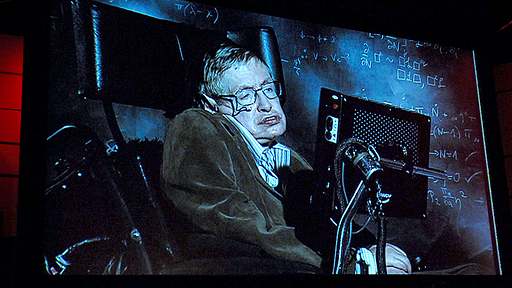
Speakers Stephen Hawking: Theoretical physicist

Stephen Hawking's scientific investigations have shed light on the origins of the cosmos, the nature of time and the ultimate fate of universe. His bestselling books for a general audience have given an appreciation of physics to millions.

Why you should listen to him:

Stephen Hawking is perhaps the world's most famous living physicist. A specialist in cosmology and quantum gravity and a devotee of black holes, his work has probed the origins of the cosmos, the nature of time and the universe's ultimate fate -- earning him accolades including induction into the Order of the British Empire. To the public, he's best known as an author of bestsellers such as The Universe in a Nutshell and A Brief History of Time, which have brought an appreciation of theoretical physics to millions.

Though the motor neuron disorder ALS has confined Hawking to a wheelchair, it hasn't stopped him from lecturing widely, making appearances on television shows such as Star Trek: The Next Generation and The Simpsons -- and planning a trip into orbit with Richard Branson's Virgin Galactic. (He recently experienced weightlessness aboard Zero Gravity Corporation's "Vomit Comet.") A true academic celebrity, he uses his public appearances to raise awareness about potential global disasters -- such as global warming -- and to speak out for the future of humanity: "Getting a portion of the human race permanently off the planet is imperative for our future as a species," he says.

Hawking serves as Lucasian Professor of Mathematics at the University of Cambridge, where he continues to contribute to both high-level physics and the popular understanding of our universe.

"We are just an advanced breed of monkeys on a minor planet of a very average star. But we can understand the Universe. That makes us something very special."
Stephen Hawking

Email to a friend »

Blog Posts on TED

  • Asking Big Questions about the universe: Stephen Hawking on TED.com – April 4, 2008

    In keeping with the theme of TED2008, professor Stephen Hawking asks some Big Questions about our universe -- How did the universe begin? How did life begin? Are we alone? -- and discusses how we might go about answering them.(Recorded March 2008 in Monterey, California, and in Cambridge, UK. Duration: 10:12.)


    Watch Stephen Hawking's talk on TED.com, where you can download it, rate it, comment on it and find other talks and performances.

    Read more about Stephen Hawking on TED.com.

    Download this talk in 480p high-def >>

    Subscribe2TEDTalks.jpg

    Embed this video: Use this code to run the video on your own site:

    More »

  • Celebrating the new AIMS Research Centre in South Africa – May 7, 2008

    AIMSStudents1.jpg

    2008 TED Prize winner Neil Turok sends these great photos from the new AIMS Research Centre, which is set to open May 12 in Muizenberg, Cape Town, South Africa. AIMS -- the African Institute for Mathematical Sciences -- promotes math and sciences education throughout Africa. Its goal is, quite simply, to find the next Einstein in Africa.

    During a two-day festival starting this weekend, Neil Turok, AIMS director Fritz Hahne and the students of AIMS will dedicate the new AIMS Research Centre -- and launch a drive to build a dozen more AIMS schools all over Africa. At the party: the head of NASA, two Nobel laureates, poets and musicians, and the 25 amazing students at AIMS, as well as Stephen Hawking, who's expected to give his first-ever lecture in Africa. Look to the TED Blog and to TEDPrize.org for more reports!


    AIMSBuilding.JPG AIMSStudents2.jpg

    More »

  • Hawking makes $100 bet that the LHC won't find Higgs – September 9, 2008

    higgs_thatcher.jpg

    Dr. Stephen Hawking has made a $100 bet that the Large Hadron Collider at CERN, which throws its first beam tomorrow, will not find the elusive particle knows as the Higgs boson. What makes the Higgs the most highly sought-after particle in physics? In his TEDTalk, Brian Cox describes the Higgs particle "in language a politician can understand": What the Higgs does is, it gives mass to the fundamental particles. The whole universe is full of something called the Higgs field, Higgs particles if you will. [Referring to the sketch above] The analogy is that these people in a room are the Higgs particles. Now, when a particle moves through the universe, it can interact with these particles. But imagine someone who's not very popular moves through the room, and everyone ignores them. They just pass through the room very quickly, essentially at the speed of light. They're massless. Now imagine someone incredibly important, and popular, and intelligent ... walks into the room, they're surrounded by people, and their passage is impeded. It's almost like they get heavy, they get massive. And that's exactly the way the Higgs mechanism works. The ... electrons and the quarks in your body, and in the universe that we see around us, are heavy, they're massive, because they're surrounded by Higgs particles. They're interacting with the Higgs field. The physicists at the LHC are looking to the Higgs particle to finally explain some mysteries of the universe. And that's why Dr. Hawking doesn't really want it to be found, he says: I think it will be much more exciting if we don't find the Higgs. That will show something is wrong, and we need to think again. I have a bet of $100 that we won't find the Higgs.

    More »

  • Stephen Hawking meets Nelson Mandela for AIMS – May 15, 2008

    hawkingmandelaturok.jpg

    Above: Professor Stephen Hawking met South Africa's former president, Nelson Mandela, in Houghton, Johannesburg, today. From left to right are Stephen Hawking, Neil Turok, Nelson Mandela, Pik Botha and David Block. Photograph by Dr Robert Groess. Professor Stephen Hawking today met with South Africa's former president Nelson Mandela to discuss the NextEinstein initiative -- part of Neil Turok's TED Prize wish to develop math and science talent all over Africa. The NextEinstein initiative builds on the success of the African Institute for Mathematical Sciences, AIMS, a pan-African centrer for postgraduate training and research, based in Muizenberg, Cape Town. AIMS has so far graduated 160 young scientists from 30 African countries; 53 students, including 20 women, are currently enrolled. The Next Einstein plan is to create many AIMS centres all over Africa. The second AIMS centre opens in Abuja, Nigeria, in July and additional centres are planned in Ghana, Uganda, Madagascar, Ethiopia, Botswana, Rwanda and Sudan. Upon meeting Mr Mandela, Professor Hawking said, "I am very pleased to meet you. I admire how you managed to find a peaceful solution to a situation that seemed doomed to disaster. It was one of the great achievements of the twentieth century. If only the Israelis and the Palestinians could do the same." In turn, Mr Mandela expressed a great interest in AIMS and a desire to visit the centre. Professor Hawking leaves tonight for Cape Town to participate in a workshop on cosmology at the new National Institute for Theoretical Physics at Stellenbosch. Read the full press release here >> Learn more about NextEinstein.org >>

    More »

  • 20 new AIMS scholarships from Barclays – May 12, 2008

    HawkingBarclays.jpg

    Amy Novogratz reports from the AIMS celebrating weekend in Muizeberg, Cape Town:

    During a luncheon to celebrate the opening of the new Research Center at AIMS -- the African Institute for Mathematical Sciences -- Barclays announces their support by starting with 20 AIMS scholarships a year, renewable.

    Stephen Hawking (right) is in South Africa for this event -- and to deliver his first-ever lecture in Africa. This all grows out of 2008 TED Prize winner Neil Turok's wish -- that the TED community will help him to educate the next Einstein in Africa. More reports from the AIMS party to come! Below, AIMS founder Neil Turok receives the support of the South African government at the luncheon.

    TurokInSA.jpg

    More »

  • Flying Stephen Hawking into zero g: Peter Diamandis on TED.com – July 1, 2008

    X Prize founder Peter Diamandis talks about how he helped Stephen Hawking fulfill his dream of going to space -- by flying together into the upper atmosphere and experiencing weightlessness at zero g. (Recorded February 2008 in Monterey, California. Duration: 04:01.)


    Watch Peter Diamandis' 2008 talk on TED.com, where you can download it, rate it, comment on it and find other talks and performances -- including Stephen Hawking's 2008 TEDTalk about humanity's greatest questions.

    Read more about Peter Diamandis on TED.com.

    Subscribe to the TEDTalks video podcast >>

    Subscribe to the TED Blog >>

    Embed this video: Use this code to run the video on your own site:

    More »

  • The answer was there all along – April 4, 2008

    SHMathJoke.jpg
    In his TEDTalk released today, physicist Stephen Hawking asks Big Questions about life, the universe and everything. His talk was recorded at Cambridge, in a borrowed classroom -- whose well-used blackboard happens to contain the Answer to life, the universe and everything. It's visible in the upper-right-hand corner of the shot above, and in this inset:
    SHMathJokeInset.jpg
    Thanks for the tip, Robert Todd!

    More »