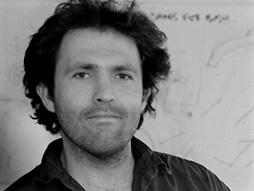
Inventor Saul Griffith looks for elegant ways to make real things, from low-cost eyeglasses to a kite that tows boats. His latest project shares open-source plans for new inventions and ideas, for grownups and kids alike.
Why you should listen to him:
Innovator and inventor Saul Griffith has a uniquely open approach to problem solving. Whether he's devising a way to slash the cost of prescription eyeglasses or teaching science through cartoons, Griffith makes things and then shares his ideas with the world.
A proponent of open-source information, he established Instructables , an open website showing how to make an array of incredible objects. He is the co-founder of numerous companies including Squid Labs, Low Cost Eyeglasses, Potenco and Makani Power, where he is President and Chief Scientist. His companies have invented a myriad of new devices and materials, such as a "smart" rope that senses its load, or a machine for making low-cost eyeglass lenses through a process inspired by a water droplet. He is a columnist at Make magazine and co-writes How Toons! He's fascinated with materials that assemble themselves, and with taking advantage of those properties to make things quickly and cheaply.
"Innovator Saul lets great ideas crash and collide in his head on a daily basis."George Negus Tonight, Australian Broadcast Co.
Blog Posts on TED
-
MacArthur "genius" grant to TEDster Saul Griffith – September 25, 2007
Saul Griffith (watch his TEDTalk) has been awarded a 2007 MacArthur "genius" grant.
Griffith is one of the brains behind Instructables, a community website that lets users share directions for ... almost anything, from building your own home lathe to "How to Kiss." His think-tank design firm, Squid Labs, has invented an array of new devices and materials -- such as a "smart" rope that senses its load, or a machine for making low-cost eyeglass lenses through a process inspired by a water droplet -- and has now spun off several separate companies to dig deeper into some of the technologies it has pioneered, including Potenco, which makes the groovy pull-string power source for the XO laptop.
Look for other talks on TED.com from MacArthur grantees, including Majora Carter (2005), Anna Deavere Smith (1996) and Amy Smith (2004). With more to come ...
-
Saul Griffith on TED.com – February 20, 2007
Inventor and MacArthur fellow Saul Griffith shares some innovative ideas from his lab -- from "smart rope" to a house-sized kite for towing large loads.
-
Tiny battery made of self-assembling viruses – August 20, 2008
MIT reports today on the work of professors Yet-Ming Chiang, Angela Belcher and Paula Hammond, who've developed a way to build tiny batteries about half the size of a human cell to power tomorrow's equally tiny devices. The electrolyte of the battery is made of polymers stamped onto a rubbery film. On top of this, a genetically altered virus goes to work, self-assembling to form wires that act as the battery's anode.
Several TEDTalks delve into the wonders of self-assembly at the microscopic scale. The first half of Neil Gershenfeld's talk is a quick primer on self-assembly, and its uses in what he sees as the coming world of ubiquitous computing -- tiny processors in doorknobs and lightbulbs, doing useful things and talking to one another. (Look for the little blocks that move on their own to spell out "M I T.") Saul Griffith talks about the elegance of self-assembly -- taking advantage of the form that natural materials want to take. Then watch Paul Rothemund twist and fold DNA into triangles, stars, and smiley faces.
Image: An array of microbattery electrodes, each only about four micrometers, or millionths of a meter, in diameter. Image courtesy / Belcher Laboratory, MIT

