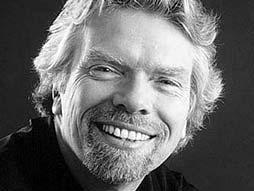
Richard Branson bootstrapped his way from record-shop owner to head of the Virgin empire. Now he's focusing his boundless energy on saving our environment.
Why you should listen to him:
He's ballooned across the Atlantic, floated down the Thames with the Sex Pistols, and been knighted by the Queen. His megabrand, Virgin, is home to more than 250 companies, from gyms, gambling houses and bridal boutiques to fleets of planes, trains and limousines. The man even owns his own island.
And now Richard Branson is moving onward and upward into space (tourism): Virgin Galactic's Philippe Starck-designed, Burt Rutan-engineered spacecraft are slated to start carrying passengers into the thermosphere in 2009, at $200,000 a ticket.
Branson also has a philanthropic streak. He's pledged the next 10 years of profits from his transportation empire (an amount expected to reach $3 billion) to the development of renewable alternatives to carbon fuels. And then there's his Virgin Earth Challenge, which offers a $25 million prize to the first person to come up with an economically viable solution to the greenhouse gas problem.
"There is luck, and then there is Richard Branson luck."The New Yorker, May 14, 2007
Blog Posts on TED
-
Branson and the climate crisis: What would Winston do? – June 25, 2008
British multi-entrepreneur and TEDster Richard Branson (watch his TEDtalk) may be in a pretty bad business when it comes to pollution -- airlines, among others -- but he is an eco-convert.
On Tuesday he told the Global Humanitarian Forum's first gathering in Geneva, Switzerland, that he favors “polluter-pay” policies and that the climate crisis should be treated as seriously as "a third world war". He added that an appropriate response could be inspired by what Winston Churchill did during WW2: "we need a war room” to tackle the environmental issue, Branson said.
The Geneva-based GHF, headed by former UN Secretary-general Kofi Annan, has focused this first meeting on the human impacts of global warming, particularly on poor countries.
During a panel, according to news site Swisster, Branson said that he supported establishing a floor for fuel prices and favored a carbon tax. Such measures would “put a useful dampener on some of the (airline industry’s) expansion". He added: "As far as polluters paying, definitely, I think they should", noting that those in a “dirty business” should "pay for the privilege.”
Photo of Winston Churchill's Cabinet War Rooms courtesy TranceMist via flickr
-
Life at 30,000 feet: Richard Branson on TED.com – October 9, 2007
When Richard Branson was at school, his headmaster predicted he would wind up either a millionaire or in jail. Since then, he's done both. He talks to TED's Chris Anderson about the ups and the downs of his career, from his multibillionaire success to his multiple near-death experiences, from Virgin's line of spacecraft to the failure of the Virgin condom. He also reveals some of his (very surprising) motivations. (Recorded March 2007 in Monterey, California. Duration: 30:44.)
Watch Richard Branson's talk on TED.com, where you can download it, rate it, comment on it and find other talks and performances.
Read more about Richard Branson on TED.com.
Embed this video: Use this code to run the video on your own site:
-
First look at Branson/Rutan's space terminal – September 6, 2007
Making private space travel possible and accessible to everyone has been a recurring topic at recent TED conferences, discussed by speakers such as Burt Rutan at TED 2006 (watch his speech), Peter Diamandis at TEDGLOBAL 2005, Richard Branson at TED 2007 and others. This week the first images of the central terminal and hangar facility at New Mexico's future private spaceport have been released:
Designed by engineering firm URS Corp and by architect Norman Foster, the structure, called Spaceport America, will serve as the operating basis for Branson's Virgin Galactic suborbital spaceliners, which are being built at Scaled Composites in California, founded by Rutan. Construction of the spaceport should begin in 2008.
Details in this story by Space.com.
-
The Lonely Interplanetary guide to scuba diving – August 1, 2008
Bored with Earthly beach destinations this summer? Does the word "Carribbean" not ring exactly, well, "exotic" these days? With this week's news that (highly acidic) water has been tasted on Mars and an ethane lake has been discovered on Saturn's moon Titan, perhaps it's time to investigate otherworldly destinations for fun in the surf. Grab your ultraviolet-shielded swimming gear and a good beach read (say, Project Orion by George Dyson, who spoke at TED in 2003), hop aboard Virgin Galactic's newly unveiled SpaceShipTwo, and cruise to these astonishing natural satellites orbiting Jupiter and Saturn, where summer never comes:
Tidally bound to face its mother planet, Europa consistently offers breathtaking views of Jupiter's turbulent atmosphere, while its breezy hardly-there chemise of molecular oxygen is delicate enough to leave the magnificent sight unobstructed. (But, beware the occasional barrage of comets yanked in by Jupiter's gravity.) Adventurers wishing to forgo Europa's "spa experience" will be at home, too: drill through miles of icy crust to access this satellite's vast subsurface ocean of liquid saltwater -- and whatever may lurk there.
Unlike visitors to other Jovian moons, sailors to Callisto can leave their ionizing radiationscreen at home: though excessively pockmarked by impacts, its outer orbit saves it from the effects of Jupiter's monstrous magnetosphere. Hiking enthusiasts can traverse its gigantic basin of concentric rings, Valhalla, spanning 600 kilometers, kicking through wisps of condensed oxygen. This moon's lack of tectonic activity makes for easy access to its likely ocean of liquid saltwater. (Robert Ballard has made the case that Earth's own oceans are still deeply mysterious.)
Athletes and thrill-seekers delight at Enceladus' suite of extreme winter features and low gravity: spirally slalom the slopes of its unforgettable impact craters; gawk at the ivory, propane-scented violence of erupting cryovolcanoes as the panorama of Saturn's rings sets below the horizon; bobsled along thousand-mile escarpments of fresh chemical ice. Meanwhile, geology geeks can enjoy exploring this highly reflective moon's incredible tectonic scars and stripes. But let divers beware: the existence of a liquid subsurface is only speculative.
Titan's atmosphere, unique among moons, makes it a mysterious entity among other natural satellites and an attractive destination for Saturn-bound families seeking an exotic experience without patent danger (asteroid strikes are rare). Visitors willing to endure its unusual weather -- the nitrogen-humid nights with the sky awash in orange; monsoons of methane and other hydrocarbons -- will be rewarded by its Earth-like terrain: newly discovered lakes of ethane, vast sand dunes, a probable ocean of water-ammonia under the surface, and perhaps even microbial life. (Get your vaccinations!)
Our solar system is truly a cornucopia of enchanting and enigmatic phenomena. Make sure your frequent-flyer miles go to good use on your next trek by studying TEDTalks by Carolyn Porco, Bill Stone, George Dyson, Freeman Dyson and other adventurers. -- Matthew Trost