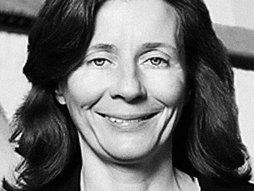
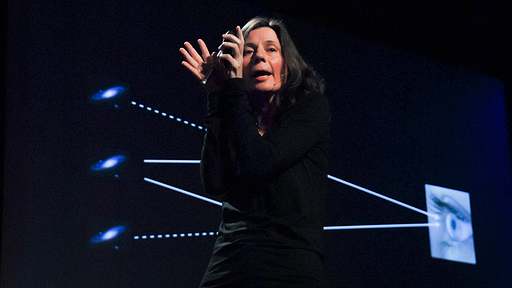
Patricia Burchat studies the structure and distribution of dark matter and dark energy. These mysterious ingredients can't be measured in conventional ways, yet form a quarter of the mass of our universe.
Why you should listen to her:
Patricia Burchat studies the universe's most basic ingredients -- the mysterious dark energy and dark matter that are massively more abundant than the visible stars and galaxies. She is one of the founders of the BaBar Collaboration at the Stanford Linear Accelerator Center, a project that's hoping to answer the question, "If there are as many anti-particles as there are particles, why can't we see all these anti-particles?"
She's a member of the Large Synoptic Survey Telescope project, which will allow scientists to monitor exploding supernovae and determine how fast the universe is expanding -- and map how mass is distributed throughout the universe. She's also part of Fermilab Experiment E791, studying the production and decay of charmed particles. Burchat received a Guggenheim Fellowship in 2005.
"By the time I arrived at Stanford, I knew I was a reductionist at heart. I am most interested in trying to understand nature at its most fundamental level."Patricia Burchat
Blog Posts on TED
-
Hawking makes $100 bet that the LHC won't find Higgs – September 9, 2008
Dr. Stephen Hawking has made a $100 bet that the Large Hadron Collider at CERN, which throws its first beam tomorrow, will not find the elusive particle knows as the Higgs boson. What makes the Higgs the most highly sought-after particle in physics? In his TEDTalk, Brian Cox describes the Higgs particle "in language a politician can understand": What the Higgs does is, it gives mass to the fundamental particles. The whole universe is full of something called the Higgs field, Higgs particles if you will. [Referring to the sketch above] The analogy is that these people in a room are the Higgs particles. Now, when a particle moves through the universe, it can interact with these particles. But imagine someone who's not very popular moves through the room, and everyone ignores them. They just pass through the room very quickly, essentially at the speed of light. They're massless. Now imagine someone incredibly important, and popular, and intelligent ... walks into the room, they're surrounded by people, and their passage is impeded. It's almost like they get heavy, they get massive. And that's exactly the way the Higgs mechanism works. The ... electrons and the quarks in your body, and in the universe that we see around us, are heavy, they're massive, because they're surrounded by Higgs particles. They're interacting with the Higgs field. The physicists at the LHC are looking to the Higgs particle to finally explain some mysteries of the universe. And that's why Dr. Hawking doesn't really want it to be found, he says: I think it will be much more exciting if we don't find the Higgs. That will show something is wrong, and we need to think again. I have a bet of $100 that we won't find the Higgs.
-
The search for dark matter and dark energy: Patricia Burchat on TED.com – August 25, 2008
Physicist Patricia Burchat sheds light on two basic ingredients of our universe: dark matter and dark energy. Comprising 96% of the universe between them, they can't be directly measured, but their influence is immense. (Recorded February 2008 in Monterey, California. Duration: 16:09)
Watch Patricia Burchat's 2008 talk on TED.com, where you can download this TEDTalk, rate it, comment on it and find other talks and performances from our archive of 275+ TEDTalks -- including many more talks on physics.
Get TED delivered:
Subscribe to the TEDTalks video podcast via RSS >>
Subscribe to the iTunes video podcast
Subscribe to the iTunes audio podcast
Get updates via Twitter >>Blog this video: Use this code to run the video on your own site:
Having trouble leaving a comment? (We're working on it...) Email it to us: blog at ted dot com -
TED2008: What is our place in the universe? – February 27, 2008
(Running notes from the TED2008 conference in Monterey, California. Second session.)
The second session of TED2008 asks "What is our place in the universe?" and it cogently opens with a sneak preview of an amazing piece of technology under development at Microsoft: the World Wide Telescope, a powerful new web-based tool for exploring the universe (for the geeks among you, this is the unnamed piece of new tech that made blogger Robert Scoble weep recently). It functions like a virtual telescope, bringing together imagery from actual ground and space (Hubble) telescopes. Roy Gould and Curtis Wong are up on stage demo-ing it. Gould, who's an astronomy educator, says that the WWT "produces a holistic view of the universe and it's going to change the way we do astronomy and teach it, and the way we see ourselves in the universe. Why do I believe that it is transformative? It enables you to experience the universe; you can tour it, with astronomers as your guides; and you can create your own tours and share them with friends. It will enable a new generation of stories and storytellers". The WWT is indeed impressive, providing an amazing, seamless, very detailed navigational experience in the depths of the universe. Since this has not been seen in public so far, here three screenshots:
The WWT is not live yet -- it's announced for sometimes later in the Spring and will be free for downloading -- but a couple of promo videoclips and background information can be found here.
A telescope of another kind is in Partricia Burchat's curriculum: she's a member of the Large Synoptic Survey Telescope project, which will allow scientists to monitor exploding supernovae and determine how fast the universe is expanding. As a particle physicist at Stanford University and at the Stanford Linear Accelerator Center, Burchat studies the basic ingredients of the universe -- dark matter and dark energy.
"The questions at the smallest and largest scale are actually very connected. Recently we have realized that the ordinary matter of the universe -- you, me, the planes, the galaxies -- makes up only a few percents of the content of the universe. Almost a quarter of the mass in the universe is invisible: it doesn't absorb, reflect or interact with the electromagnetic spectrum. We know it's there -- "it" is dark matter -- because of its gravitational effects.
You saw many images of galaxies in the previous WWT demo. In galaxies most of the mass is concentrated in the center of it. Logically, it would appear that stars that are closer to the mass in the middle rotate at higher speeds. Instead, when measurements are made we find that speed is constant as a function of distance -- which means that there is a gravitational pull from matter that we don't see.
The universe is expanding. The distance between galaxies is getting bigger because the universe is getting bigger. After the Big Bang, space expanded rapidly. But then, instead of slowing down the rate of expansion has been speeding up. This is a surprising scientific result, and there is no persuasive explanation for why it is happening, except for the presence of "dark energy"."
John Hodgman is the resident expert on Comedy Central's "Daily Show". He's an expert on everything -- and on nothing, really, since his expertise is mostly of the comedic kind. His hilarious book "The areas of my expertise" features, among other fakeries, lobster conspiracies and US presidents with hooks for hands. He's also the guy playing "the PC" in the "Mac vs PC" funny ad series (see the one on viruses and the one on spyware). He does a very funny piece on "where is everybody?" and "was Enrico Fermi an alien?" (above left the picture Hodgman used) and his "close encounters".
Contrary to Hodgman, Peter Ward's areas of expertise are multiple and real. A paleontologist and astrobiologist and co-author of "Rare Earth", he has studied mass extinctions and has theorized that complex life forms are so rare that it's possible that Earth is the only place in the universe that has any -- while simple life may exist elsewhere and possibly be very common. He tells a medical/scientific/detective story.
"What does it take for a planet to be liveable, and for sustain complexity. We have to start thinking about what is a good planet and what isn't. Our planet is good because it has water. Mars is a "bad" planet but still good enough for us to go there and live in its surface if protected. Venus is a bad-bad planet, where we couldn't survive (high temperature and clouds of sulfuric acid). Earth, if we are lucky enough (if we are not blasted by a supernova), will live long. But what if there is an accident such as mass extinction? Many researchers believe that cosmic detritus probably caused at least four of the five largest mass extinctions in the last 600 million years. The animals that generally survive mass extinction are cold-bloods, crocodile-like creatures, with a couple of tiny mammals hiding in the fringes. But what if there was no impact?"
There are microbes that produce hydrogen sulfide, that can stop complex life from existing. Ward tells how he learned that mammals, including humans, when inhaling hydrogen sulfide (H2S), go into suspended animation, a sort of coma. They can be "frozen" and then revived hours later (think of the implications for people hurt in an accident -- "this is going to be a revolution"). Why? The only reason mammals could have developed this capacity must have to do with previous periods in history with severe climate changes happened. "Many of the mass extinctions were caused by lowering oxygen levels and H2S being produced out of the oceans. Can this happen again?".
Sri Sri Ravi Shankar (picture right) is not the legendary sitar virtuoso. He's an Indian anti-stress and meditation guru. He emphasizes breathing as the link between body and mind. (He will lead two early-morning meditation sessions for TED attendees tomorrow and Friday).
"Life is to create a "wow". Everyone can experience the "nirvana" Jill Taylor was talking about earlier. When we die, the first thing is that breath will stop. The first thing we do when we are born is breathing. But rarely we take the time to think about that. Breath hold the secret to our mind, to our inner life, and there are patterns in our breath that link us to the universe. If you remember this morning when you woke up, what was the state of your mind? And one hour later, what was the state of your mind? As the sun rises and sets, the patterns of your breathing change. If you breath through the left nostril, there is more right-brain activity. When you're breathing through your right nostril, there is faster metabolism, you understand things better, your perception is better, logic is better. By learning breathing techniques, you can get over tendencies of depression, alcoholism, stress, confusion, learn to defeat negative emotions. We have to see ourselves in a biggest context, the context of the universe."
Closes the session Kaki King, with a show of her extended guitar techniques (watch her on Youtube).


