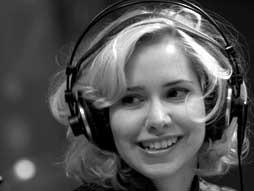
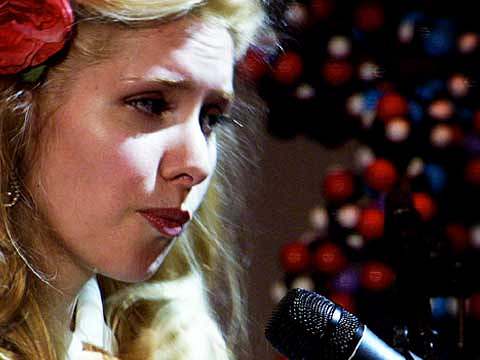

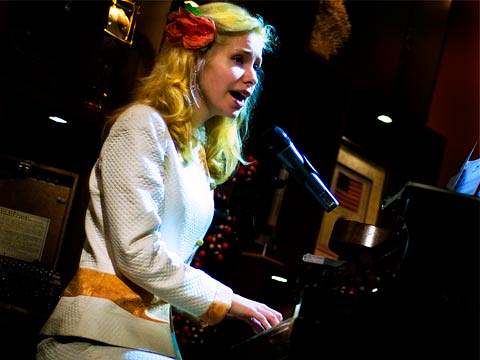
Speakers Nellie McKay: Singer/songwriter

Nellie McKay sings, croons, raps, grooves and -- barks? -- to glowing critical acclaim.

Why you should listen to her:

Playful, quirky, hilarious, endearing: not attributes of your typical political agitator. But singer-songwriter-producer-activist Nellie McKay merits the description. Her music is whimsical, colorful, catchy and as engaging as it is restless. Toying with antique genres and yet undeniably contemporary, it flirts with multiple styles of delivery while maintaining a sharp social conscience.

For these and other eccentricities, McKay has gained a devoted fan following. On stage and off, she’s an outspoken advocate of animal rights, a friend and ally to any arch political quip and -- lucky for us -- artistically uncompromising. After cutting two major-label records, her own indie label, Hungry Mouse, produced her latest, Obligatory Villagers.

"McKay crafts piano-based standards that bristle with smart, thorny lyrics and address everything from cloning to pet adoption, and she delivers them with lingering languor, then rat-a-tat bravado."
Entertainment Weekly

Email to a friend »

Blog Posts on TED

  • "Clonie": Nellie McKay on TED.com – June 27, 2008

    Singer-songwriter Nellie McKay performs the semi-serious song "Clonie" -- about creating the ultimate companion. (Recorded February 2008 in Monterey, California. Duration: 02:20.)


    Watch Nellie McKay's 2008 performance on TED.com, where you can download it, rate it, comment on it and find other talks and performances.

    Read more about Nellie McKay on TED.com.

    Subscribe to the TEDTalks video podcast >>

    Subscribe to the TED Blog >>

    Embed this video: Use this code to run the video on your own site:

    More »

  • TED2008: How dare we be optimistic? – March 1, 2008

    (Unedited running notes from the TED2008 conference in Monterey, California. Session eleven.)

    Ben Kaufman, founder of Kluster, goes on stage to tell what he and his team have been doing -- with the help of TED attendees and 1200 people around the world -- since the beginning of the conference. Kluster is an online collaboration and decision-making platform. Klustergame They set out Wednesday morning to develop a product, with some basic guidelines but "we didn't know what it would be". They set up a studio in the conference's venue, and got 208 ideas submitted in 24 hours. Collaboratively, it was decided that it would be an education board game; the content for it was developed; a name chosen ("OverThere" -- the logo was submitted by a participant online); the rules set; a tagline developed; a full prototype developed (photo). 72 hours, 1200 participants, a board game "of social awareness" collectively invented, developed and prototyped: a pretty awesome piece of work.

    Johnny Lee does research on human-computer interaction at Carnegie Mellon University -- and explains it via videos on YouTube. He goes on stage for a short talk explaining how at the tip of the Nintendo Wii remote controller there is a rather sophisticated infrared camera, and Johnny shows how, by pointing it to a projection screen or LCD display, you can create a low-cost white board; because the camera can see multiple dots, it becomes a multitouch screen as well. The audience goes: "wow!", and indeed what Johnny does is really cool. See the demos on his site.

    Bottombillion Economist Paul Collier has written one of the most interesting books of last year, "The Bottom Billion", identifying the traps that keep many countries in poverty and outlining new ways to development through a mix of direct aid and investment. He is the director of the Center for the Study of the African Economies at Oxford.
    A billion people have been stuck living in economies that have been stopped for 40 years. So the question is: how can we give credible hope to that billion people. That's in my mind the fundamental challenge of development. Two forces that change the world for good: and enlightened of self-interest. Compassion because a billion people are living in societies that can't offer credible hope; enlightened of self-interest because of that economic divergence continues for another 40 years it will lead to disaster.
    What does it mean to get serious about providing hope for the bottom billion? A good guide is: what did we do last time the rich world got serious about developing another region of the wold? That goes back to the 1940s: the Marshall Plan and the reconstruction of Europe, financed by the rich US. It was not only compassion: it was also enlightened self-interest by America, because in Europe country after country was falling into the Soviet sphere of interest. What else did America do? Before the war the US had been very protectionist; after the war, total reversal of trade policy with the general agreement on tariffs and trade. Before the war, US had an isolationist security policy; after the war, posted troops in Europe. Before the war, the US treated national sovereignty so stringently that it didn't even want to join the League of Nation; after the war, position reversed.
    Aid, trade, security, and governance. That frontier is still there. We need to be at least as serious as we were there.
    Let's focus on governance. The opportunity we're going to look to is a genuine basis for optimism about the bottom billion: the commodity boom. It's pumping an unprecedented amount of money into many -- not all -- of the countries of the bottom billion. Partially because community prices are high, partly because there is a range of new discoveries and explorations. Between them, these new revenue flows dwarf aid. How is that gonna help development? What is the relationship between high commodity prices of exports and the growth of commodity-exporting countries. In the short time, the first 5-7 years, it's great. Everything goes up. But in the long run, it reverses -- "the resource curse". The critical issue is the level of governance. In fact, if you got good enough governance, there is no resource curse: you go up in the short term, and even more in the long run. Nigeria is worst off than if it never had oil. There is a threshold level of governance. Is the bottom billion above or below that threshold? Maybe we can be more optimistic
    Democracy makes even more of a mess of the resource boom that autocracies. There are two distinct aspects of democracy: electoral competition, that determines how you acquire power, and checks and balances which determines how you use it. What the countries at the bottom billion need is very strongly checks and balances. They have elections, but not c-and-b. We should have some international standards, which would be voluntary but would spell out the basic needs. We know these standards because we already have one: the international extraction revenues transparency. It requires that governments report to their populations the revenues of extraction.
    What would the content be of these international standards? How to take the resources out of the ground, how to sell the rights for resource extraction. Now, a company flies in, make a deal with a minister, that's great for the company and often for the minister, but rarely for the country. There is a piece of institutional technology that can work: verified auctions. Like the British Treasury sold wireless 3G licenses back in the early 2000 (the full story of that auction here - PDF). If we can create such standards, we can help the people in these societies.
    And yet, we've not got these rules. If you think about, the cost of promulgating international rules is very low. Why are they not there? Because until we have a critical mass of informed citizens in our own societies, politicians will get away with gestures -- things that look good but don't work. We have to go through the business of building an informed citizenry. That's why I wrote an economic book that you can read on a beach.

    Eric Kuhne, architect and planner from London, gives a short talk about a new city project in the Middle East, where symbolism and urban planning interact. Architecture has become a new diplomacy. We want to restore the storytelling qualities of cities. A city has been and always will be the greatest work of art.

    Singer-songwriter-producer-activist Nellie McKay is next, toying with antique genres yet producing music that's unequivocally contemporary.

    Three-minutes speech by Andy Hobsbawm is one of the founders of The Green Thing, a London-based online community that encourages people to behave more sustainably, one small step at a time, through information and fun. I've already blogged it here and here.

    Last year was quite a year for former US vice-president Al Gore. He was awarded the Nobel prize for Peace (together with the IPCC), won an Oscar for his documentary "An Inconvenient Truth", and saw the theme of climate change gain center stage in the political and social discussion. He has spoken previously at TED, in 2006 (watch the video).
    He has a new speech related to his last book, "The Assault On Reason", which will also be turned into a documentary.
    "I was reminded by Karen Armstrong's presentation that if religion is not really about belief but about behaviour, maybe we should say the same thing about optimism. Optimism is often represented as an intellectual posture -- Gandhi's "You must be the change you wish to see in the world". But when we change our behaviour in our daily lives, we sometimes leave out the democracy and citizen part. In order to solve the climate crisis, we have to solve the democracy crisis, and we have one. There is a bridge between the climate crisis and the crisis of extreme poverty in our world. We have to find a unified Earth theory. The struggles of climate change and extreme poverty and diseases are connected to the problems of overconsumption, wastefulness, economic transformation. We have to approach this as a unified challenge. Local, regional, global conflicts: each level requires a different allocation of resource, organizational model, etc. The climate crisis is the rare and strategic global conflict, we have to organize our response accordingly (BG: I partially disagree). What we do with the poorest countries matters to all of us. We have to act. Since that post-war economic boom, one aspect of the engine of economic growth was a pattern of consumption that morphed into overconsumption. The solution to the climate crisis requires that we replace that engine -- consumption without overconsumption. We need a worldwide movement. But the political will needs to be mobilized in order to mobilize the resources.
    Gore discusses (and shows convincing images about) the melting of the Arctic icecap and the thawing of permafrost in the North; peak fishing; emissions.
    Venus and the Earth have roughly the same size. On Earth, carbon is trapped. On Venus, it's in the atmosphere -- and temperatures reach 855 degrees F.
    Algore1 The majority of Americans now think that climate change is a problem, that warming is real. But there still isn't a sense of urgency. (He shows a video -- a frame at left -- with elephants falling from the sky, "every year the US emits CO2 for the equivalent weight of 1.2 billion elephants: It's time to stop ignore 1.2 billion elephants in the room").
    Solution: put a price on carbon. We need a CO2 tax, revenue-neutral, to replace taxation on emplomyent, which was invented by Bismarck and some things have changed since. In the poor world we have to integrate responses to poverty with solutions to the climate crisis. Responses can make a huge difference. Think of the "energy super grid" with solar energy produced in North Africa by solar and the energy sold to Europe (picture below). If you invest in tar sands, you have a subprime portfolio.

    Energysupergrid

    780 US cities are now supporting Kyoto.
    We heard a couple of days ago about the value of making individual heroism so commonplace that it becomes banal routine. What we need is another hero generation. Those of us who are alive in the US today, but also in the rest of the world, have to somehow understand that history has presented us with a choice. Just as Jill Taylor was figuring out how to save her life while she was distracted by the amazing stroke that she was witnessing.We now have a culture of distraction but we have a planetary emergency. We need to find a way to create a sense of generational mission.   We have the capacity to do it. I'm optimistic, because I do feel very deeply that the kind of moving spirit that is celebrated in so many of the sessions that we've all been moved by here is alive in all of us. I believe we have the capacity at moments of great challenge to set aside the causes of distraction and rise to the historic challenges. Sometimes I hear people respond to the disturbing facts of the climate crisis by saying "this is so terrible, what a burden". Let's reframe that: how many generations in all of human history have had the opportunity to rise to a challenge that is worthy of our best efforts, a challenge that can pull from us more that we knew we could to. We ought to approach this challenge with a sense of profound joy and gratitude that we are the generational about which 1000 years from now orchestras and poets and singers will celebrate by saying: they swere the ones that found within themselves to solve this crisis and lay the basis for a bright and optimistic human future. Let's do that.
    Chris Anderson asks Gore whether he is excited by Hillary Clinton and Barack Obama's environmental plans. Gore: We should feel grateful that both of them and John McCain, all three have a position on the climate challenge, have offered leadership and an approach very different from the current administration. But the campaign dialog -- often sponsored by the "clean coal" industry btw -- has not laid the basis for the kind of bold initiative that is really needed. They're saying the right things, and whoever of them is elected may do the right things. But when I came back from Kyoto in 1997 with a great feeling, and then confronted the US Senate and only a handful were willing to ratify that treaty: whatever the politicians say needs to be alongside what people say. The climate challenge is part of the fabric of our life. Changing the pattern is beyond anything we've done in the past. Change light bulbs, but change the politics too. I do believe that between now and November it is possible that the debate will get bolder. We can change things, actively. What's needed really is a higher level of consciousness, and it's hard to create, but it's coming. As the African say: if you want to go quickly go alone, if you want to go far go together. We have to go far quickly.

    More »

  • "Mother of Pearl" and "If I Had You": more Nellie McKay on TED.com – July 11, 2008

    Link fixed: The wonderful Nellie McKay sings "Mother of Pearl" (with the immortal first line "Feminists don't have a sense of humor") and "If I Had You" from her sparkling set at TED2008. (Recorded February 2008 in Monterey, California. Duration: 5:34.)


    Watch Nellie McKay's 2008 performance on TED.com, where you can download it, rate it, comment on it and find other talks and performances -- including more from Nellie McKay.

    Read more about Nellie McKay on TED.com.

    Subscribe to the TEDTalks video podcast >>

    Subscribe to the TED Blog >>

    Embed this video: Use this code to run the video on your own site:

    More »

  • "The Dog Song": Nellie McKay on TED.com – August 22, 2008

    Animal fan Nellie McKay sings a sparkling tribute to her dear dog. She suggests we all do the same: "Just go right to the pound/ And find yourself a hound/ And make that doggie proud/ 'cause that's what it's all about." Nellie's TED performance of "The Dog Song" is dedicated to this handsome fellow, Carmello, beloved pal of TED's Film + Video editor, Marla Mitchnick. (Recorded February 2008 in Monterey, California. Duration: 3:33)

    Watch Nellie McKay's 2008 performance on TED.com, where you can download this TEDTalk, rate it, comment on it and find other talks and performances from our archive of 275+ TEDTalks -- including lots more from Nellie McKay.

    Get TED delivered:
    Subscribe to the TEDTalks video podcast via RSS >>
    Subscribe to the iTunes video podcast
    Subscribe to the iTunes audio podcast
    Get updates via Twitter >>

    Subscribe to the TED Blog >>

    Blog this video: Use this code to run the video on your own site:

    More »

Nellie McKay on the Web

Bookmark this speaker

Related Speakers

Related themes

Conferences

  • TED2008