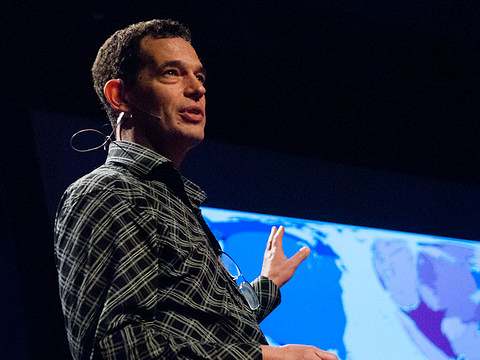
Neil Turok is working on a model of the universe that explains the big bang -- while, closer to home, he's founded a school to promote math and science studies in Africa.
Why you should listen to him:
Neil Turok works on understanding the universe’s very beginnings. With Stephen Hawking, he developed the Hawking-Turok instanton solutions, describing the birth of an inflationary universe -- positing that, big bang or no, the universe came from something, not from utter nothingness.
Recently, with Paul Steinhardt at Princeton, Turok has been working on a cyclic model for the universe in which the big bang is explained as a collision between two “brane-worlds.” The two physicists recently cowrote the popular-science book Endless Universe.
In 2003, Turok, who was born in South Africa, founded the African Institute for Mathematical Sciences (AIMS) in Muizenberg, a postgraduate center supporting math and science. His TED Prize wish: Help him grow AIMS and promote the study and math and science in Africa, so that the world's next Einstein may be African.
Later on in 2008, Turok was named the Executive Director of the Perimeter Institute for Theoretical Physics, in Ontario, Canada.
"To me this seems like one of the most fundamental questions in science, because everything we know of emerged from the Big Bang. Whether it's particles or planets or stars or, ultimately, even life itself."Neil Turok, interviewed on Edge.com
Blog Posts on TED
-
How to get involved in TED Prize wishes – May 18, 2008
Since it began in 2005, the TED Prize has been making wishes that call on the power of the global TED community. Here's a roundup of current TED Prize wishes that you can get involved in -- in large or small ways, with money, ideas, time or skills:
+ In 2007, biologist E.O. Wilson wished that we would help him build a comprehensive catalog of life on Earth. The Encyclopedia of Life launched this spring and is growing -- with many ways for both scientists and non-scientists to contribute. Create an account on the site to hear about the latest updates and opportunities -- including the debut of a tool for uploading your own photos. Find out more about The Encyclopedia of Life and EOL.org>>
+ In 2005, photographer Edward Burtynsky wished for new ways to teach kids about environmental stewardship. Working with WGBH in Boston, his web cartoon show, The Greens, just celebrated its first anniversary and seventh episode. Watch shows online and download art and music, take a movie quiz and share the site with kids you know. Find out more about The Greens >>
+ At TED2008, physicist Neil Turok wished for the TED community's help in developing math and sciences talent all over Africa, though the African Institute for Mathematical Sciences (AIMS). Our next Einstein, he says, could be African. At NextEinstein.org, learn more about AIMS, watch video interviews with students, and find many ways to help in this drive to open 15 math and sciences academies in Africa and fund scholarships for the best and the brightest on the continent. Find out more about NextEinstein.org >>
+ in 2008, writer and activist Dave Eggers gave a hilarious TED Prize talk about his wish: that we will all become personally involved in our local schools, and tell a story about it. Whether you volunteer with a chapter of Dave's 826 National foundation, or on your own, sign in at OnceUponASchool.org and share your story. Find out more about OnceUponASchool.org >>
+ In 2006, filmmaker Jehane Noujaim made an audacious wish: to connect the world for one day through the power of film. Last weekend's Pangea Day was a moving 4-hour festival -- and you can replay the day on PangeaDay.org. Watch the films, speakers and music you missed, find ways to take action, and discuss each film on the site (click on "Comments" to expand the discussion). Find out more about PangeaDay.org >>
+ In 2006, Cameron Sinclair asked TED to help him build an open-source platform to help architects connect with communities in need of designs. The result was the Open Architecture Network -- a successful website that acts as both a clearinghouse for building plans and a vibrant social network, allows its users to sample, remix and customize design work for their needs. To help Sinclair's wish come true, join the community at the Open Architecture Network's website.
+ In 2006, Dr. Larry Brilliant wished to start a global early warning system to prevent the spread of infectious disease. The organization that grew out of this wish, Innovative Support To Emergencies Diseases and Disasters (InSTEDD) is a venue for humanitarian collaboration with a focus on those involved in disease tracking and disaster response. You can help Dr. Brilliant now by test-driving an alpha version of their crisis assistance directory.
-
Celebrating the new AIMS Research Centre in South Africa – May 7, 2008

2008 TED Prize winner Neil Turok sends these great photos from the new AIMS Research Centre, which is set to open May 12 in Muizenberg, Cape Town, South Africa. AIMS -- the African Institute for Mathematical Sciences -- promotes math and sciences education throughout Africa. Its goal is, quite simply, to find the next Einstein in Africa.
During a two-day festival starting this weekend, Neil Turok, AIMS director Fritz Hahne and the students of AIMS will dedicate the new AIMS Research Centre -- and launch a drive to build a dozen more AIMS schools all over Africa. At the party: the head of NASA, two Nobel laureates, poets and musicians, and the 25 amazing students at AIMS, as well as Stephen Hawking, who's expected to give his first-ever lecture in Africa. Look to the TED Blog and to TEDPrize.org for more reports!

-
Stephen Hawking meets Nelson Mandela for AIMS – May 15, 2008
Above: Professor Stephen Hawking met South Africa's former president, Nelson Mandela, in Houghton, Johannesburg, today. From left to right are Stephen Hawking, Neil Turok, Nelson Mandela, Pik Botha and David Block. Photograph by Dr Robert Groess. Professor Stephen Hawking today met with South Africa's former president Nelson Mandela to discuss the NextEinstein initiative -- part of Neil Turok's TED Prize wish to develop math and science talent all over Africa. The NextEinstein initiative builds on the success of the African Institute for Mathematical Sciences, AIMS, a pan-African centrer for postgraduate training and research, based in Muizenberg, Cape Town. AIMS has so far graduated 160 young scientists from 30 African countries; 53 students, including 20 women, are currently enrolled. The Next Einstein plan is to create many AIMS centres all over Africa. The second AIMS centre opens in Abuja, Nigeria, in July and additional centres are planned in Ghana, Uganda, Madagascar, Ethiopia, Botswana, Rwanda and Sudan. Upon meeting Mr Mandela, Professor Hawking said, "I am very pleased to meet you. I admire how you managed to find a peaceful solution to a situation that seemed doomed to disaster. It was one of the great achievements of the twentieth century. If only the Israelis and the Palestinians could do the same." In turn, Mr Mandela expressed a great interest in AIMS and a desire to visit the centre. Professor Hawking leaves tonight for Cape Town to participate in a workshop on cosmology at the new National Institute for Theoretical Physics at Stellenbosch. Read the full press release here >> Learn more about NextEinstein.org >>
-
20 new AIMS scholarships from Barclays – May 12, 2008
Amy Novogratz reports from the AIMS celebrating weekend in Muizeberg, Cape Town:
During a luncheon to celebrate the opening of the new Research Center at AIMS -- the African Institute for Mathematical Sciences -- Barclays announces their support by starting with 20 AIMS scholarships a year, renewable.
Stephen Hawking (right) is in South Africa for this event -- and to deliver his first-ever lecture in Africa. This all grows out of 2008 TED Prize winner Neil Turok's wish -- that the TED community will help him to educate the next Einstein in Africa. More reports from the AIMS party to come! Below, AIMS founder Neil Turok receives the support of the South African government at the luncheon.
-
Finding the next Einstein in Africa: Neil Turok's TED Prize wish on TED.com – March 20, 2008
Accepting his 2008 TED Prize, physicist Neil Turok speaks out for talented young Africans starved of opportunity: by unlocking and nurturing the continent's creative potential, we can create a change in Africa's future. Turok asks the TED community to help him expand the African Institute for Mathematical Sciences by opening 15 new centers across Africa in five years. By adding resources for entrepreneurship to this proven model, he says, we can create a network for progress across the continent -- and perhaps discover an African Einstein. To brainstorm on this wish and get involved, visit TEDPrize.org >> (Recorded February 2008 in Monterey, California. Duration: 24:44.)
Watch Neil Turok's TED Prize talk on TED.com, where you can download it, rate it, comment on it and find other talks and performances.
Read more about Neil Turok on TED.com.
Embed this video: Use this code to run the video on your own site:
-
TED Prize 2008: Dave Eggers and Tutoring, Neil Turok and the next African Einstein, Karen Armstrong and the Charter for Compassion – February 28, 2008
(Unedited running notes from the TED2008 conference in Monterey, California. Session six - TED Prize)
Every year at TED, three exceptional people are awarded the TED Prize. They each receive US$ 100'000, but that's not the real prize: they also are granted a wish -- no restrictions -- that they can express in front of the TED audience, asking for help to turn it into reality.
2007 UpdatesLast year, former president Bill Clinton, photographer James Nachtwey and biologist EO Wilson received the TED Prize. What happened since:
- Clinton asked for help in developing a "high quality rural health system for the whole country" of Rwanda: teams have been sent to the country, technology is being developed, and funds have been raised.
- Nachtwey solicited help for reporting and spreading "a story that the world needs to know about", related to public health: many partners have given a hand, and the story will be released in September in "Time" magazine, on billboards, through public events and communication campaigns, etc.
- EO Wilson wanted help in creating the Encyclopedia of Life, an online resource with an indefinitely expandable page for each species, contributed to by scientists and amateurs: the EOL is now under development and the first version of the site is live.
The three wishes still need support to be completed. See a detailed update here.
2008 Winners
This year's TED Prize winners are writer David Eggers, physicist Neil Turok, and religious scholar Karen Armstrong.
Eggers is an author of many bestselling books, including the recent "What is the what" about a Sudanese refugee, a publisher of books and literary magazines, and a teacher-at large: In 1998 he founded in San Francisco 826Valencia, a very successful writing and tutoring lab for young people from the neighborhood, which has since been cloned in five other American cities.
He tells in a very funny way and with great pictures the story of 826Valencia, of the adjoining store (a mad trove of delightful things), of the chapters in other cities, and -- his TED Prize wish -- he wants now to go farther than that, because "empowering a child with writing is the essence of democracy". He asks the conference's attendees -- and anyone else who's in a position to help -- to "find a way to directly engage with a public school in your area" and then share the story of their involvement on the OnceUponASchool website, hoping in their inspirational effect to start a virtuous cycle, "so that within a year we have 1000 examples of transformative partnerships".
The site went live minutes ago, offering guidelines for partnering with schools and providing a space for receiving people's pledges and stories of involvement (there are already several telling stories of literacy and writing programs). Many things are needed to make Dave's inspiring wish a reality: personal engagement by the largest possible number of people, of course, but also very practical things such as funding and web hosting.
Interested in supporting Eggers' wish? See an implementation plan and a list of needs here and a discussion board here.
Neil Turok is a South-African born physicist at Cambridge, and a close collaborator of Stephen Hawking, with whom he speculated that the Big Bang wasn't the beginning, that the universe existed before the Bang and that there may be Bangs in the future, and that we may live in an endless universe.
In his spare time, Turok is the founder of the African institute for mathematical sciences (AIMS), hosted in a converted hotel in Cape Town, minutes from the beach (which helps in attracting top lecturers...). "If you don't have math, you are not going to enter the modern age, he says. We emphasize problem-solving, working in groups. Everyone lives together in the hotel, lecturers and students, so it's not surprising to find impromptu tutorials at 1am. We specially emphasize areas of great relevance to African development." Turok tells stories of AIMS students (who come from three dozen countries) who went on to Masters and PhDs, and brings two of them up on stage.
Rarely a TED wish has been expressed more unequivocally than Turok's: Help me, he says, make sure that the next Einstein will be African, by "unlocking and nurturing scientific talent" across the continent, because The only people who can fix Africa are talented young Africans".
His wish is a crisp, yet very ambitious vision, and to realize it he has a plan: building 15 centres of excellence across Africa, possibly modeled on AIMS but specialized in different areas of science, recruiting outstanding students and teachers, developing fellowship and entrepreneurship programs, attracting both private and public support, etc. Turok plans to start with Ghana, Nigeria, Sudan, Uganda and Madagascar; he has already obtained political support, and local scientists will be leading the way. "The institutes have to be relevant, innovative, cost-effective, and high quality, because we want Africa to be rich."
Interested in helping out? At this point, everything is needed, from building a website for what Turok named the "Next Einstein From Africa" program to teaching equipment and more. Plan and list of needs here, discussion board here.Religious thinker Karen Armstrong is a former nun and has written more than 20 books on faith and the major religions, and is a powerful voice for ecumenical understanding.
She tells how she "encountered" Judaism and Islam while reporting a story for British TV in Jerusalem. In that tortured city, where the three faiths jostle so closely, you understand what religion can be. It led me, she says, to look at my own religion in a different way, and found things that were incredible: unproven, abstract doctrines. Belief, which we make such a fuss about today, is actually a recent enthusiasm, it surfaced in the 17th century in the West. Previously, belief only meant love. "Credo" didn't mean to accept certain acts of faith: it meant I commit myself, I engage myself.
If religion is not about believing things, what is it about? It's about behaving differently, in a committed way -- and then you begin to understand the truths of religions. You understand religious doctrines only when you put them into practice. In each of the major world's faiths, compassion is not only the test of any true religiosity, also the way to get into the presence of the divinity. In compassion we remove ourselves from the center of our world and we put another person there. Every major tradition has put at its core a "golden rule": do not do to others what you do not want be done to you.
But look at our world. We are living in a world where religion has been hijacked, where terrorist sing Koranic verses to justify their atrocities, where we have Christians judging other people. We have a talent as a species for messing up wonderful things.
The traditions also insisted that you could not and must not confine your compassion to your own group. You must have concern for everybody. Love your enemies. Honor the stranger. We formed you into tribes and nations so that you may know one another, says the Koran.
There is also a great deal of religious illiteracy. People seem to equate faith with "believing things", and very often secondary goals get pushed into first place instead of the golden rule, compassion, because the golden rule is difficult. A lot of religious people prefer to be right, rather than compassionate.
Since 9/11 I've travelled all over the world and found everywhere a desire for change. Recently in Pakistan hundreds of people came to my lectures, especially young people, asking what they can do to create change.
It seems to me that our current situation is so serious that any ideology that doesn't promote a sense of global understanding and global appreciation of each other is failing the test of the time. The golden rule should be applied globally, we should not treat other nations in ways that we would not like to be treated ourselves. It's time that we move beyond the idea of toleration, and towards appreciation of the other.
Armstrong's TED Prize wish sits right in the middle of some of today's most profound global tensions: help me, she asked, "with the creation, launch and propagation of a Charter for Compassion", to be crafted by a group of twelve inspirational thinkers from the three Abrahamic traditions of Judaism, Christianity and Islam, and "based on the fundamental principles of universal justice and respect".
Bridging the divide among the three prevalent monotheistic faiths, which all claim Abraham as part of their religious history, using the lens of compassion, will require more than scholarly preeminence and good will. It will call for the creation of a totally new narrative, stepping beyond hatred and defensiveness and, in Armstrong's own words, "making the authentic voice of religion a power in the world that is conducive to peace". It will demand a subtle effort that engages everybody. It will necessitate operational support (which will come from the UN Alliance of Civilizations, but also from individuals). Mostly, it will depend on the participation of many and on finding the right answer to the key question: Who are the spiritual leaders of these three religions who should be solicited to participate in the group of twelve?
Interested in supporting Karen to turn her very ambitious and very necessary vision into reality? Plan and list of needs, and discussion board.A performance by South African singer Wusi Mahlasela closes the session.
The videos of today's three TED Prize speeches will be released on TED.com in a couple of weeks.
-
Inspiring stories from students at AIMS – July 13, 2008
From the TED Prize blog: More AIMS Student Talks: Be inspired by the stories of current and former AIMS students -- young Africans whose lives have been changed through access to a top-notch scientific education at the African Institute for Mathematical Sciences. Every two weeks, the TED Prize team uploads three talks from the May 12 launch party for the NextEinstein initiative in South Africa (part of the TED Prize wish of physicist Neil Turok). This week we've posted talks from two students, Daphne and Viani, as well as a musical performance by Vusi Mahlasela, who dedicates a song to the students of AIMS. Watch Daphne's talk below, and see many more amazing talks and performances on the NextEinstein YouTube Channel. Get frequent updates on the TED Prize wishes via the TED Prize blog RSS feed.
-
Brian Greene on leadership in science and tech – May 29, 2008
Physicist Brian Greene will talk today with Leonard Lopate on WNYC about how the US can regain its leadership in science and technology. It's an interesting time to be having this conversation -- funding of basic physics research is much in the news lately. Yesterday, an anonymous donor gave $5 million to Fermilab, outside Chicago, which has been laying off staff after its budget was slashed by Congress. And in the Times of London this weekend, Neil Turok blasts the UK government for cutting funds that support basic research in the sciences. Turok is leaving Cambridge to take a job at the Perimeter Institute in Ontario, a research center for theoretical physics founded by the inventor of the BlackBerry. (Update on 6/1/08: The week before Brian Greene gave this talk, Lawrence Berkeley Labs laid off more than 400 people, including physicists, engineers and chemists -- sparking more fears of a US "brain drain.")
-
Watch the TED Prize wishes live on Thursday – February 27, 2008
Join a global audience and watch online as the 2008 TED Prize winners, Dave Eggers, Neil Turok and Karen Armstrong, share their inspiring visions, followed by the moving and infectious music of Vusi Mahlasela. It will be an evening of big ideas, bold plans and audacious wishes -- and you'll hear ways to help grant their wishes right away! Click here for the live feed, Thursday, February 28, starting at 5:15pm US/Pacific time >>
-
TEDPrize.org launches today – February 28, 2008

The TED Prize has a brand-new homepage, where you can read all about our 2008 winners, and find out ways to start helping their wishes come true. Look here for wishes from Dave Eggers, Neil Turok, and Karen Armstrong. Take a look and start granting these wishes big enough to change the world >> -
Africa's brain drain may have hidden benefits – August 21, 2008
Each year, untold numbers of bright young Africans -- doctors and nurses, scientists and programmers -- leave their home countries to live and work abroad. This continental "brain drain" has the predictable effect:
Many experts believe the flight of health workers, scientists, and teachers hinder the continent's development. "It will be impossible to achieve an African renaissance without the contributions of the talented Africans residing outside Africa," writes Ravinder Rena of the Eritrea Institute of Technology. ....
But a new report from the Council on Foreign Relations, titled "Is Brain Drain Good for Africa?", suggests two upsides. First, it points out that remittances -- the money that expatriate workers send home to their families -- have become a meaningful part of some African economies:A March 2008 paper by economists William Easterly and Yaw Nyarko says remittances to Africa are likely undercounted, but on average they are equivalent to 81 percent of the foreign aid (PDF) received by an individual country.
And second, the report suggests that a significant number of expatriates eventually return home to work, envigorated by exposure to global markets and ideas, and often charged with a mission to improve the lives of their compatriots. (Sociologist Rubin Patterson calls this phenomenon "brain circulation.") Several TEDTalks speakers are examples of this -- like Patrick Awuah, pictured above, who left Seattle (and a career at Microsoft) to found the first liberal arts university in his native Ghana. Watch Patrick Awuah's TEDTalk >> Ideally, the efforts of these returning expatriates will help African states to, eventually, nurture and keep homegrown talent. Earlier this year, 2008 TED Prize winner Neil Turok spoke with CFR's writer on one way to stop the brain drain: by promoting math and science education throughout Africa. Listen to the podcast interview >> -
NextEinstein is recruiting a CEO – July 30, 2008
Via the TED Prize blog, over on TEDPrize.org: If you'd like to lead an incredible drive to build math and science academies all over Africa -- and help find the next Einstein -- take a look at this want ad:
The Next Einstein Initiative (NEI) is building a network of postgraduate centres of excellence for teaching and research in the mathematical sciences, throughout Africa.
NEI is now recruiting a Chief Executive Officer, to manage all aspects of the development and implementation of the NEI programme. The successful applicant will be strongly committed to African development and the NEI goals; be a highly knowledgeable project manager preferably with an MBA and/or business building experience ...
Applications are due September 30. Download the job description here. Visit NextEinstein.org to get involved in many other ways too -- start by watching and sharing some inspiring videos from students whose lives were changed by the chance to get a top-notch education inside Africa.
-
This week on TEDPrize.org – July 4, 2008
There's a great blog over on our sister site, TEDPrize.org, with news of all the 2008 TED Prize winners and interesting updates. This year's wishes are interactive and amazing, with lots of great things happening right now. Keep up via the feed. From the TEDPrize.org blog: + Karen Armstrong at The Chautauqua Institution -- last week, Karen gave 5 talks exploring the theme of “What is Religion?” She discusses the distinction between faith and belief; she speaks about silence, the limitations and difficulty of God-talk, the purpose of ritual and the rise of atheism. ... Read more >> + AIMS (Abuja) Opens -- The search for the NextEinstein just expanded to Nigeria. On Monday June 30, a new AIMS center opened in Abuja, Nigeria, the capital city. AIMS (Abuja), based at the African University of Science and Technology (AUST), is the second of the fifteen AIMS centers to be rolled out across Africa in the next 5 years. ... Read more >> + A TED Table at 826NYC -- At an 826NYC event on Thursday, three TEDsters sponsored chairs for the study area. If one more TED fan sponsors a chair, we will have a TED table-full of chairs. Each chair is $110. If you are interested in sponsoring a chair, contact Jennifer at jennifer [@] 826nyc [dot] org. (And there are many other ways to support 826NYC.) ... Read more >> + An 826/TED Field Trip -- pics and reports from the first 826/TED event ... Read more >> + What to Watch in July -- Some bright spots in the wasteland of summer TV ... Read more >> + Assessing Your Community -- Dave Eggers' wish is based on the idea that communities should be involved in their public schools. His wish happens at the micro level: individuals impact the lives of individual students by offering their talent and time. The Public Education Network just released its Civic Index for Quality Public Education tool which considers this idea on a macro level. The tool assesses the strengths and weakness of the community as it relates to public education. (It helps answer the question: Is your town a good place to be a school?) ... Read more >> To get daily updates from the TEDPrize Blog, sign up for the RSS feed.