Speakers Murray Gell-Mann: Physicist

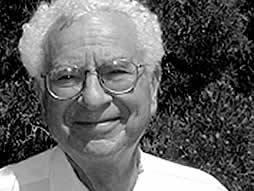
Murray Gell-Mann brings visibility to a crucial aspect of our existence that we can't actually see: elemental particles. He won the Nobel Prize in Physics for introducing quarks, one of two fundamental ingredients for all matter in the universe.

Why you should listen to him:

He's been called "the man with five brains" -- and Murray Gell-Mann has the resume to prove it. In addition to being a Nobel laureate, he is an accomplished physicist who's earned numerous awards, medals and honorary degrees for his work with subatomic particles, including the groundbreaking theory that the nucleus of an atom comprises 100 or so fundamental building blocks called quarks.

Gell-Mann's influence extends well beyond his field: He's a member of the National Academy of Sciences, the American Academy of Arts and Sciences, and the Council on Foreign Relations. He also serves on the board of the Wildlife Conservation Society and is a director of Encyclopedia Britannica. Gell-Mann, a professor emeritus of Caltech, now heads the evolution of human languages program at the Santa Fe Institute, which he cofounded in 1984.

A prolific writer -- he's penned scores of academic papers and several books, including The Quark and the Jaguar -- Gell-Mann is also the subject of the popular science biography Strange Beauty: Murray Gell-Mann and the Revolution in 20th-Century Physics.

"The names alone that Gell-Mann applies to his new theories and formulations reflect his sense of humor, immensely broad range of interests, and deep understanding. The theories themselves say that much more."
PBS

Email to a friend »

Blog Posts on TED

  • Browse an archive of science advice to Congress – July 25, 2008

    Nonpartisan science advice in the US Congress? A newly opened online archive shows that it was possible -- and stimulates a call to re-open the Office of Technology Assessment as an advisor to Congress. The OTA's archive of 700+ scientific reports on topics ranging from addiction to terrorism to "personal rapid transit" spans the lifetime of the Office of Technology Assessment, which advised the US Congress on science and technology questions from 1972 to 1995. The archive has been put online by the Federation of American Scientists, and makes for fascinating browsing. It's often difficult to separate science from politics. The 2006 book The Jasons: The Secret History of Science's Postwar Elite, by Ann Finkbeiner, discusses the legendary summer institute where some of the most distinguished scientists in postwar America, including Freeman Dyson (watch his TEDTalk) and Murray Gell-Mann (watch his TEDTalk), kicked around the biggest questions. It's a fascinating look at the complicated Sputnik-era collision between science and government.

    More »

  • TED2007 Day One: things that knocked my hat in the creek – March 8, 2007

    414380190_0b8e6c9926

    I had my mind blown in a thousand different directions by TED2007 today.  My big impression was having felt the future, in myriad ways.  From hallway conversations to the content of speaker presentations to the feeling of just being a part of it all, it was a fabulous first day. 

    My assignment, as handed down by the head office of TED, is to tell you about the thing which blew my mind the most.  However, I'm going to take the easy route and talk about everything buzzing in my mind right now.  All the speakers were wonderful, but here are my personal highlights.  So bear with me; here we go:

    • Philippe Starck:  Proof positive that tangents are but the arcs of greater circles, Philippe gave us a very big picture look at life, beauty, meaning, the universe, and brushes for one's toilet and mouth.  No photos, no precious design shots, just him and the space around him dancing around the stage in a virtuostic lesson in what it means to be a charismatic speaker.  Strictly nonlinear in presentation -- and likely uncomfortable to some -- his time on stage tickled me pink, and was formidable!  Watch for the TEDTalks on this one.  You need to see it to understand it all.
    • Hans Rosling:  How does one go about topping your previous world-changing effort?  Hans Rosling did it.  With equal parts killer interface design + serious storytelling + oodles of data + approximately a third of a meter of reliable Swedish steel, Hans Rosling pulled it all off.
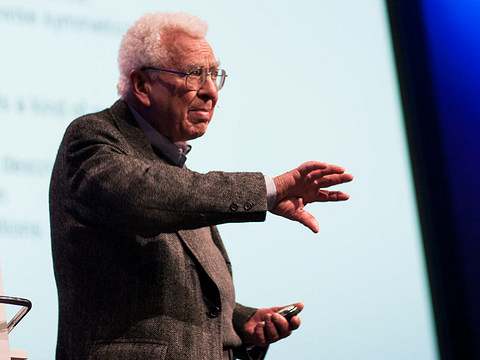
    • Murray Gell-Mann: Was the field of particle physics ever presented in a more human, accessible way?  Elegance personified.  I loved every minute of this.  It was like being in the room with a triumvirate of geniuses: Newton, Einstein, Gell-Mann.  Wow.
    • Jeff Han:  Okay, I want one.  Please.  I want one.
    • Steve Miller: As part of TEDUniversity, told stories about Tiger Woods to reveal some elegant points about how to set standards of excellence and then rise to meet them.
    • Kareem Abdul-Jabbar:  A moving essay on jazz, leadership, responsibility, and the need to look deep within to find excellence.  Inspiring.
    • Raul Midon:  A degree of artistic achievement which made we weep, so powerful was his music.  The high point of Day One.  And recipient of my TED Quote of the Day Award:  "Feel the fear, but do it anyway".

    Onward!  Tomorrow bodes to be another amazing day.

    photo credit: Jurvetson

    More »

  • Wordle, an addictive new web toy – June 18, 2008

    GalloWordle.jpg

    Jonathan Feinberg, a sometime collaborator of artist Golan Levin (watch Levin's TEDTalk), has given the world an addictive new web toy. Wordle turns any block of text into a word cloud -- like a tag cloud but prettier. It's hard to stop using it once you start. TEDTalks transcripts produce these handsome results:

    McKean.jpg

    ABOVE: Erin McKean redefines the dictionary

    Gell-MannWordle.jpg

    ABOVE: Murray Gell-Mann finds beauty and truth in physics

    AT TOP: David Gallo shares underwater astonishments

    More »

  • Do all languages have a common ancestor? Murray Gell-Mann on TED.com – June 11, 2008

    After speaking at TED2007 on elegance in physics, the amazing Murray Gell-Mann gives a quick overview of another passionate interest of his: finding the common ancestry of our modern languages. (Recorded March 2007 in Monterey, California. Duration: 2:15.)


    Watch Murray Gell-Mann's short talk on TED.com, where you can download it, rate it, comment on it and find other talks and performances -- including his longer talk from TED2007 on beauty and elegance in physics.

    Read more about Murray Gell-Mann on TED.com.

    Subscribe2TEDTalks.jpg

    Embed this video: Use this code to run the video on your own site:

    More »

  • TED2007: Day one wrap-up – March 7, 2007

    Quotes of the day:

    Cassini imaging team head Carolyn Porco: "So there are possibly liquid water, organic materials and excessive heat on Saturn and its moons. Which means that Saturn could be a place were life is possible. If we can demonstrate that Genesis has happened not once (Earth) but twice (Saturn)  then we can infer that it has happened hundreds of thousands of times across the solar system. If we can demonstrate that Genesis has happened not once [on Earth] but twice [including Saturn] in the solar system, then by inference that means it has occurred a staggering number of times across the universe in its 13.7 billion year history".

    Nobel prize of physics Murray Gell-Mann: "In fundamental physics, beauty is a very successful criterion for choosing the right theory".

    Psychologist Steven Pinker: "The truth is that our ancestors were far more violent that we are, and today we are probably living in the most peaceful times in history".

    Computer scientist Jeff Han: "We basically have to un-teach people what they have learned so far about computing, and convince them that they can use several fingers, that several people can work on the screen at once".

    Architect Philippe Starck: "I believe in general that my job is absolutely useless; but now, after Carolyn and these guys, I feel like shit".

    Statistician Hans Rosling: "Bring me my sword!" (Rosling is a serious demographer but he is also -- another deadly serious activity -- one of the few sword-swallowers active in Sweden, and he ends his speech swallowing a Swedish bayonette).

    More »

  • A non-trivial holiday – March 14, 2008

    The TED office is running in circles trying to get the word out about Pi Day, that special day for number nerds that only comes around once a year. We'd love to hear what TED fans are doing to celebrate -- whether watching Pi, baking a pie or taking an irrational out to dinner. If you've chosen to circumvent the fanfare, however, keep in mind that March 14th is also Talk Like a Physicist Day. (It's Albert Einstein's birthday, after all.) TEDTalks can help you brush up on your non-Newtonian oratorical skills with lessons from Murray Gell-Mann, Martin Rees and David Deutsch. -- Matthew Trost

    More »

  • Beauty and truth in physics: Murray Gell-Mann on TED.com – December 6, 2007

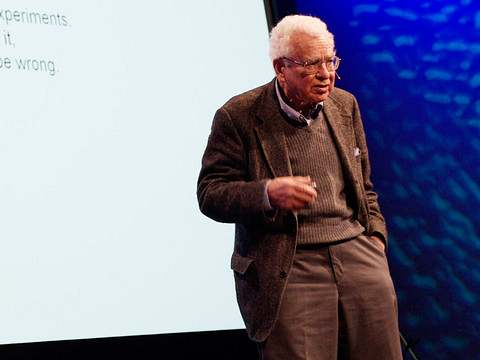
    Wielding laypeople's terms and a sense of humor, Nobel Prize winner Murray Gell-Mann drops some knowledge about particle physics, asking questions like, Are elegant equations more likely to be right than inelegant ones? Can the fundamental law, the so-called "theory of everything," really explain everything? His answers will surprise you. (Recorded March 2007 in Monterey, California. Duration: 17:07.)


    Watch Murray Gell-Mann's talk on TED.com, where you can download it, rate it, comment on it and find other talks and performances.

    Read more about Murray Gell-Mann on TED.com.

    NEW: Read the transcript >>

    Embed this video: Use this code to run the video on your own site:

    More »