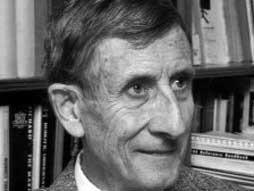
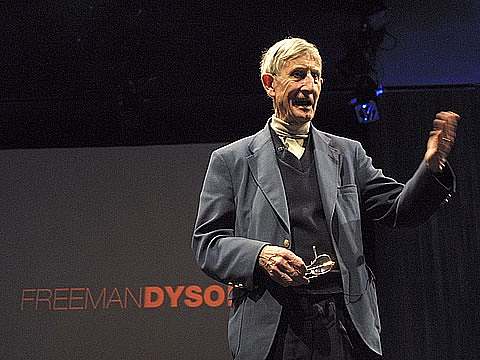
With Freeman Dyson's astonishing forecasts for the future, it's hard to tell where science ends and science fiction begins. But far from being a wild-eyed visionary, Dyson is a clear and sober thinker -- and one not afraid of controversy or heresy.
Why you should listen to him:
From inventing Dyson Spheres, a sci-fi conceit postulating habitable shells around Sol-like stars, to "space chickens" and trees that grow in comets, Freeman Dyson is not afraid to go out on a cosmic limb. It would be wrong, however, to categorize him as a publicity-hungry peddler of headline-grabbing ideas. In his 60-year career as one of planet Earth's most distinguished scientists, several things characterize Dyson more than anything else: compassion, caution and overwhelming humanism.
In addition to his work as a scientist, Dyson is a renowned and best-selling author. His most recent book, A Many-Colored Glass, tackles nothing less than biotechnology, religion and the role of life in the universe. He does not shy away from controversy: His recent critiques of the politics of the global warming debate have raised the hackles of some environmentalists. But far from wielding his conclusions like a bludgeon, Dyson wants younger generations of scientists to take away one thing from his work -- the necessity to create heresies of their own.
"What sets Dyson apart among an elite group of scientists is the conscience and compassion he brings to his work"Kristi Coale, Salon.com
Blog Posts on TED
-
Let's look for life in the outer solar system: Freeman Dyson on TED.com – July 14, 2008
Physicist Freeman Dyson suggests that we start looking for life on the moons of Jupiter and out past Neptune, in the Kuiper belt and the Oort cloud. He talks about what such life would be like -- and how we might find it. (Recorded February 2003 in Monterey, California. Duration: 19:11.)
Watch Freeman Dyson's 2003 talk on TED.com, where you can download it, rate it, comment on it and find other talks and performances.
Read more about Freeman Dyson on TED.com.
Subscribe to the TEDTalks video podcast >>
Embed this video: Use this code to run the video on your own site:
-
Browse an archive of science advice to Congress – July 25, 2008
Nonpartisan science advice in the US Congress? A newly opened online archive shows that it was possible -- and stimulates a call to re-open the Office of Technology Assessment as an advisor to Congress. The OTA's archive of 700+ scientific reports on topics ranging from addiction to terrorism to "personal rapid transit" spans the lifetime of the Office of Technology Assessment, which advised the US Congress on science and technology questions from 1972 to 1995. The archive has been put online by the Federation of American Scientists, and makes for fascinating browsing. It's often difficult to separate science from politics. The 2006 book The Jasons: The Secret History of Science's Postwar Elite, by Ann Finkbeiner, discusses the legendary summer institute where some of the most distinguished scientists in postwar America, including Freeman Dyson (watch his TEDTalk) and Murray Gell-Mann (watch his TEDTalk), kicked around the biggest questions. It's a fascinating look at the complicated Sputnik-era collision between science and government.
-
TEDTalks' own guitar heroes – August 3, 2008
TEDTalks fan Stefan Kreitmayer was watching Tod Machover -- whose lab at MIT developed the tech behind Guitar Hero -- when he noticed an interesting coincidence and took a screenshot. Wondering what to watch next? How about these guitar heroes:
(Links for these talks: Craig Venter ... Freeman Dyson ... Kwabena Boahen ... the Theme "What's Next in Tech" ... and check out Stefan Kreitmayer's blog.)
-
The Lonely Interplanetary guide to scuba diving – August 1, 2008
Bored with Earthly beach destinations this summer? Does the word "Carribbean" not ring exactly, well, "exotic" these days? With this week's news that (highly acidic) water has been tasted on Mars and an ethane lake has been discovered on Saturn's moon Titan, perhaps it's time to investigate otherworldly destinations for fun in the surf. Grab your ultraviolet-shielded swimming gear and a good beach read (say, Project Orion by George Dyson, who spoke at TED in 2003), hop aboard Virgin Galactic's newly unveiled SpaceShipTwo, and cruise to these astonishing natural satellites orbiting Jupiter and Saturn, where summer never comes:
Tidally bound to face its mother planet, Europa consistently offers breathtaking views of Jupiter's turbulent atmosphere, while its breezy hardly-there chemise of molecular oxygen is delicate enough to leave the magnificent sight unobstructed. (But, beware the occasional barrage of comets yanked in by Jupiter's gravity.) Adventurers wishing to forgo Europa's "spa experience" will be at home, too: drill through miles of icy crust to access this satellite's vast subsurface ocean of liquid saltwater -- and whatever may lurk there.
Unlike visitors to other Jovian moons, sailors to Callisto can leave their ionizing radiationscreen at home: though excessively pockmarked by impacts, its outer orbit saves it from the effects of Jupiter's monstrous magnetosphere. Hiking enthusiasts can traverse its gigantic basin of concentric rings, Valhalla, spanning 600 kilometers, kicking through wisps of condensed oxygen. This moon's lack of tectonic activity makes for easy access to its likely ocean of liquid saltwater. (Robert Ballard has made the case that Earth's own oceans are still deeply mysterious.)
Athletes and thrill-seekers delight at Enceladus' suite of extreme winter features and low gravity: spirally slalom the slopes of its unforgettable impact craters; gawk at the ivory, propane-scented violence of erupting cryovolcanoes as the panorama of Saturn's rings sets below the horizon; bobsled along thousand-mile escarpments of fresh chemical ice. Meanwhile, geology geeks can enjoy exploring this highly reflective moon's incredible tectonic scars and stripes. But let divers beware: the existence of a liquid subsurface is only speculative.
Titan's atmosphere, unique among moons, makes it a mysterious entity among other natural satellites and an attractive destination for Saturn-bound families seeking an exotic experience without patent danger (asteroid strikes are rare). Visitors willing to endure its unusual weather -- the nitrogen-humid nights with the sky awash in orange; monsoons of methane and other hydrocarbons -- will be rewarded by its Earth-like terrain: newly discovered lakes of ethane, vast sand dunes, a probable ocean of water-ammonia under the surface, and perhaps even microbial life. (Get your vaccinations!)
Our solar system is truly a cornucopia of enchanting and enigmatic phenomena. Make sure your frequent-flyer miles go to good use on your next trek by studying TEDTalks by Carolyn Porco, Bill Stone, George Dyson, Freeman Dyson and other adventurers. -- Matthew Trost

