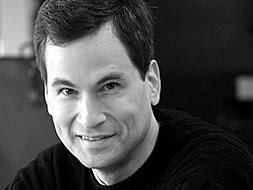
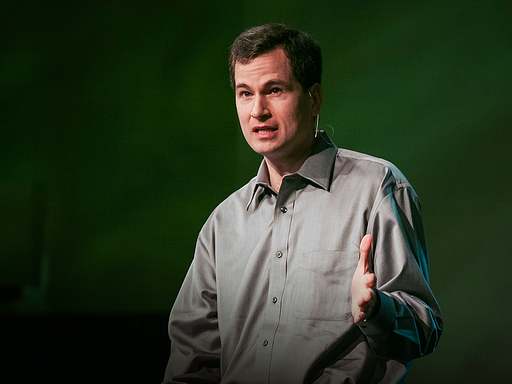
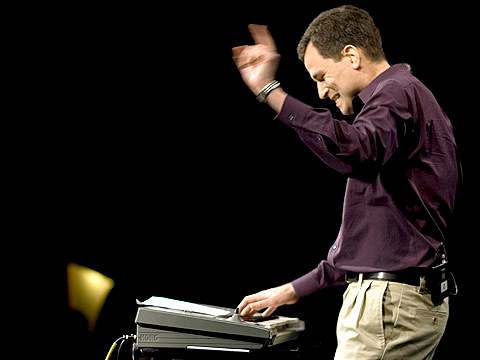
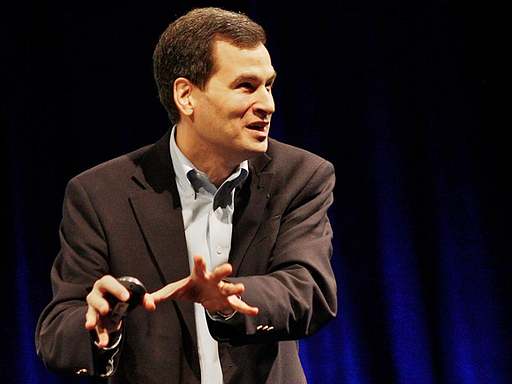
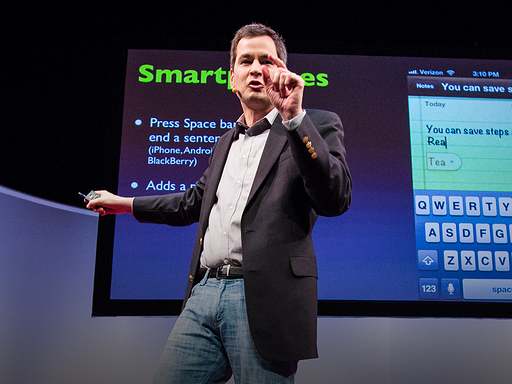
David Pogue is the personal technology columnist for the New York Times and an Emmy Award-winning tech correspondent for CBS News. He's also one of the world's bestselling how-to authors, with titles in the For Dummies series and his own line of "Missing Manual" books.
Why you should listen to him:
Which cell phone to choose? What software to buy? Are camera-binoculars a necessity or novelty? As release cycles shorten and ever-shrinking gadgets hit the market with dizzying speed, it's harder and harder to know what’s worth the investment. A tireless explorer of everyday technology, David Pogue investigates all the options so we don't have to.
After happily weathering installation nightmares, customer service hiccups, and an overwhelming crush of backups, upgrades and downloads, Pogue reports back with his recommendations via his many columns, TV appearances and how-to books. And he does it all with relatable insight, humor and an unsinkable sense of pun, er, fun. All that, and he sings, too.
Blog Posts on TED
-
Maira Kalman on Alvar Aalto, in T Magazine – May 5, 2008

A lovely moment in the latest T Magazine, in this Sunday's New York Times: Maira Kalman writes about and illustrates her classic Alvar Aalto vase. Read the full story >> -
New TED.com and TED's June Cohen featured in today's New York Times – April 16, 2007
Today's New York Times carries an article by E-Commerce reporter Bob Tedeschi about the new TED.com:
Hiroko Masuike for The New York Times
June Cohen, director of TED Media, said putting conference presentations on the Internet helped increase exposure.
By BOB TEDESCHI
Published: April 16, 2007
THOSE who don’t have $6,000 or enough prominent connections to get into a TED conference can take heart. The price of admission just went to zero, provided you can settle for a more remote experience.The TED organization (TED stands for Technology, Entertainment and Design) runs an invitation-only conference in Monterey, Calif., every year for movers and shakers in business and nonprofit circles.
Yesterday, TED introduced a Web site that offers about 100 of its TED Talks, the polished 20-minute presentations for which the conference is renowned.
The new site will generate more advertising revenue for TED, but more important, conference leaders said, it will expose TED’s content to millions of people who would otherwise never attend the event.
In so doing, TED is at the vanguard of a trend in the conference industry, where organizers have begun to exploit assets that in years past evaporated as soon as speakers left the stage.
“I’m so struck by it anytime I’m at a great event,” said June Cohen, director of media for TED, a nonprofit business based in New York. “That was so wonderful, but now it’s gone. It’s a shame they’re not captured and preserved.”
Ms. Cohen said TED’s organizers began posting last June a handful of free videos from past conferences on TED.com, with “fairly aggressive goals for how I thought they’d do. But we blew past those pretty quickly.” By January, the number of TED Talks on the site had grown to 44, and they had been viewed more than three million times.
Article continues after the jump...
-
TEDTalks turn 2! – June 27, 2008
Two years ago today, TED.com posted its first six TEDTalks. It was a radical notion to share these powerful talks and ideas with the world -- but it looks like it was the right notion. This week, TEDTalks notched its 50 millionth view, and we moved to a daily publishing schedule to keep up with the demand for more great talks, performances and conversations.
Celebrate with us by suggesting your favorite TEDTalks over the past two years. Count down the Top 10 TEDTalks in a special Theme page, where you can discuss the talks and suggest your own hidden gems from the archive.
Watch the first six TEDTalks, posted two years ago today:
Al Gore on 15 ways to avert a climate crisis
David Pogue says "Simplicity sells"
Majora Carter's tale of greening the ghetto
Ken Robinson asks, Do schools kill creativity?
Tony Robbins talks about why we do what we do
Hans Rosling shows the best stats you've ever seen
-
A freak blog migrates into an institution – August 14, 2007
After over two years at freakonomics.com, Steven Levitt and Stephen Dubner -- co-authors of the 3-million-copies "Freakonomics" -- last week moved their blog under a bigger and more institutional brand, that of the Opinion section of the New York Times' website.
Levitt spoke at TED2004 offering a preview of a chapter of "Freakonomics" titled "Why do crack dealers still live with their moms?" (watch the video) and exposing his very unconventional approach to economic analysis.
The migration of the blog wouldn't be a remarkable event (even though the blog is very interesting and highly interactive, attracting hundreds of readers' comments) were it not for two facts. The move, in a way, closes a circle: "Freakonomics" was born from a profile that Dubner wrote about Levitt for the New York Times Magazine in 2003, "The Economist of Odd Questions". It also underscores a nascent trend, that of well-known bloggers moving into newspapers' and magazines' websites, creating synergies and pooling readerships -- another step towards the hybridization of the media. The NYT is not the first to try this strategy: France's Le Monde, for example, has been doing so for a while.
-
TED Salon: Further reading – September 29, 2007
Some selected source material and references from Wednesday night's TED Salon: David Keith (pictured, left) showed a New York Times editorial on the coming climate change -- from May 24, 1953:
How Industry May Change Climate
The amount of carbon dioxide in the air will double by the year 2080 and raise the temperature an average of at least 4 per cent. The burning of about two billion tons of coal and oil a year keeps the average ground temperature somewhat higher than it would otherwise be. ...Within the NYTimes archive, we found a related story from 1953:
The Weather Is Really Changing
Studies confirm that feeling you've had that summers are getting warmer. So are our winters. But atmosphere, not atoms, is to blame.
A few other historical sources Keith referred to:
+ Changing Climate, by the Carbon Dioxide Assessment Committee, U.S. National Research Council, 1983
+ Restoring the Quality of Our Environment, Report of the Environmental Pollution Panel, President’s Science Advisory Committee, The White House, December 1965 Martin Hoffert discussed the Kardashev scale -- a ranking of civilizations based on the kinds of energy they use. Earth is still at the bottom of this scale -- we're just using whatever we find lying around on the planet. More advanced civilizations in the universe, Kardashev theorizes, will begin to harvest and grow power using all the resources of their star system and of the universe. Hoffert shows us one step toward star power: solar energy via satellite. Juan Enriquez talked about two scientists whose work could point the way to a new future of energy. As an inspiration, he points to Norman Borlaug, called "the Father of the Green Revolution." Borlaug developed optimized strains of wheat that, quite literally, now feed the world. He brought a biological, a scientific approach to agriculture that allowed it to leap beyond the boundaries of traditional "brute force" farming -- to become efficient, dependable and more productive by orders of magnitude. Enriquez' next scientist-hero is Hamilton Smith, who shared the 1978 Nobel Prize in Medicine for his work in manipulating DNA. Is Smith, or someone like him, the person who will help energy make the great leap forward that farming has? Photo of David Keith by Myrna Suarez, Condé Nast Portfolio -
Introducing TEDTalks – June 27, 2006
Today, for the first time ever, we're thrilled to present some of the most remarkable talks from TEDs past. We launch with six from this year's conference — Al Gore, Tony Robbins, David Pogue, Majora Carter, Hans Rosling and Ken Robinson — with more coming weekly. All the talks are downloadable as audio or video, searchable and free.
It's a big moment for us: Until now, the TED experience has been limited to 1,000 people each year. But we believe passionately that these talks deserve a much wider audience. Now — thanks to the maturation of online video and podcasting, and a visionary sponsorship from BMW — we can share them for the first time.
TEDTalks are designed to fit into your life: You can subscribe, to easily receive updates each week. There's an audio series (produced with WNYC/New York Public Radio) that commutes well, as well as the video series, offered on this blog and TED.com, and downloadable through iTunes. Plus, the talks are fully searchable, so you can always find exactly what you're looking for.
Our intention here isn't to draw attendees (TED2007 already has a long waiting list), but simply to share these profound talks — which have had such great impact on us — with the widest possible audience. They're ideas worth spreading. So whether you're a TED veteran or virgin, we encourage you to clear your schedule and watch at least three talks, back to back. They have a cumulative effect ... — Chris
-
Pogue tests the Apple iPhone – June 28, 2007
NYTimes tech columnist and TED06 speaker David Pogue has been testing the Apple iPhone, which will hit stores tomorrow Friday in the US, and he shows it all on video, feature by feature, dressed with classic Pogue fun. Or you can read his article. Summary: "much of the hype and some of the criticisms are justified. The iPhone is revolutionary; it’s flawed ... it does things no phone has ever done before; it lacks features found even on the most basic phones."

By the way, David has a book coming out in a few weeks about the iPhone - "iPhone: The Missing Manual".


