
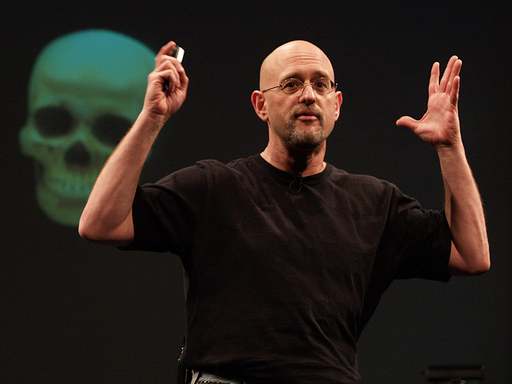
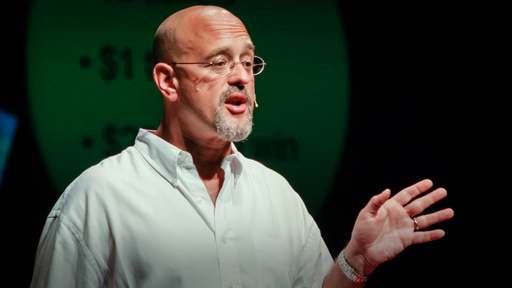

Harvard psychologist Dan Gilbert says our beliefs about what will make us happy are often wrong -- a premise he supports with intriguing research, and explains in his accessible and unexpectedly funny book, Stumbling on Happiness.
Why you should listen to him:
Dan Gilbert believes that, in our ardent, lifelong pursuit of happiness, most of us have the wrong map. In the same way that optical illusions fool our eyes -- and fool everyone’s eyes in the same way -- Gilbert argues that our brains systematically misjudge what will make us happy. And these quirks in our cognition make humans very poor predictors of our own bliss.
The premise of his current research -- that our assumptions about what will make us happy are often wrong -- is supported with clinical research drawn from psychology and neuroscience. But his delivery is what sets him apart. His engaging -- and often hilarious -- style pokes fun at typical human behavior and invokes pop-culture references everyone can relate to. This winning style translates also to Gilbert’s writing, which is lucid, approachable and laugh-out-loud funny. The immensely readable Stumbling on Happiness, published in 2006, became a New York Times bestseller and has been translated into 20 languages.
In fact, the title of his book could be drawn from his own life. At 19, he was a high school dropout with dreams of writing science fiction. When a creative writing class at his community college was full, he enrolled in the only available course: psychology. He found his passion there, earned a doctorate in social psychology in 1985 at Princeton, and has since won a Guggenheim Fellowship and the Phi Beta Kappa teaching prize for his work at Harvard. He has written essays and articles for The New York Times, Time and even Starbucks, while continuing his research into happiness at his Hedonic Psychology Laboratory.
"Gilbert's elbow-in-the-ribs social-science humor is actually funny. ... But underneath the goofball brilliance, [he] has a serious argument to make about why human beings are forever wrongly predicting what will make them happy."New York Times Book Review
Blog Posts on TED
-
Archive: Dan Gilbert asks, "Why are we happy?" on TEDTalks – August 14, 2008
For the next week, we're presenting some of our favorite TEDTalks from among the 270+ talks and performances we've posted since June 2006. Look for brand-new TEDTalks starting August 18. Until then, enjoy these gems -- and suggest your own by writing to contact@ted.com or joining the conversation on TED.com.
Dan Gilbert, author of Stumbling on Happiness, challenges the idea that we’ll be miserable if we don’t get what we want. Through experiments, he's found that our "psychological immune system" lets us feel truly happy even when things don’t go as planned. It's a big idea that has spawned pages of discussion on TED.com. About this talk and Barry Schwartz's (yesterday's archive pick), one blogger writes, "I found reading the comments on the talks as interesting as the talks themselves." (Recorded February 2004 in Monterey, California. Duration: 21:28)
Watch Dan Gilbert's 2004 talk on TED.com, where you can download it, rate it, comment on it and find other talks and performances from our archive of 270+ TEDTalks.
Get TED delivered:
Subscribe to the TEDTalks video podcast via RSS >>
Subscribe to the iTunes video podcast
Subscribe to the iTunes audio podcast
Subscribe to the TED Blog >>Blog this video: Use this code to run the video on your own site:
-
How toddlers (and monkeys) make choices – October 26, 2007

What's the relationship between our happiness and the choices we make? TEDTalks from Barry Schwartz and Daniel Gilbert point out some paradoxes of this relationship, and the complex emotions involved in choice. Now, some new research from Yale sheds light on how toddlers and monkeys make choices. From the BPS Research Digest Blog:
Forty 4-year-olds used a scale of smiley faces to indicate how much they liked a range of animal stickers. For each child, the researchers identified three stickers which that child liked equally – let’s call these A, B, C. Each child then faced two choices – first to choose which of A or B they would like to take home. Afterwards, they then had to choose between sticker C and whichever sticker (A or B) they hadn’t selected before.
The surprising result was, faced with the second choice, the kids overwhelmingly picked sticker C -- though they'd liked all three stickers equally at first. The other surprising result was, the researchers got the same result with capuchin monkeys, who chose among three different-colored M&Ms. For more on this study, read the journal abstract or a detailed post on the blog The Proper Study of Mankind. Photo from Wikimedia: Cebus capucinus: Capuchin Monkeys Sharing Source: Powell K: Economy of the Mind. PLoS Biol 1/3/2003: e77. Photo courtesy of Frans de Waal.
-
Stumbling on sadness? – February 12, 2008
Many TEDTalks explore themes of happiness -- Stumbling on Happiness' Daniel Gilbert, Mattheiu Ricard (who's been called the Happiest Man on Earth), happy designer Stefan Sagmeister, and many more ...
Now a recent story in Newsweek rounds up the latest on happiness' opposite: sadness. It's an interesting gloss on the growing happiness industry -- and what the story calls "the backlash against the happiness rat race." -
Happiness Expert Dan Gilbert on TEDTalks – September 26, 2006
Dan Gilbert is a psychology professor at Harvard, and author of Stumbling on Happiness. In this memorable talk, filmed at TED2004, he demonstrates just how poor we humans are at predicting (or understanding) what will make us happy. (Recorded February 2004 in Monterey, CA. Duration: 22:02)
Download this talk: Audio (MP3) | Video (MP4)
More TEDTalks: TEDTalks website | iTunes (audio) | iTunes (video)
Blog this video: Use this code to run the video on your own site:
Subscribe to TEDTalks for free, automatic updates.
-
Edge question 2008: What have you changed your mind about? Why? – January 2, 2008
Many TEDTalks speakers have answered the 2008 Edge Foundation question: What have you changed your mind about? Why?
Among the more than 160 essays from leading thinkers -- scientists, philosophers, artists -- look for Wired's Chris Anderson, Nick Bostrom, Stewart Brand, Richard Dawkins, Aubrey de Grey, Juan Enriquez, Helen Fisher, Neil Gershenfeld, Daniel Gilbert, Daniel Goleman, Kevin Kelly, Steven Pinker, Carolyn Porco, Martin Rees, Michael Shermer and Craig Venter. Block out some time to sample these -- it's an addictive read.

