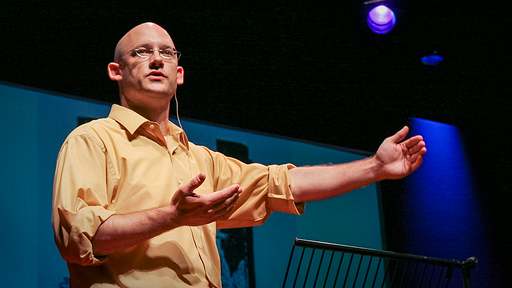
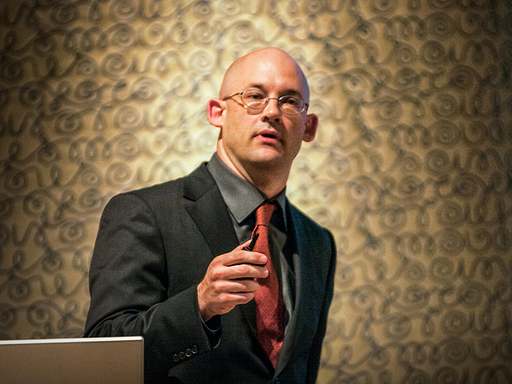
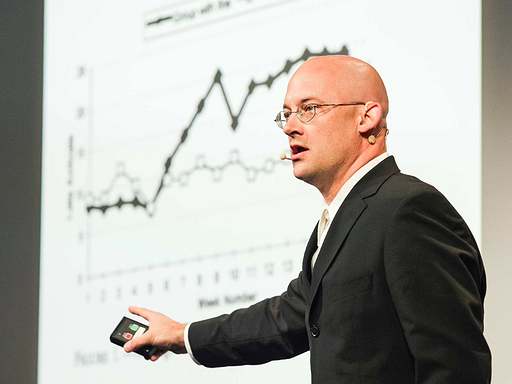
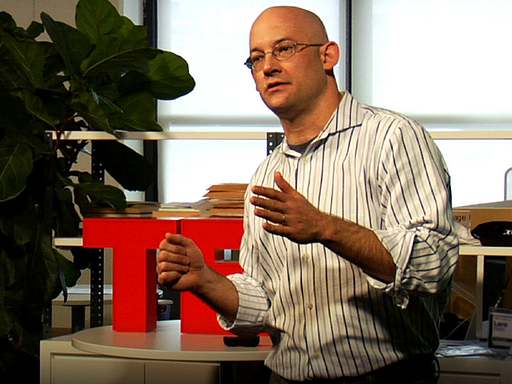
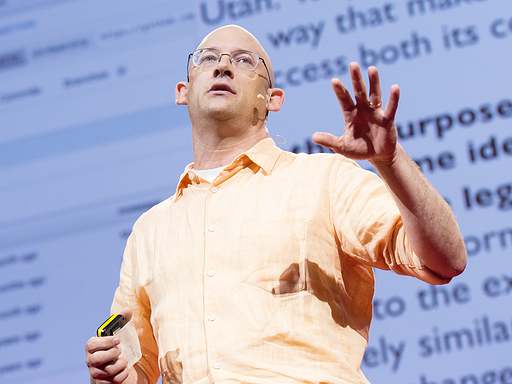
Shirky, a prescient voice on the Internet’s effects, argues that emerging technologies enabling loose collaboration will change the way our society works.
Why you should listen to him:
Clay Shirky's consulting focuses on the rising usefulness of decentralized technologies such as peer-to-peer, wireless networks, social software and open-source development. New technologies are enabling new kinds of cooperative structures to flourish as a way of getting things done in business, science, the arts and elsewhere, as an alternative to centralized and institutional structures, which he sees as self-limiting. In his writings and speeches he has argued that "a group is its own worst enemy." His clients have included Nokia, the Library of Congress and the BBC. Shirky is an adjunct professor in New York University’s graduate Interactive Telecommunications Program, where he teaches course named "Social Weather."
Shirky is author of Here Comes Everybody.
"Shirky is one of the handful of people with justifiable claim to the digerati moniker. He's become a consistently prescient voice on networks, social software, and technology's effects on society."WIRED
Blog Posts on TED
-
Whither Web 2.0? – October 22, 2008
Via Slashdot, blogger Andrew Keen writes that economic troubles will trigger the decline of the "free" economy, collaboration, and open-source -- including communities such as Wikipedia -- and even, perhaps, the blogosphere itself.
People will be less likely to give away "their intellectual labor on the Internet in the speculative hope that they might get some 'back end' revenue," writes Keen.
But one Slashdot commenter points to Yochai Benkler's Wealth of Networks for evidence to the contrary: "For all of us, there comes a time on any given day, week, and month,every year and in different degrees over our lifetimes, when we choose to act in some way that is oriented toward fulfilling our social and psychological needs, not our market-exchangeable needs. It is that part of our lives and our motivational structure that social production taps, and on which it thrives. There is nothing mysterious about this. It is evident to any of us who rush home to our family or to a restaurant or bar with friends at the end of a workday, rather than staying on for another hour of overtime or to increase our billable hours; or at least regret it when we cannot."
Benkler's 2005 TEDTalk argues that a collaborative economy does not easily falter.
Watch other related TEDTalks:
+ Clay Shirky on why free communities are more thorough, creative and productive than formal institutions designed to accomplish the same things.
+ Howard Rheingold on way-new collaboration -- and why cooperation succeeds.
+ Chris Anderson of WIRED on tech's long tail. (He recently predicted the rise of a free economy.)
See also: Cameron Sinclair on open-source architecture, Richard Baraniuk on open-source learing, and Jimmy Wales on Wikipedia.
What do you think?
-
Clay Shirky on our cognitive surplus – August 22, 2008
There's a great talk from Clay Shirky in the latest issue of Edge -- about all of our surplus, unused brain power, and what we might be able to do with it if we turn off our TVs:
How big is that surplus? If you take Wikipedia as a kind of unit, all of Wikipedia, the whole project -- every page, every edit, every line of code, in every language Wikipedia exists in -- that represents something like the cumulation of 98 million hours of human thought. I worked this out with Martin Wattenberg at IBM; it's a back-of-the-envelope calculation, but it's the right order of magnitude, about 98 million hours of thought.
And television watching? Two hundred billion hours, in the U.S. alone, every year. Put another way, now that we have a unit, that's 2,000 Wikipedia projects a year spent watching television.
Having trouble leaving a comment? (We're working on it...) Email it to us: blog at ted dot com -
Four new books by TEDGLOBAL 2005 speakers – July 21, 2008

Four of the speakers that participated in the first TEDGLOBAL in Oxford (July 2005) have all published new books recently. Former Afghani minister and head of Kabul University Ashraf Ghani (watch his TEDtalk), together with Clare Lockhart, has penned "Fixing Failed States: A Framework For Rebuilding A Fractured World". They discuss the "between forty and sixty nations" -- that's one-quarter of all the countries in the world -- that are broken to various degreees and have become "the breeding ground of networks of criminality and terror", and suggest an integrated state-building approach that goes beyond military intervention and humanitarian aid to make them "stakeholders in a global system". It's a radically optimist book. Since Ghani spoke at TEDGLOBAL, he and Lockhart have co-created the Institute for State Effectiveness. In "We Think: Mass Innovation, Not Mass Production", British innovation and creativity guru Charles Leadbeater (watch his TEDtalk) makes the case, based on countless well-documented examples from all over the world, that innovation in the era of the Web has become a collective, collaborative effort. "You are what you share", he writes. Walking his talk, he shares part of the final book and the full first draft on his website. Groups of people increasingly coming together to share, work or take public action are also the starting point for Clay Shirky's new book "Here Comes Everybody: The Power Of Organizing Without Organizations". The social-media master (watch his TEDtalk) contends that "when new technology appears, previously impossible things start occurring". For example: "We are used to a world where little things happen for love and big things happen for money. Love motivates people to bake a cake and money motivates people to make an encyclopedia. Now, though, we can do big things for love". The reference, obviously, is to Wikipedia, which is just one of many examples used by Shirky. Recently, he told me that the book somehow was born at TEDGLOBAL 2005: "That speech was the opportunity to link a lot of my earlier work into a coherent structure". He's blogging and discussing the book at HereComesEverybody.org. Carl Honoré's previous bestseller "In Praise Of Slow" discussed our culture obsessed with speed (that's the topic of his TEDtalk). In his new book, "Under Pressure: Rescuing Childhood From The Culture Of Hyper-Parenting", he applies that lens to growing up in today's developed societies, and says that we are raising "a generation of overprogrammed, overachieving, exhausted children". Based on extensive research -- fact after example after anecdote (including that of the father of a tennis player who drugged his child's opponents) -- and beautifully written, "Under Pressure" is not a parenting manual. "Slow", in the meantime, has built up to somewhat a global movement, and Carl is one of the co-founders of a website for all things slow, Slow Planet. Where they remind us that "slow is not about doing everything at a snail's pace; it's about working, playing and living better by doing everything at the right speed". The next TEDGLOBAL will take place in Oxford, 21-24 July 2009. More details will be forthcoming in September. (Note: Some of the cover images above may be different from what you will find online or at your local bookstore, depending on the different country-specific editions of each book.)

