Speakers Carolyn Porco: Planetary scientist

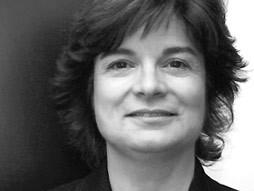
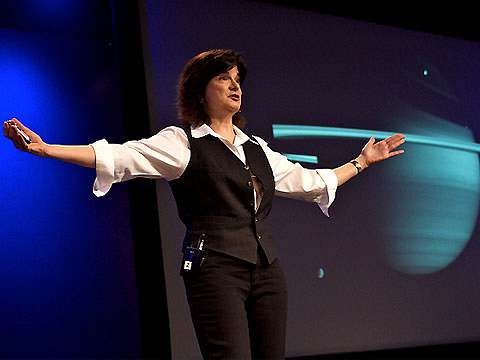
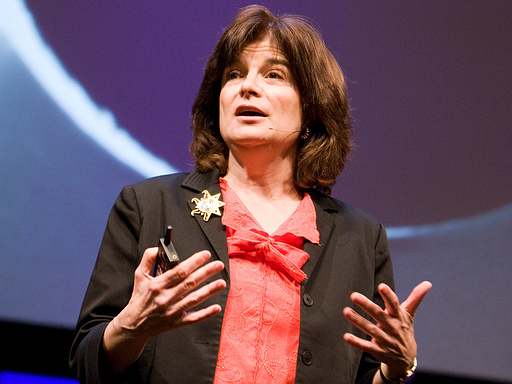
As the leader of the Imaging Team on the Cassini mission to Saturn, Carolyn Porco interprets and shares the pictures coming back from this fascinating planet, its rings and its moons.

Why you should listen to her:

Planetary scientist Carolyn Porco studies and interprets the photos from the Cassini-Huygens mission, orbiting Saturn and its largest moon, Titan. She and a team of scientists from NASA and the European Space Agency have been analyzing the images that Cassini has been sending back since it left Earth in 1999. They've found many new rings and four new moons (so far). And they've produced breathtaking images and animations of the stormy face of Saturn, its busy rings, and its jumble of moons and moonlets.

Back in the mid-1980s, while still working on her doctorate, Porco was drafted onto a team at JPL that was crunching the mountains of data coming back from the Voyager fly-by of Saturn. Her work on the planet's "ringlets," and on a spoke pattern noticed in the rings, made an important connection between Saturn's rings and its magnetic field -- and cemented her connection with Saturn.

Her ongoing work at the Cassini Imaging Central Laboratory for Operations (CICLOPs) has two goals: to process and interpret the Cassini images for other scientists, and to make sure the images -- in all their breathtaking poetry and mystery and sheer Save-Image-As-Desktop awesomeness -- connect with the general public. She is an advocate for the exploration and understanding of planetary space, and her frequent talks (as well as her "Captain's Log" memos on the CICLOPS website) speak to everyone, scientist and nonscientist alike.

Email to a friend »

Blog Posts on TED

  • Porco awarded, Antonelli promoted – January 17, 2008

    TED speaker Paola Antonelli (watch her TED 2007 talk) has been promoted to senior curator of the New York Museum of Modern Art's department of architecture and design. The promotion was announced by MoMA's director Glenn Lowry. Paola is currently preparing "Design and the Elastic Mind", an exhibition on science, design and innovation that will open at MoMA on February 24. Carolyn Porco, leader of the imaging team for the Cassini space mission to Saturn and the opening speaker at TED 2007 (watch her talk), will be the recipient of this year's Isaac Asimov Science Award, given by American Humanist Association. Porco will receive the award in June in Washington. To both, congratulations!

    More »

  • Earth-rise and Earth-set – November 14, 2007

    Consider it a bonus track to the great speech by Carolyn Porco last March at TED07, when she showed amazing images of Saturn and its moons. The Japanese Aerospace Exploration Agency (Jaxa) has just released video footage taken by the the onboard high-definition camera of their spacecraft Kaguya, showing extraordinary images of the Moon's surface and the Earth "rising" and "setting" beyond the Moon's horizon. (Clicking on the link on their page opens up a second window: let the whole video download -- it takes a while -- before watching it).

    Earth-rise:

    Jaxaearthrise

    Earth-set:

    Jaxaearthset

    (Cross-posted on LunchOverIP)

    More »

  • Celebrate 10 years of Cassini-Huygens with new views of Saturn – October 16, 2007

    OntheFinalFrontier.jpgThe Cassini-Huygens mission to Saturn and its moons celebrates its diamond anniversary this week by releasing a new collection of images, movies and maps. If you could not get enough of Carolyn Porco's images from her talk at TED2007, head over to the CICLOPS site for new and just-posted archival images, as well as a new set of 9 holes -- the Outer Links -- for the Flash game Golf Sector 6. Photo, released Oct 15, 2007: On the Final Frontier: Saturn sits nested in its rings of ice as Cassini once again plunges toward the graceful giant. Courtesy CICLOPS.

    More »

  • TED2007: Day one wrap-up – March 7, 2007

    Quotes of the day:

    Cassini imaging team head Carolyn Porco: "So there are possibly liquid water, organic materials and excessive heat on Saturn and its moons. Which means that Saturn could be a place were life is possible. If we can demonstrate that Genesis has happened not once (Earth) but twice (Saturn)  then we can infer that it has happened hundreds of thousands of times across the solar system. If we can demonstrate that Genesis has happened not once [on Earth] but twice [including Saturn] in the solar system, then by inference that means it has occurred a staggering number of times across the universe in its 13.7 billion year history".

    Nobel prize of physics Murray Gell-Mann: "In fundamental physics, beauty is a very successful criterion for choosing the right theory".

    Psychologist Steven Pinker: "The truth is that our ancestors were far more violent that we are, and today we are probably living in the most peaceful times in history".

    Computer scientist Jeff Han: "We basically have to un-teach people what they have learned so far about computing, and convince them that they can use several fingers, that several people can work on the screen at once".

    Architect Philippe Starck: "I believe in general that my job is absolutely useless; but now, after Carolyn and these guys, I feel like shit".

    Statistician Hans Rosling: "Bring me my sword!" (Rosling is a serious demographer but he is also -- another deadly serious activity -- one of the few sword-swallowers active in Sweden, and he ends his speech swallowing a Swedish bayonette).

    More »

  • Flying to the moons of Saturn: Carolyn Porco on TED.com – October 2, 2007

    Planetary scientist Carolyn Porco says, "I'm going to take you on a journey." And does she ever. Showing breathtaking images from the Cassini voyage to Saturn, she focuses on Saturn's intriguing largest moon, Titan, with its deserts, mudflats and puzzling lakes, and on frozen Enceladus, which seems to shoot jets of ice. Could one of these places harbor water -- or life? (Recorded March 2007 in Monterey, California. Duration: 17:21.)


    Watch Carolyn Porco's talk on TED.com, where you can download it, rate it, comment on it and find other talks and performances.

    Read more about Carolyn Porco on TED.com.

    Embed this video: Use this code to run the video on your own site:

    More »

  • Saturn's mysterious black-and-white moon – October 9, 2007

    Carolyn Porco's Saturn imaging team has found "tell-tale clues" to a centuries-old mystery surrounding Saturn's moon Iapetus -- why is it stark white on one side, coal black on the other? It's a striking oddity in a sky full of gray rocks. As the CICLOPS site reports, the white side of this moon is covered with brightly reflective ice, while sunlight has melted the ice on the dark-colored side, revealing the moon's surface. Watch Carolyn Porco's 2007 TEDTalk to learn more about this intriguing planet and its moons.

    More »

  • The Lonely Interplanetary guide to scuba diving – August 1, 2008

    Bored with Earthly beach destinations this summer? Does the word "Carribbean" not ring exactly, well, "exotic" these days? With this week's news that (highly acidic) water has been tasted on Mars and an ethane lake has been discovered on Saturn's moon Titan, perhaps it's time to investigate otherworldly destinations for fun in the surf. Grab your ultraviolet-shielded swimming gear and a good beach read (say, Project Orion by George Dyson, who spoke at TED in 2003), hop aboard Virgin Galactic's newly unveiled SpaceShipTwo, and cruise to these astonishing natural satellites orbiting Jupiter and Saturn, where summer never comes: moons_europa_1.jpgTidally bound to face its mother planet, Europa consistently offers breathtaking views of Jupiter's turbulent atmosphere, while its breezy hardly-there chemise of molecular oxygen is delicate enough to leave the magnificent sight unobstructed. (But, beware the occasional barrage of comets yanked in by Jupiter's gravity.) Adventurers wishing to forgo Europa's "spa experience" will be at home, too: drill through miles of icy crust to access this satellite's vast subsurface ocean of liquid saltwater -- and whatever may lurk there. moons_callisto_1.jpgUnlike visitors to other Jovian moons, sailors to Callisto can leave their ionizing radiationscreen at home: though excessively pockmarked by impacts, its outer orbit saves it from the effects of Jupiter's monstrous magnetosphere. Hiking enthusiasts can traverse its gigantic basin of concentric rings, Valhalla, spanning 600 kilometers, kicking through wisps of condensed oxygen. This moon's lack of tectonic activity makes for easy access to its likely ocean of liquid saltwater. (Robert Ballard has made the case that Earth's own oceans are still deeply mysterious.) moons_enceladus_1.jpgAthletes and thrill-seekers delight at Enceladus' suite of extreme winter features and low gravity: spirally slalom the slopes of its unforgettable impact craters; gawk at the ivory, propane-scented violence of erupting cryovolcanoes as the panorama of Saturn's rings sets below the horizon; bobsled along thousand-mile escarpments of fresh chemical ice. Meanwhile, geology geeks can enjoy exploring this highly reflective moon's incredible tectonic scars and stripes. But let divers beware: the existence of a liquid subsurface is only speculative. moons_titan_1.jpgTitan's atmosphere, unique among moons, makes it a mysterious entity among other natural satellites and an attractive destination for Saturn-bound families seeking an exotic experience without patent danger (asteroid strikes are rare). Visitors willing to endure its unusual weather -- the nitrogen-humid nights with the sky awash in orange; monsoons of methane and other hydrocarbons -- will be rewarded by its Earth-like terrain: newly discovered lakes of ethane, vast sand dunes, a probable ocean of water-ammonia under the surface, and perhaps even microbial life. (Get your vaccinations!) Our solar system is truly a cornucopia of enchanting and enigmatic phenomena. Make sure your frequent-flyer miles go to good use on your next trek by studying TEDTalks by Carolyn Porco, Bill Stone, George Dyson, Freeman Dyson and other adventurers. -- Matthew Trost

    More »

  • Edge question 2008: What have you changed your mind about? Why? – January 2, 2008

    edge.gifMany TEDTalks speakers have answered the 2008 Edge Foundation question: What have you changed your mind about? Why? Among the more than 160 essays from leading thinkers -- scientists, philosophers, artists -- look for Wired's Chris Anderson, Nick Bostrom, Stewart Brand, Richard Dawkins, Aubrey de Grey, Juan Enriquez, Helen Fisher, Neil Gershenfeld, Daniel Gilbert, Daniel Goleman, Kevin Kelly, Steven Pinker, Carolyn Porco, Martin Rees, Michael Shermer and Craig Venter. Block out some time to sample these -- it's an addictive read.

    More »

  • Cassini buzzes Enceladus today, closer than ever – March 12, 2008

    CassiniEnceladus.jpg

    The Cassini mission to Saturn (see Carolyn Porco's stunning TEDTalk on this mission) today makes its closest flyby yet of Enceladus, a geologically active moon. With its frozen surface and plumes of ice, Enceladus is a fascinating body, and the Cassini probe will be imaging the moon in several areas with many different instruments. From the mission notes:

    At 17:40:12 UTC ... UVIS will scan across the disk of Enceladus to measure the ultraviolet albedo of the surface and look for oxygen in the environment around Enceladus which may have dissociated from water molecules in the plumes.

    The Cassini probe is set to pass through one of Enceladus' ice plumes as it passes closest to the surface of the moon -- flying by at about 70 km, or 50 miles up.

    More »