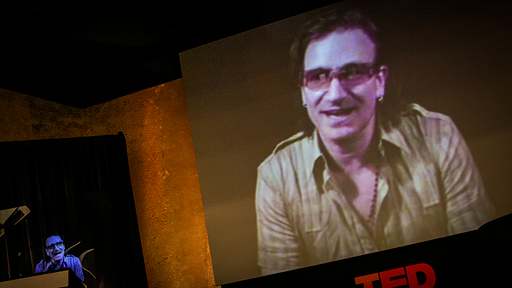
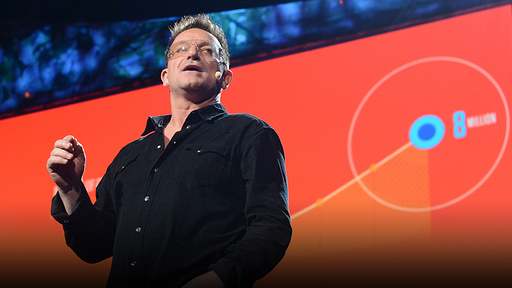
Speakers Bono: Musician, activist

Bono, the lead singer of U2, uses his celebrity to fight for social justice worldwide: to end hunger, poverty and disease, especially in Africa. His nonprofit DATA raises awareness via media, policy and calls to action.

Why you should listen to him:

It is an extraordinary fact that the lead singer with the world's biggest rock band is also our generation's most persuasive champion of the downtrodden. Irreverent, funny, iconoclastic and relentless, Bono has become stunningly effective in bringing the world’s most powerful leaders to take seriously the problems of AIDS and African poverty.

In 2002, he co-founded DATA (Debt, AIDS, Trade, Africa). Many credit him as the driving force behind the US government's recent dramatic increase in AIDS funding. And no one who has heard him speak about "our generation's greatest challenge" can come away unmoved.

After U2's historic Live Aid performance in 1985, Bono traveled to Ethiopia with his wife, Ali. There they spent several weeks helping with a famine relief project. The experience shocked him and ignited a determination to work for change. In Bono's own words: "What are the blind spots of our age? It might be something as simple as our deep-down refusal to believe that every human life has equal worth." In 2005, Bono became one of the inaugural winners of the TED Prize; he used his wish to raise awareness and inspire activism for Africa. In 2007, he accepted an honorary British knighthood for his work.

"Bono always makes his visits [to Africa] substantive, using the accompanying media to educate the wider world about the plight of the poor in less developed countries."
Philadelphia Inquirer

Email to a friend »

Blog Posts on TED

  • TED's Emeka Okafor on the conversation after TEDGlobal – July 22, 2007

    As Program Director for TEDGlobal2007, Emeka Okafor worked with TED Curator Chris Anderson and the TED team to assemble a list of speakers that spoke to the heart of the new Africa -- the "cheetah generation" of inventors and investors, policymakers and bloggers, who are bringing new energy to the continent. We spoke to Emeka -- who's an entrepreneur and multiple blogger himself -- about life since TEDGlobal: First -- have you recovered? Yes, it's been a blissful recovery to see the continued strength of post-conference conversations. Have you been reading the coverage of the conference since it ended? What do you think about the difference between the mainstream press coverage and the blog coverage? The MSM press completely missed the zeitgeist that the conference tapped into. I wonder, did they go to a different conference? My thinking is that they proved to be one of the key reservoirs of preconceived thinking about the continent.

    The blogosphere conversely provided everything that one would expect from the MSM and much much more. We tend to forget that not a single TEDTalk from TEDGlobal has been released yet -- it seems as if a good portion have. The blogs have excelled themselves in reportage, analysis, opinions, post-TEDGlobal initiative/project planning, etc. What are some of the plans you've heard about that are inspired by TEDGlobal? + The AfricanLoft blog is hosting a carnival that is infused with TEDGlobal ideas.

    + Afrigadget has a proposal for "A strategy for supporting innovative entrepreneurs in Africa"

    + Jen Brea asks "there are tons of people out there doing projects who would like to know how to do them better? Or differently? What kind of forum could be created for brainstorming, critiquing, and improving upon existing ideas and models?"

    + Tunji Lardner, TED Fellow and founder of WangoNet, is looking at "unlocking products from various research institutes in Nigeria, we intend to scientifically bundle them and them market them."

    ... and this is just the tip of the iceberg. In the week to come, watch for more news from TEDGlobal's continuing conversation, and guest posts from conference bloggers. Premiering Wednesday, August 1: The first TEDTalks from TEDGlobal2007!

    More »

  • Day Two in Quotes [TEDGlobal 2007] – June 6, 2007


    “Dignity is more important to the human spirit than wealth” — Acumen Fund CEO/Founder Jacqueline Novogratz "What we call governments are vampire states, which suck the economic vitality out of the people." — Economist George Ayittey "I want to make Africans rich. If you make Africans rich, they'll be less poor. That's my development strategy." — Private equity pioneer Idris Mohammed "What we're trying to do is create a family tree for everyone alive today." — Anthropologist and geneticist Spencer Wells, who's leading the Genographic Project, a landmark study tracing human origins to their roots in Africa "There is no region of the world and no period in history that farmers have had to bear the burden of risk that African farmers bear today. But I'm not here to lament or wring my hands. I'm here to tell you that change is in the air." — Economist Eleni Gabre-Madhin, who is founding the first commodities market for farmers in Ethiopia "World progress needs a good dose of spontaneous human intelligence to realize that the answers to many of the questions we ask ourselves are just around the corner." — Architect Issa Diabete, who draws inspiration from innovative, makeshift urban solutions found in Africa's sprawling squatter cities "I'm hopeful because nature is amazing resilient. Seemingly dead tree stumps -- if you stop hacking them for firewood, in 10 years you can have a 30 ft tree.” — Primatologist and conservationist Jane Goodall “I am a mathematician and I would like to stand on your roof.” — Mathematician Ron Eglash's standard greeting to African families, when he was researching the intriguing fractal patterns observed in many villages across the continent Technorati tags: tedglobal2007

    More »

  • Walk-in Music, African style – June 5, 2007

    Those of you who've attended TED in Monterey know that when you hear the Elephant March from Aïda, it means the doors for the Main Hall have opened, and it's time to scramble for a seat. (Over the years, this becomes a Pavlovian response; a single bar of that striding score touches off the rush of anticipation, inspiration, excitement (and let's face it, a bit of seat-finding stress) I associate with TED. But for TEDGlobal, we thought we'd choose something more site-specific. (Yes, yes ... I know Aïda was an African princess. But still.) And so, welcoming us into the Main Hall each day in Arusha: A reinterpretation of the Tanzanian classic "Kuna Kunguni" (listen to it here) by the late master musician Hukwe Zawose, funked up in a version produced by Michael Brooks. The gyst of the song, for those who don't speak Swahili, is an upbeat invocation for people to come together, and work toward a better world. (Thanks to Bill Bragin for sourcing it!) Technorati tags: TED, TEDGlobal, TEDGlobal2007

    More »

  • TEDGlobal 2007: What the blogs say (Day one) – June 5, 2007

    "There’s nothing like a little controversy to get the party started. TEDGlobal hasn’t disappointed thus far." --White African "I'm fascinated to see how the crowd - both regular attendees of the conference and first-timers - react to the program that Emeka Okafor has put together. (...) I suspect that the overall message of the event will challenge the preconceptions of all participants, African and non-African." Ethan Zuckerman "Meanwhile, down toward the southern end of the Great African Rift Valley in Arusha, Tanzania a kinder, gentler type of world event is taking place — Africa: The Next Chapter..." — Jewels in the Jungle More blog coverage of TEDGlobal 2007

    More »

  • TEDGlobal 2007 Session 6: Listening to Nature – June 6, 2007

    The day's journey continued with anthropologist and geneticist Spencer Wells, who had us riveted with details of the Genographic Project, a landmark study he's leading for National Geographic, tracing human origins to their roots in Africa. By collecting DNA samples from people around the world (especially groups of indigenous people), he's determined the genetic origins of humanity going back over 50,000 years. "What we're trying to do is create a family tree for everyone alive today." Simon Mwacharo followed, with the story behind the wind-powered turbine he invented. He's determined to bring power to the poorest rural areas in Africa, and that means turning toward alternative, renewable energy sources and inexpensive, readily available materials. Next up: A living legend. Bi Kidude, the 90-something singer from Zanzibar, sang her heart out with the equally legendary Culture Musical Club of Zimbabwe, while young women shook and shimmied around her. All I can say is: Wow. 90+ and still rocking out. If that's not inspiring ... Well, if that's not inspiring, well Jane Goodall always is. The legendary cast a spell on the room, with her gentle voice and steadfast mission: To save the chimpanzees — and the jungle — she loves, against the steady progression of habitat loss and climate change. "When I look at my granchildren and think about how we've harmed this planet since I was their age, I feel a kind of desperation." Still, she finds reason for optimism. "You can't come to a conference like TED and not have hope, can you? I'm hopeful, because nature is amazing resilient ... Seemingly dead tree stumps -- if you stop hacking them for firewood, in 10 years you can have a 30 ft tree.” A standing ovation, of course. (If you're following along from home, you can catch her 2003 TEDTalk here.) For more extensive descriptions of each talk, see Ethan Zuckerman's real-time posts on Spencer Wells, Simon Mwacharo, and Jane Goodall and Bi Kidude. Watch for these talks on TED.com beginning midsummer 2007.

    Technorati tags: tedglobal2007

    More »

  • Powerful new documentary on the Darfur genocide – July 26, 2007

    darfur.jpgTED Curator Chris Anderson writes: Last night, I attended the New York premiere of The Devil Came on Horseback, a searing documentary about Darfur, told through the eyes of US military observer Brian Steidle, whose photographs of the ongoing genocide there exploded onto the world two years ago. They raised awareness then, and the new film has the potential to do so again. It packs a powerful punch. I came out seething with anger, and I think that was the intent. Manohla Dargis of the New York Times writes: "Brutal, urgent, devastating -- the documentary The Devil Came on Horseback demands to be seen as soon as possible and by as many viewers as possible." See it if you possibly can. If anyone out there thinks they can help boost distribution of the film (similar to how this community helped with An Inconvenient Truth), please let me know by writing to chris at ted dot com, and I'll connect you with the filmmakers Ricki Stern and Anne Sundberg.

    More »

  • From blogger Jennifer Brea: "Writing A New Story About Africa" – June 6, 2007

    Beijing-based blogger Jennifer Brea is one of 100 Fellows attending TEDGlobal. She's the Francophonia editor for Global Voices, and a prolific and powerful blogger about Africa. I love what she wrote about rethinking media coverage of Africa. Just an excerpt below. Read the full post here.

    The first day's speakers--Euvin Naidoo, Andrew Mwenda, Carol Pineau, Andrew Dosunmu, Zeray Alemseged, and Newton Aduaka--took the story of Africa, the tired story of dependence, desperation, and despair, and tore it to shreds. They took the West's gaze, and killed it, stomped on it, mocked it, burned its effigy (Joseph Conrad to be precise) so that we could start an entirely new conversation using an entirely different vocabulary. We killed famine, death, hopelessness, hunger, tragedy, poverty and started using words like potential, opportunity, wealth, entrepreneurship, ingenuity, art, imagination, creativity, success, investment, growth, choice.
    These are words the media use liberally when writing about emerging nations like India, China or Brazil, but not to describe some of the fastest-growing economies in the world when they happen to be in Africa.
    Now imagine spending four days where you only use the good words to talk about Africa: words of forward motion, words of change. I'm not talking about bringing Tony Robbins on stage and dreaming of a better future. I'm talking about hearing from the mouths of people who are out there living it, building it, succeeding (and quite possibly getting very rich) in Africa.
    It's been thrilling.
    Technorati tags: tedglobal2007, Africa

    More »

  • Images fom Arusha: Opening the show – June 6, 2007

    At the conference midway point, a few images from the TEDGlobal stage ...

    slide6sm.jpg

    Mali-born, Paris-based chanteuse Rokia Traore opens the conference with a traditional Griot song of welcome.

    slide5sm.jpg

    TED Curator Chris Anderson and TEDGlobal Program Director Emeka Okafor co-host the show from the TED stage. Technorati tags: tedglobal2007 Technorati Profile

    More »

  • AfriGadget is one of Time's 50 best websites of 2008 – June 16, 2008

    Afrigadget.jpg

    AfriGadget, the fascinating blog that rounds up inventions and hacks from around the African continent, was just named one of Time magazine's 50 best websites of the year. Founded by TED Fellow Erik Hersman (also one of the brains behind Ushahidi), AfriGadget is a vital -- and inspiring -- look at creativity and engineering brilliance on a very, very low budget.

    More »

  • [TEDGlobal 2007] Session 2: Looking Back to Look Forward – June 4, 2007

    We began session two looking back to ... session one. Bono offered an unscheduled talk, taking on the anti-aid stance of journalist Andrew Mwenda, articulated earlier that day. (A bit of background: Bono's moving 2005 TED Prize acceptance speech helped ignite within the TED Community a heightened interest in Africa, and led quite directly to the planning of this conference.) Bono led off with a video greeting from German chancellor Angela Merkel; a reminder that, in a parallel universe, the G-8 Summit also convenes this week, focusing in part on what some have called an African Marshall Plan. "Tomorrow is the 60th anniversary of the Marshall Plan," Bono began. "I was going to talk about the Marshall Plan. But instead I'll talk about the Mwenda Plan, inaugurated today." He challenged Mwenda on multiple fronts, emphasizing the still-relevant role of aid in saving and improving lives, and the imperative of debt relief for nations who suffered corrupt regimes. I have a strong sense that the aid vs. investment debate is only just getting started ... We then returned to our regularly scheduled program, looking to Africa's past to inform the future. Paleontologist Zeresenay "Zeray" Alemseged took us deep into our history, shedding light on human evolution through the fossil of Salam, a 3-million-year-old toddler he discovered in Ethiopia. (Fascinating fact: The shape of the skull indicated a brain closer to humans than chimps. But the vocal box was distinctly monkey-like, meaning this 3-year-old hominid may well have used language, but would have sounded more like a chimp than a child.) Historian Kenneth Vickery brought us into the recent past, offering snapshots of key moments in African history, which have resonance today. Then the program leapt unexpectedly from our heads to our hearts (as so many memorably TED sessions do). Nigerian-born, Paris-based filmmaker Newton Aduaka shared an extraordinarily moving clip from Ezra, the Sundance-nominated film about child soldiers in the Sierra Leone. Then the magnificent Rokia Traore took the stage again (visibly moved by Aduaka's film), and enchanted us with her voice, which alternately floated and soared. Mali-born and Paris-based, Traore brings traditional music (and instruments) into a modern context, creating a sound all her own. Audience reaction: Not one, but two standing ovations. For more extensive descriptions of each speaker, see Ethan Zuckerman's real-time posts on Bono, Zeresenay "Zeray" Alemseged, Kenneth Vickery and Newton Aduaka. Watch for these talks on TED.com beginning midsummer 2007.

    More »

  • TEDGlobal 2007: bloggers' first thoughts from home – June 9, 2007

    Afromusing sums it up:

    TED Global felt like a seminal moment in Africa. I may have said this already but i will say it again. It was unlike any conference i have ever attended. Stupendous, challenging, interesting, eye-opening, heart-opening literally with Dr. Seyi Olesola and figuratively with Binyavanga Wainaina, Chris Abani and the music of Vusi Mahlasela. It was not uncommon to see people quietly wiping away tears during some of the talks. ...
    Bankalele brought TED's perspective to stories from the G8 summit:
    After listening to a week of stories on aid, development, and entrepreneurship, we emerged from Ted Global in Arusha to find one of the proponents of a new vision for development in Africa -- outgoing British prime minister Tony Blair endorsing shady dealings that involve Saudi Arabia in the name of strategic relationships. ...
    In a post titled "Panic Mode," Mentalacrobatics shares a searing story (with photos) that must be read start to finish. It begins:
    Well, well, well. I get back from TEDGlobal in Arusha to find the world has gone mad back at home. ...
    After blogging every single session, Ethan Zuckerman is still processing:
    Conferences like TED Global are only a couple of days long, but I find I can get surprisingly used to them -- wake up, absorb a mass of new and provocative ideas, have a few dozen conversations, stagger back to the hotel, rinse and repeat. And then, all of a sudden, they’re over. ...
    ... And now I’m enroute to Cape Town, wondering what we’ve learned, what might come out of this gathering.
    Mweshi says:
    I believe the people of TED provided us with a great platform with which to communicate with one another and if we can harness the power of those present at TED, Africa’s future is looking very bright! ...
    And from a previous post: What happens after this conference now is entirely up to all of us who love our continent. To all TEDsters out there, let’s make this event the genesis of the cheetah renaissance!
    Afrigadget/White African's Erik Hersman was offline from Thursday on --but he's back, and it's worth catching up. Also check out his photos from the conference here. And our apologies to those readers who've tried to leave comments in the past week. While we're making repairs, please join the conversation on TED.com, perhaps in the Theme called "Africa: The Next Chapter," where we've collected some Talks from past TEDs that touch on the themes from TEDGlobal 2007!

    More »

  • Inspiring stories from students at AIMS – July 13, 2008

    From the TED Prize blog: More AIMS Student Talks: Be inspired by the stories of current and former AIMS students -- young Africans whose lives have been changed through access to a top-notch scientific education at the African Institute for Mathematical Sciences. Every two weeks, the TED Prize team uploads three talks from the May 12 launch party for the NextEinstein initiative in South Africa (part of the TED Prize wish of physicist Neil Turok). This week we've posted talks from two students, Daphne and Viani, as well as a musical performance by Vusi Mahlasela, who dedicates a song to the students of AIMS. Watch Daphne's talk below, and see many more amazing talks and performances on the NextEinstein YouTube Channel. Get frequent updates on the TED Prize wishes via the TED Prize blog RSS feed.

    More »

  • Premiere: George Ayittey on Cheetahs vs. Hippos – August 1, 2007

    This grab-you-by-the-throat talk by Ghanaian economist George Ayittey unleashes an almost breathtaking torrent of controlled anger toward corrupt leaders -- the "Hippos" (lazy, slow, ornery, greedy) who have ruined postcolonial Africa, he says. Why, then, does he remain optimistic? Because of the young, agile "Cheetah Generation," a "new breed of Africans" taking their futures into their own hands. (Recorded June 2007 in Arusha, Tanzania. Duration: 18:00.)


    Watch George Ayittey's talk on TED.com, where you can download it, rate it, comment on it and find other talks and performances.

    Read more about George Ayittey on TED.com.

    NEW: Read the transcript >>

    Embed this video: Use this code to run the video on your own site:


    New: Download this talk in high resolution >>

    More »

  • TEDGlobal 2007 Session 8: Health and Heroism – June 6, 2007

    In a session punctuated by spontaneous applause and quiet tears, three heroes told their stories. If ever you doubt the ability of one person to move the world, any one of these talks would make you a believer. Ernest Chijioke Madu is determined to bring world-class cardiovascular care to Africa, and stem the tide of elites leaving the continent to seek health care. Relying on foreign hospitals -- as most Africa elites do -- is neither sustainable nor sensible, in the case of cardiovascular disease, as most deaths occur in the 24 hours following a heart attack or stroke. "If you have a heart attack tonight, what will you do?" he asked. "Will you fly back to the US? To Germany? To France? No. You will die." The hospital he'll build in Nigeria will be modeled after the Heart Institute of the Caribbean, the pioneering clinic he founded, which has a telemedicine platform, so other doctors around hte world can log in and lend advice. It's helped stem the tide of elites going overseas for medical care, while also offering care for all. "We have a policy of not turning away anyone regardless of ability to pay." (Can you hear the audience cheering?) Environmental defender Corneille E.N. Ewango is a tropical botanist and conservation ecologist who risked his own life to protect the okapi reserve in the Congo forest ... In 1995, he started work at the reserve, home to elephant, giraffe, okapi, forest giraffe and more than 1,300 plant species, many of them unknown outside the park. There was a coup soon after, and Ewango found himself caught between pillaging rebel soldiers and government forces. Rather than flee, he focused on preserving what he could. He hung important equipment from trees, buried their 4x4 cars in the ground, and packed samples from 4,500 plants on the back of his bicycle, which he pedaled four days to Uganda and back. A second war soon followed, and Ewango became a one-man reporting bureau, of sorts. Using an Iridium satellite phone, a laptop and a solar panel, he fed information -- on troop movements and war crimes -- to western NGOs. He won the 2005 Goldman Environmental Prize for his courageous effort. Now, in a more peaceful time, he’s managing a research project on global warming. Our final hero, Leon Kintaudi focuses not on the typical African focal points of AIDS, malaria or TB, but on maternal health. The situation in his native Congo was dire when Kintaudi returned to try to improve it: The maternal and child death rates higher than most of the world (1 in 5 children die before age 5). So he founded the SANRU (Santé Rurale) Rural Health Program, a comprehensive program including preventative care, free malaria bednets, vaccinations, drug distribution, while also calling for society wide changes in educating children and promoting laws that protect women. For more extensive descriptions of each talk, see Ethan Zuckerman's real-time posts on Ernest Madu, Corneille Ewango and Leon Kintaudi Watch for these talks on TED.com beginning midsummer 2007.

    More »

  • Premiere: William Kamkwamba on building a windmill – August 1, 2007

    When he was just 14 years old, Malawian inventor William Kamkwamba built his family an electricity-generating windmill from spare parts, working from rough plans he found in a library book. In conversation with TED Curator Chris Anderson, Kamkwamba, now 19, tells a moving story of ingenuity and adaptation, and shares his dreams: To build a larger windmill to help with irrigation for his entire village, and to find the funds to go back to school. This talk inspired outpourings of support from the TED community and in the blogosphere. (Recorded June 2007 in Arusha, Tanzania. Duration: 04:23.)


    Watch William Kamkwamba's talk on TED.com, where you can download it, rate it, comment on it and find other talks and performances.

    Read more about William Kamkwamba on TED.com.

    NEW: Read the transcript >>

    Embed this video: Use this code to run the video on your own site:


    New: Download this talk in high resolution >>

    More »

  • Learning Africa's stories: Chris Abani on TED.com – August 8, 2007

    Novelist and poet Chris Abani believes the heart of a place can be best understood through its poems and narratives. He talks about African and Nigerian stories -- including his own story of artistic and political awakening, which began with an inventive teacher who taught him the forbidden history of his own people. How, he asks, can we reconcile stories of terror and war and corruption with one's enduring sense of pure wonder? (Recorded June 2007 in Arusha, Tanzania. Duration: 17:49.)


    Watch Chris Abani's talk on TED.com, where you can download it, rate it, comment on it and find other talks and performances.

    Read more about Chris Abani on TED.com.

    Embed this video: Use this code to run the video on your own site:


    New: Download this talk in high resolution >>

    More »

  • "TEDGlobal was a seminal moment for Africa ..." – July 24, 2007

    Next week on TED.com, we'll premiere the first talks from the TEDGlobal 2007 conference, held in Arusha, Tanzania, this June. Several bloggers from the conference will be posting here over the coming week. TEDGlobal 2007 Fellow Juliana Rotich has been keeping the influential blog Afromusing for two and a half years, writing and interviewing about such issues as green energy, technology and many other topics around Kenya and the African continent. She also contributes to AfriGadget and is working on a forum for renewable-energy information exchange. As the videos from TEDGlobal are released, I'd like to share a few thoughts on what I felt as a TED Fellow, an African and blogger; what this conference meant to me and other Fellows that I have been conversing with since this historic conference ended. TEDGlobal was a seminal moment for Africa. It opened our eyes and minds to the ideas, people and technology shaping a continent. Glimpses of history from the segment "Looking Back to Look Forward," the present innovation in "Emergent Design" and "Tales of Invention," to the future in the segment "Ideas Worth Spreading." It felt like a precursor to a Wired Nextfest of sorts -- Africa edition, a "jumping-off point." It was an out-of-the-box experience: boxes of tribe, nationality, continent and yes, even boxes of race. Chris Anderson and Emeka Okafor on stage reminded me of Seinfeld's black-and-white cookie. It was also about conversations between different minds from different continents, backgrounds and specialties. To have been in a forum where views and ideas about Africa are discussed with fervor, passion and engagement was ground-breaking, inspiring, enlightening and fantastic. As an African, one might think that we would already know about the content presented at TEDGlobal 2007, but many of us could not have imagined the breadth and talent in Technology, Entertainment and Design coming from Africa. There was even a metaphorically poignant moment when the president of Tanzania, Jakaya Kikwete, removed his suit jacket and got comfortable to address the TEDGlobal audience. It was a moment that seemed to signal a peeling away of old ideas, seeing new ways to tackle Africa's challenges. Inasmuch as our minds were opened up to the potential of the African continent, on looking back I am reminded that the themes at TEDGlobal are indeed ... Global. As you watch the talks and see the ideas being shared, think of the universal questions that bind us all together. For the African fellows like me, to have a video by a fellow African who looks like me, comes from the same continent, showing what they have done to change Africa ... It touches my mind and resolutely affirms a belief that perhaps was in the back of my mind, but today has been brought to the fore of my consciousness. The belief that Africa's next chapter is being written with innovative, entertaining and creative ideas that will shape a bright future. As we watch, engage in the conversations, and spread the ideas coming out of TEDGlobal, I am reminded that we are in one sandbox of a planet. We might as well learn and help each other. The African voices you will see and hear will have an idea, a message, a story that I hope will also touch you. Cheers TED, and thank you.

    Watch for the premiere of the first talks from TEDGlobal, next week on TED.com.

    More »

  • TEDGlobal 2007 Session 7: Tales of Invention – June 6, 2007

    Day Three of TEDGlobal began with a series of pointed questions ... "Where are the women inventors?" Bola Olabisi asked, as she walked around an international inventors fair, where she'd come on a slow afternoon in London, while pregnant with her fourth child and in need of distraction. She walked the hall all day, and failed to find a single woman inventor. Distressed, she approached the organizer to ask why no women were represented. "If you can find them, let me know," he said. And this sent Olabisi on what became her new life's mission, to encourage innovation and invention among women, and African women in particular. "There was a lack of acknowledgement, recognition or even awareness of any African inventor or innovator." So along with founding the Global Women Inventors & Innovators Network she developed a Pan-African network for women inventors as well. And while there were many doubters ("Women inventors in AFRICA? have you thought about this carefully?"), every seat in her first symposium was full, often with designers of low-tech inventions -- floor tiles, wigs, household appliances, children's toys -- who may not have otherwise considered themselves "inventors." The question, "Where are the African inventors?" echoed through the next talk as well, as Moses Makayoto called on young African scientists and engineers to stand up and be counted. An inventor and chemist himself, Makayoto invented the popular Mama Safi detergent, produced cheaply using local resources, and is now doing R&D into naturally developed malaria treatments and bio-pesticides, which can, for example, prevent malaria by attacking mosquitoes at the larval stage, and which can be created from raw materials found anywhere. From Dr. Seyi Oyesola, a different question: Where are the well-trained African doctors? Answer: Overseas. Where they're better paid, better treated and enjoy modern hospital settings. In contrast, most hospitals on the continent lack vital equipment, and woefully fail to uphold sanitary standards. So "where do generally healthy Africans go if they need to be treated for things besides malaria, TB or HIV?" Oyeseola asks. Distressed by the conditions in a Nigeria hospital where he came to perform a dozen open-heart surgeries (equipment was held together by duct tape; floors were dirty; X-rays were taped to windows for lack of a light table), Oyesola resolved to find a portable solution for bringing modern medicine with him. He co-developed the "Hospital in a Box" -- a pop-up, portable, plug-and-play system for off-grid medicine. Its environment-tolerant anesthesia makes surgery possible even in deeply inhospitable regions (or deeply ill-equipped regional hospitals). His portable invention aside, the charismatic Oyesola stressed the importance of developing a strong non-emergency health care system throughout Africa. Emphasizing its economic significance, he quoted TEDster Hans Rosling: "You get wealthy faster if you're healthy first." (Watch Rosling's TEDTalk on TED.com) The session's final question was asked by the entire audience, silently, to ourselves: "How on EARTH did he do that?" Chris and Emeka asked one of the TED Fellows -- 17-year-old William Kamkwamba from Malawi -- to the stage. A natural inventor, he built a fully-functional electricity-producing windmill from spare parts, working only from a photo in a magazine. After reading about Kamkwamba in a local African newspaper, TEDGlobal Conference Director Emeka Okafor spent several weeks tracking him down and invited him to join us here in Arusha, as part of our sponsored Fellowship program (There are 100 Fellows here). From the stage, William explained to TED Curator Chris Anderson that the windmill now powers 4 lights and two radios in his parents home. His dream? To build a larger version to help with irrigation, and go back to school. I have a feeling the next question for is: "How can we help?" For more extensive descriptions of each talk, see Ethan Zuckerman's real-time posts on Bola Olabisi, Moses Makayoto and Dr. Seyi Oyesola. Watch for these talks on TED.com beginning midsummer 2007.

    Technorati tags: tedglobal2007

    More »

  • TEDGlobal Premiere: Four talks from "Africa: The Next Chapter" – August 1, 2007

    TEDG07-VerticalPhotoStrip-01.jpgToday we premiere the first online talks from this summer's extraordinary TEDGlobal: "Africa: The Next Chapter." The talks from the conference have been buzzed about around the blogosphere, and we're thrilled now to offer them as they happened. Whether or not you were with us in Arusha, you will want to check these out ... and then join the exhilarating conversation taking place about Africa's brighter future. Four talks to kick things off. Euvin Nadoo set the scene on day one, describing a continent poised to light up. George Ayittey roused the audience alternating from lacerating criticism of Africa's "hippo generation" to inspiring appeal for the "cheetah generation" to arise. Ngozi Okonjo-Iweala, the final speaker of the four days, provided a tour-de-force, telling powerful personal stories and showing how the different pieces of the aid vs trade argument, which had animated the conference all week, could be reconciled. And 19-year-old William Kamkwamba won a standing ovation for his shy 3-minute interview, revealing how as a 14-year-old he solved his parents' energy needs in a village which had no electricity. Over the coming months we'll continue to release ever more of these talks. These just represent the tip of the iceberg. Chris Anderson, TED Curator Emeka Okafor, Conference Director, TEDGlobal

    More »

  • From "The Art of Conference Blogging" – July 28, 2007

    Ethan Zuckerman blogged TEDGlobal 2007 (and several past TEDs). Every session. Every speaker (save a few). Every day for four days. His near-real-time blogging was a crucial record of this conference. Many comments were made about his ability to turn out fully formed, thoughtful posts almost instantly. Just as important, his posts helped other TEDGlobal bloggers begin the conversations that have continued ever since. The roster of TEDGlobal bloggers, working together, told the story of this conference, as he writes in the excerpt below, taken (with his permission) from his post "The 5-4-3 Double Play, or the Art of Conference Blogging" -- which offers his 10 keys to conference blogging.

    Collaborate:
    "Hash," writing about bloggers at the TEDGlobal conference in Arusha, used the Swahili term “harambee” to describe the ideal operation of a group of bloggers at a conference:

    Harambee is a Swahili term that means “pulling together”. That mentality, the willingness to work together, was what made it possible to cover a busy event like TEDGlobal ... Some of us decided to take pictures, some did interviews between sessions and others decided to summarize the day. Everyone who blogs has their own voice, and I think it showed in the coverage. What could have been an amalgamation of everyone saying the same thing turned into a fairly well-rounded coverarge of the event.

    My goal in blogging a conference is not to be the sole, authoritative voice of the blogosphere. It’s to do what I enjoy doing: writing detailed summaries of each sessions. But that means I can’t take photos of the speakers on stage, can’t interview speakers between sessions, can’t monitor coverage of the conference in the blogosphere. At TED, we were able to split up the tasks, so that Hash and Andrew took photos, Ndesanjo blogged in Swahili, Juliana did interviews, June and Emily monitored blogosphere coverage, etc. It’s a whole lot more fun to blog these events in groups, even if that means sitting next to someone trying to liveblog at the same time as you are, arguing about how to spell a word the speaker has just uttered.

    Watch for the first TEDTalks from this conference, premiering Wednesday, August 1, on TED.com.

    More »

  • Building an economic market in Ethiopia: Eleni Gabre-Madhin on TED.com – October 25, 2007

    Economist Eleni Gabre-Madhin outlines her ambitious vision to found the first commodities market in Ethiopia. Her plan would create wealth, minimize risk for farmers and turn the world's largest recipient of food aid into a regional food basket. "There is no place in the world and no time in history that small farmers have had to bear the burden of risk that African farmers bear today," she says. "But I'm not here to lament or wring my hands. I'm here to tell you that change is in the air." (Recorded June 2007 in Arusha, Tanzania. Duration: 20:46.)


    Watch Eleni Gabre-Madhin's talk on TED.com, where you can download it, rate it, comment on it and find other talks and performances.

    Read more about Eleni Gabre-Madhin on TED.com.

    New: Download this talk in high resolution >>

    Embed this video: Use this code to run the video on your own site:

    More »

  • The whole world is watching TEDGlobal bloggers – June 10, 2007

    TEDGlobal 2007 has been largely reported and disseminated via blog. Which is not surprising, when you consider the sheer number of African and world bloggers who attended -- and how powerful their blogs have been in sharing ideas of the new Africa. For those following the conference from home, it's clear that the blog coverage of TEDGlobal has the power to provoke emotion, passion and the desire to make change. Ethan Zuckerman -- in a post-TED post that is a must-read for anyone thinking about Africa -- reports:

    I got an IM from a friend in the States today who told me she’d found the ideas expressed at TED - which she followed through the blogs - inspiring, filling her with hope. I hope that reaction is widespread. ...


    Home viewer beninmwangi makes the point on his MySpace blog:

    ... if you have not already guessed it, I am truly inspired, but as a blogger what inspires me the most is how the bloggers in attendance have taken the stage from the usual suspects -- the conventional media.


    The African Uptimist writes:

    Jennifer Brea ... made my day with her post "Writing a new story about Africa," in which she invites the reader to "imagine four days where you only use the good words to talk about Africa: words of forward motion, words of change...[four days of hearing] from the mouths of people who are out there living it, building it, succeeding (and quite possibly getting very rich) in Africa." I think it is safe to say that TED Global Conference 2007 was special in that it marked a turning point towards the 're-branding' of Africa.


    Other blogs, including smallSHIFT, nobaddays and Magaidi, also shared their excitement over the ideas coming out of the conference via bloggers such as Ethan Zuckerman, Erik Hersman of AfriGadget and White African, and David McQueen (who notes "Well my blog has never been so popular. I must go away some more and write like nuts"). You can see the full list of bloggers here.

    Thank you to BijanBlog for a nice compliment on our coverage here at the TEDBlog -- and for pointing out the connection between TEDGlobal's blog coverage and the Bob Thurman talk we posted this week on TED.com:

    A few days ago, TEDBlog posted an earlier video of Bob Thurman's talk (taken on 12/06) about ... an all-connected world:
    "When we can know everything, we can see how everything is interconnected -- and we can begin to feel compassion for every living being."
    Wow.


    More »

  • "Rock star" Ngozi Okonjo-Iweala named to World Bank – October 5, 2007

    NgoziOkonjoIweala-headshotForBlog.jpgNgozi Okonjo-Iweala (watch her TEDTalks from TED2007 and TEDGlobal07), the crusading economist and former Finance Minister of Nigeria, has been appointed a Managing Director of the World Bank. Dr. Okonjo-Iweala will oversee the World Bank’s work in Africa, South Asia, and Europe and Central Asia. "Her commitment to the developing world is unparalleled," said Robert Zoellick, the president of the World Bank. She's been working with the Stolen Assets Recovery (StAR) initiative to help poor countries reclaim assets lost to corruption, and with Bono's DATA organization on historic debt-relief programs. Bono said of her last week, "She's the kind of leader we all want to work for." (And as Portfolio.com commented, she's as much a rock star as that Irish gentleman.)

    More »

  • Premiere: Euvin Naidoo on the Africa You Don't Know – August 1, 2007

    In the talk that opened TEDGlobal 2007 ("Africa: The Next Chapter"), South African investment banker Euvin Naidoo sets the scene, framing the conversation that would unfold over the four-day event. "What's the worst thing you've heard about Africa?" he asks. After fielding call-outs of "famine," "war," "corruption," he urges the audience to move past these preconceptions and see the broader picture of the African continent -- large, diverse, full of potential -- and shows why investing in Africa can make great business sense. (Recorded June 2007 in Arusha, Tanzania. Duration: 19:13.)


    Watch Euvin Naidoo's talk on TED.com, where you can download it, rate it, comment on it and find other talks and performances.

    Read more about Euvin Naidoo on TED.com.

    Embed this video: Use this code to run the video on your own site:


    New: Download this talk in high resolution >>

    More »

  • Premiere: Ngozi Okonjo-Iweala on reconciling aid and trade – August 1, 2007

    After four days of intense discussion on aid versus trade at TEDGlobal 2007, it was up to Ngozi Okonjo-Iweala, the former Finance Minister of Nigeria, to sum it up. She asks for the discussion to continue, and to grow more sophisticated, more nuanced. And she brilliantly refocuses the concept of foreign aid: As she points out, most Western countries could not have been built without "aid" from Africa; their rapid development relied on Africa's natural and human resources. So when the US or the UK gives aid, she says, what they are really doing is giving back. (Recorded June 2007 in Arusha, Tanzania. Duration: 22:22.)


    Watch Ngozi Okonjo-Iweala's talk on TED.com, where you can download it, rate it, comment on it and find other talks and performances, including her talk from this spring's TED2007 in Monterey, CA.

    Read more about Ngozi Okonjo-Iweala on TED.com.

    NEW: Read the transcript >>

    Embed this video: Use this code to run the video on your own site:


    New: Download this talk in high resolution >>

    More »

  • Catching Up with AfriGadget/White African – June 11, 2007

    After a security breach crashed his two crucial blogs, AfriGadget and White African, on Thursday morning, blogger Erik Hersman lost his voice for the conclusion of TEDGlobal. But now he's back up, and we're catching up with him: From "Finally! A Mobile Payment System for Africa!":

    Yesterday’s talk by Herman Chinery-Hesse was one of the highlights of TEDGlobal for me. He is the owner of SoftTribe, the leading computer technology company in West Africa, and a dynamic speaker and visionary. He’s been a trailblazer in what he called, “tropically tolerant software.” ...
    ... Herman stated one thing that I think will rub some in the diaspora the wrong way, but he uses his own life as an example:
    "It is not dignified for an African to live their whole lives overseas."
    Hersman blogged his own talk too -- he gave a 3-minute presentation on AfriGadget, saying:
    Africans are bending the little they have to their will, using creativity to overcome life’s challenges.
    The examples on AfriGadget showcase African ingenuity, the type of ingenuity born of necessity.
    TEDBlog comments are still down -- and you're invited to join the conversation on TED.com, perhaps in the Theme called "Africa: The Next Chapter," where we've collected some Talks from past TEDs that touch on the themes from TEDGlobal 2007.

    More »

  • Incremental infrastructure for Africa – July 4, 2007

    Extending the discussions at TEDGLOBAL2007 in Tanzania and the conversation that's currently taking place online, Ethan Zuckerman has a must-read post on the economic growth of Africa as exemplified by the very fast growth of mobile telephony across the continent -- there are currently nearly 120 million subscribers to cell phones. That growth has been breathtaking, and is central to many discussions about the future of Africa. However, Ethan wonders, it’s hard to know whether it is replicable in other sectors:

    There’s a couple of circumstances that I think are critical to understand in the rise of mobile networks on the continent:

    • You can build a mobile phone network one piece at a time. With a GSM license and a single tower, a company can begin earning revenue and start using this revenue to finance future expansion. An investment in the single-digit millions can turn into a multi-billion dollar business through reinvestment of revenues. That just isn’t true for creating container ports, major roads or large power generating facilities (...)
    • Users financed a great deal of the infrastructure behind the mobile phone boom - specifically, they purchased the handsets (...)
    • Sheer government incompetence helped the mobile industry by ensuring that most phone buyers weren’t replacing land lines with mobiles, but purchasing their first phones. It’s easier to sell someone a new, useful service rather than an improvement on an existing service (...)

    I’m trying to figure out whether these criteria lead to an infrastructure investment strategy for Africa based on incremental infrastructure development. (...) African mobile phone companies are being forced to become power companies. In urban areas, phone companies have to equip every tower with diesel generators because of frequent power cuts. In more rural areas, where companies can’t rely on grid power, providers need to put in two generators - one to power the station, the second as backup. The cost of delivering diesel fuel to these locations is substantial - Russell Southwood calculates that a grid and road-connected base station costs $2,500 a month to maintain, while a very rural station might cost $20,000. (...) If mobile phone companies - or a similarly entrepreneurial entity - could begin building larger, more efficient power generating facilities, they could service local communities with power as well as with telephony. If there were sufficient success for this model, it might start to resemble the “electranet” that some have suggested might alleviate African power problems.

    More »

  • Blogging the young windmill builder who rocked TEDGlobal – June 25, 2007

    William Kamkwamba, the 19-year-old self-taught engineer who built a windmill power system for his family's home in Malawi, was a star of TEDGlobal 2007. As reported by Ethan Zuckerman, several TEDsters have pledged to help him further his education. Now you can follow William's journey on his blog. Read about the windmill he built, his latest upgrades to his power system, and the people he is meeting who -- like so many people at TEDGlobal and in the blog community -- are impressed and inspired by what he's achieved.

    More »

  • TED.com's new discussion space: Africa: The Next Chapter – May 30, 2007

    As the TED Conference team departs for Tanzania and TEDGlobal 2007, the TED.com team is beginning the conversation online, with our latest theme: Africa: The Next Chapter. We start with an observation: That while we're all familiar with Africa's challenges -- famine and disease, conflict and corruption -- it's less known that across the continent, change is afoot. A new generation of Africans -- entrepreneurial, optimistic, inventive, undaunted -- are shaping a very different future for the their homeland.

    Ingenious solutions are being applied to tackle some of the toughest health and infrastructure problems. Businesses are being launched that can transform the lives of millions. New communication technologies allow ideas and information to spread, enabling markets -- and governments -- to be more efficient. The numbers suggest that real growth is on the way ... A new Africa beckons.

    Next week, we hold our first conference in Africa (also titled "Africa: The Next Chapter") to learn all we can about the profound changes sweeping the continent. Thought leaders from across Africa will gather with counterparts from the west in hopes of building new and lasting collaborations. But the meeting in real time is only the beginning: It's the conversations and connections that continue online which will have even deeper reverberations.

    Though the talks from TEDGlobal won't be online till midsummer, we've started the conversation off with several relevant talks from TEDs past, including Ngozi Okonjo-Iweala, the pioneering Nigerian Finance Minister, who captures the zeitgeist of the moment with a talk on rethinking the African economy. It dovetails nicely with Jacqueline Novogratz, who promotes a new approach to philanthropy, based on investment rather than traditional aid. Both those thoughts were echoed by Ashraf Ghani, former Finance Minister of Afghanistan, whose rousing talk on his country's future resonates with this theme, despite geographical distance. And then there's Bono, whose memorable 2005 TED Prize acceptance speech was the original inspiration for the conference (though many there may disagree with his approach).

    Click here to go to TED.com's new Theme, Africa: The Next Chapter >>

    More »

  • Day 4: reports from the bloggers – June 7, 2007

    Two final sessions, "Leadership and Truth" and "Ideas Worth Spreading," brought together economists, activists and the president of Tanzania. And the big ideas keep coming. Mweshi reports:

    Salim Amin is asking every African and those interested in the continent to help his for-Africa by-Africa 24-hour news channel, A24, come to fruition. With 900 million people on the continent, we continue to look to international news channels to provide information about our continent. ...
    ... It’s time Africa got its own 24-hour news channel.
    After Salim Amin comes Ory Okolloh, a lawyer, activist and blogger from Kenya (and yet another TEDGlobal blogger to take the stage). NETucation digests her remarks, which begin:
    Africa is a continent full of contradictions. You’re Harvard educated and you’re coming here to tell us what to do?
    James Shikwati is described onstage as "a one-man think tank libertarian economist" by TED curator Chris Anderson. NETucation quotes Shikwati:
    We need to understand how the world works, how the world thinks. The Aid debate operates under the constrained position i.e. the African person is in a box, somebody else must free him. We need to focus on releasing the African mind.
    Tanzanian president Jakaya Mrisho Kikwete closed the early-morning session with a talk on African governance as it works on the ground. Ethan Zuckerman reports on what he said:
    In the past, leaders would march in, declare themselves President, dismiss the parliament. They’d declare a ‘revolutionary council’, but there’s no revolution there. This used to be the way the continent worked. We’re moving beyond this, and beyond the leaders who led us out of colonialism.
    Starting the final session of TEDGlobal 2007, President Shikwati got back on stage for a wonderful announcement, as reported by Ethan:
    Tanzanian President Jakaya Mrisho Kikwete took the stage with Dr. Larry Brilliant of Google.org and Bruce McNeighbor of Technoserve. Dr. Brilliant announces his support for “Believe, Begin, Become,” a national business plan competition, modeled on the successful experiment Google and Technoserve operated this past year in Ghana.
    Noah Samara got up to talk about how he built WorldSpace, the first satellite radio network -- in a case where, as NETucation reports:
    ... for the first time technology was launched in Africa before it was handed down to America.
    Journalist Dele Olojede talked about a decision he had to make in 1994: cover the birth of the new South Africa, or cover the Rwandan genocide? Ethan reports:
    He decided that he’d give anything to see Mandela see his dream through, and he missed the Rwanda story.
    “It became clear this was not an ordinary Central African horror story,” Olejede tells us, “and perhaps my decision was not correct.” Out of a sense of penance, he became “obsessed with the idea of Rwanda, with understanding it,” and has been travelling there ever since.
    Patrick Awuah left Microsoft (pointing out that "While he worked at Microsoft the revenue of the company group grew larger than the GDP of Ghana") to found a university at home in Ghana. NETucation reports on his talk:
    A month after launching he received and email from a student, “I am thinking now.” Another student asked “Can we create a perfect society?” after they were issued a challenge to come up with their own honour codes. This has lead to a vigorous debate among the students on campus. For the first in the history of Ghana, a woman was elected to be president of student body. This is real hope.
    The amazing Ngozi Okonjo-Iweala, former Finance Minister of Nigeria, closed the session. In a week of refocusing the aid story, she made a brilliant point, says Ethan:
    African entrepeneur Mo Ibrahim dreams of the moment when Africa is giving aid. “But we’re already doing it - the UK and the US could not have been built without African aid. The resources - including human resources - have made those countries what they are today.” So when those countries are willing to give something back, we need to take it, but we need to use it effectively.
    NETucation quotes her further:
    Aid has to be a facilitator, it can be catalytic. China says Nigeria needs infrastructure and discipline to succeed. Within the private sector maybe aid can be used as a money guarantee. Her punchline is to help women get more access to resources - the research and statistics of this speaks for itself.The final question is what you will do with aid, the government, the private sector and the African as an individual.
    Soyapi reports via Twitter on the party that folllowed:
    Vusi on stage at tedglobal2007. Will be joined by the other 2 lady musicians. Ngozi Okonjo-Iweala just did the last talk.

    More »

  • Day 3: Morning reports from the blogs – June 6, 2007

    TEDGlobal's attending bloggers offer great roundups of the two morning sessions, called "Tales of Invention" and "Health and Heroism." Africa abounds in creative energy and innovation, a point made yesterday by Kwabena Boahen and elaborated today by two panels of inventors and health workers. As always, Ethan Zuckerman has the speaker-by-speaker accounts. Mweshi writes about finding innovation in new places -- and in places where, simply, no one has bothered to look. As he says: "We have so many great inventors on the continent, and yet we do not have any manufacturing plants":

    What stood most about [Bola Olabisi's] talk was her showcasing of lo-tech inventions by some of Africa’s up and coming women inventors and innovators. Definitely an inspiration for a lot young girls and women on the continent and the world over...
    ... William Kamkwamba created a windmill in Malawi using locally available materials after reading a book called “Using Energy” by Atwater, M. et. Al. His main materials consisted of:
    * old bicycle parts
    * wooden poles
    * plastic pipes
    * an old car battery for energy storage, etc. ...
    ... Ernest Madu put his mouth where his mouth was by starting the Heart Institute of the Caribbean, a facility that has brought world-class medical services to the West Indies at 10% of what it costs to run and provide similar services in the continental United States. His argument is that through tele-medicine technology and education, we can improve the livelihoods of millions of people in the developing world.
    Afromusing's detailed roundup of "Tales of Invention" captured a short talk by another TEDGlobal blogger, Erik Hersman of White African and Afrigadget:
    Next, there was an excellent 3 minute presentation by Erik Hersman of Afrigadget -- the slides showcased some of the stories covered by afrigadget team, demonstrating how Africans solve problems every day by making tools and using local materials. The main idea he shared is that -- Ingenuity born of necessity. The quotable from him is that **Where others see trash, africa recycles**
    Hersman writes about his encounters with two inventors: William Kamkwamba, a young man who built his family a windmill out of scrap parts, and Moussa Keita of Geekcorps:
    There are two individuals here at TEDGlobal that it has been a great honor to meet. They are inventors, on the ground in Africa, creating solutions that will work in their area. These are great success stories that need to be celebrated, encouraged and supported. ...
    Don at fifthculture says:
    Today was about practical solutions and something else, something more ephemeral, transcendent. Under the heading practical solutions Seyi Oyesola pointed out that there is no system in place in most African countries for events such as accidents or chronic illness. His talk was titled "Beyond HIV and Malaria" and in it he stressed the need to get healthy, not just focus on HIV and AIDS.
    David McQueen took this great pic of inventor and chemist Moses Makayoto, who is working to focus African innovation on local materials, local solutions, and modernized production. And then there's Corneille E.N. Ewango -- for whom we need to invent a new term that combines "scientist," "hero," and frankly, "hearththrob." A sort of Indiana Jones of botany, Ewango literally put his life on the line to protect the Congo forest. Ethan has the details.

    More »

  • TEDGlobal, one month on – July 10, 2007

    It's been a month since TEDGlobal 2007 rocked Arusha, Tanzania -- bringing together Africans from all over the continent and the world, philanthropists and businesspeople, global citizens and key bloggers. The four days of the conference were up-all-night intense -- and many bloggers signed off on the last day with promises to write more when they caught up on their sleep. Well, now they have. Blogger Jen Brea turned in a sharp article for American.com that sums up the discussions around Africa sparked, in June, by TEDGlobal, the G8 summit and Vanity Fair:

    Three weeks ago, TED held its first-ever conference in Africa, bringing together trademark optimism with an even more humbling sort of A-list.
    Eleni Gabre-Madhin, a World Bank economist, returned to her native Ethiopia to start a commodities exchange to prevent future famines. Daniel Annerose invented software in Senegal that allows farmers to track market prices via SMS text messaging. Alieu Conteh built the first cellular network in the Congo, Florence Seriki, Nigeria's first computer manufacturing company.
    Then there's William Kamkwamba, the undisputed showstopper, a teenager from rural Malawi who, at age fourteen, built a windmill from plastic scrap and an old bicycle frame that generates enough electricity to light his family's house.
    These speakers were selected to support a thesis, painfully obvious but somehow radical in this age: Africa won't be "saved" by aid, but by the ingenuity and determination of its own people. ...
    Conference speaker Nii Simmonds, at Nubian Cheetah, reports on a conversation with revered economist George Ayittey two weeks ago:
    George asked, "so Nii, how do we get you TED Cheetahs to contribute to African development"?
    I thought about it for a second and said, "I would be nice if TED sponsored fellows to their respective countries to use their professional work experience to help a business for a month or so."
    I heard a pause, and George said, "well that is nice, but what about a fund, called a Cheetah Fund that is sustainable was set-up to help TED fellows or other African Cheetahs with funding for their respective businesses".
    Wow, I said to myself, how come I didn't think about this before. African chiefs have been using this system for centuries before colonialism, we just have to go back to some of our indigenous roots ...
    Speaker Ory Okolloh, who blogs at Kenyan Pundit and runs the public-affairs site mzalendo:Eye On Kenyan Parliament, is working her way through the sessions, using Ethan Zuckerman's liveblogging for her notes. During Euvin Naidoo's talk, she mused:
    ... wouldn’t it be great to have a one-stop shop website or something where you can access stats and info about investing in individual African countries. I thought the Investment Climate Facility was supposed to be doing that, but it appears that they are focused on other things. Niche blog opportunity anyone?
    Lova Rakotomalala, from blogging family Global Voices, offers a quote-packed roundup from the Malagasy blogosphere (with translations from French to English):
    Harinjaka got to visualize his dream of helping his homeland by attending the TED conference ...
    He explains that he drew inspiration from the discussion in Arusha and he plans on leaving France and going back home to contribute to the turnaround ...
    This is just a sample from the TEDGlobal blogging community; visit our list of TEDGlobal bloggers to find more updates and news. And watch this space: Video from TEDGlobal 2007 will start appearing on TED.com this month.

    More »

  • George Ayittey's critique of "coconut republics" -- too good to keep to ourselves – June 4, 2007

    In the months before each TED, we ask speakers to fill in a short, casual questionnaire for the program guide, answering questions like "Who are your heroes?" and "Family apart, what are you most proud of?" Most speakers write a sentence or two for each. But for TEDGlobal 2007, iconoclastic Ghanaian economist George Ayittey took it to a whole different level. His Q&A came back as a 6-page polemic, including a sharp, off-the-cuff dissection of the toxic "coconut republics" of Africa. Powerful and funny, it was too good to keep to ourselves.

    Click here for George Ayittey's full Q&A >>

    More »

  • Initiatives and gifts announced at TEDGlobal: the bloggers report – June 8, 2007

    TEDGlobal 2007 was studded with announcements of new initiatives and major gifts to the cause of Africa's next chapter. Here's a sampling, as reported by the blogs: As Ethan Zuckerman reports from the final session:

    Tanzanian President Jakaya Mrisho Kikwete took the stage with Dr. Larry Brilliant of Google.org and Bruce McNeighbor of Technoserve. Dr. Brilliant announces his support for Believe, Begin, Become, a national business plan competition, modeled on the successful experiment Google and Technoserve operated this past year in Ghana. He emphasizes the importance of job creation and business development as critical parts of economic development. Brilliant describes the program as “tried and tested” in Africa and Latin America, where it accompanies investment with intensive entrepreneurship training ...
    Afromusing has more on the press conference that followed:
    President Jakaya Kikwete’s comments during the press conference and also during the TED global address showed that he is a leader with an open mind, engaging and committed to market liberalization. He struck me as a new breed of African leader, who engenders progressive ideals.
    Reuters reported June 7 that Ethiopia's first commodities exchange -- modeled on the Chicago Board of Trade -- has set a target date to be in beta by the end of this year, quoting TED speaker Eleni Gabre-Madhin:
    "What we hope to do first is to have a first launch of some kind of a pilot by the end of 2007. We hope to have a starting bell by December 2007," Eleni Gabre-Madhin, programme director with Washington DC- based International Food Policy Research Institute (IFPRI), told Reuters.
    Some 100 of the conference's attendees were TEDFellows, sponsored to attend because of their contributions to Africa's next chapter. TED's Director of Partnerships, Tom Rielly, helped arrange to send the TEDFellows home with some lovely parting gifts, courtesy of GE, Google and AMD, and Noah Samara from Worldspace, as Ethan reports -- and TEDFellow Soyapi Mumba Twitters:
    Mac vs PC live in Africa! TEDGlobal2007 fellows to choose either Mac or PC as their gift laptop sponsored by Google and AMD. I'm a Mac!
    As Erik Hersman at White African reported earlier in the week: Google also annouced its first sub-Saharan Africa hire:
    Joseph Mucheru has been named the new site lead for Google Kenya. This was whispered to be happening, but at today’s Google lunch at TEDGlobal the position was made official by Francoise Brougher, Director of Google Business Opportunities.
    And a grassroots effort is being formed to support one extraordinary young speaker; Ethan shares the details:
    This isn’t the only generous effort coming out of the TED Global conference. William Kamkwamba, the amazing young Malawian engineer who built his first windmill at age 14, has captured the imagination of many of the people in the crowd. A number of TED attendees have banded together to support him fiscally to complete his high school education and go onto university. A TED staffer is travelling to Malawi next week to start working on finding tutors for William to help prepare him to attend a top high school in Malawi.