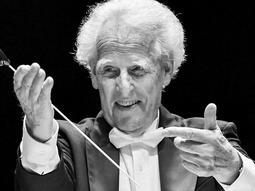
A leading interpreter of Mahler and Beethoven, Benjamin Zander is known for his charisma and unyielding energy -- and for his brilliant pre-concert talks.
Why you should listen to him:
Since 1979, Benjamin Zander has been the conductor of the Boston Philharmonic. He is known around the world as both a guest conductor and a speaker on leadership -- and he's been known to do both in a single performance. He uses music to help people open their minds and create joyful harmonies that bring out the best in themselves and their colleagues.
His provocative ideas about leadership are rooted in a partnership with Rosamund Stone Zander, with whom he co-wrote The Art of Possibility.
"Arguably the most accessible communicator about classical music since Leonard Bernstein, Zander moves audiences with his unbridled passion and enthusiasm."Sue Fox, London Sunday Times
Blog Posts on TED
-
TED2008: Days 3 and 4 in Quotes – March 2, 2008
“Imagine Martin Luther King saying, ‘I have a dream ... But I don’t know if the others will buy it.’” - Boston Philharmonic conductor Ben Zander, on the importance of persuasive leadership "Human progress depends on unreasonable people. Reasonable people accept the world as they meet it; unreasonable people persist in trying to change it. Well, I’m Bob and I’m an unreasonable person. And if TED is anything, it is the olympics of unreasonable people." - Musician and activist Bob Geldof (above) “Why are we ignoring the oceans? Why does NASA spend in one year what NOAA will spend in 1600 years? Why are we looking up? Why are we afraid of the ocean?” - Ocean explorer Robert Ballard "I think it's the dopamine." - Anthropologist Helen Fisher, explaining to Chris Anderson why she's still optimistic about love, despite understanding its chemical and biological basis "Relative to the universe, it's just up the road." - Physicist Brian Cox, after referring to Chicago as 'just up the road' from Monterey, CA “If you think half of America votes badly because they are stupid or religious, you are trapped in a matrix ... Take the red pill, learn some moral psychology and step outside the moral matrix.” - Jonathan Haidt, author of The Happiness Hypothesis “If you want the truth to stand clear before you, never be for or against. The struggle between 'for' and 'against' is the mind’s worst disease.” - Jonathan Haidt, quoting Sent-ts’an, from 700CE China "The job of the C is to make the B sad." - Boston Philharmonic conductor Ben Zander, deconstructing a piece by Chopin “How do we give credible hope to the billion poorest people in the world? It requires compassion to get ourselves started, and enlightened self-interest to get serious... If economic divergence continues, combined with global integration, it will build a nightmare for our children.” - Paul Collier, author of The Bottom Billion “In order to solve the climate crisis, we need to solve the democracy crisis.” - Al Gore, urging citizen involvement not only on a personal level, but also on a political level “How dare we be pessimistic? Maybe the future is better than it used to be.” - Peter Schwartz, co-founder of the Global Business Network “It's important to leave the security of who we are, and go to the place of who we are becoming. I encourage you to let yourself out of any prison you might find yourself in. Because we have to do something now. We have to change now.” - Environmental advocate John Francis (below), who went 17 years without speaking
More
-
A moment which totally knocked my hat in the creek – February 29, 2008
-
TED loves classical music – March 4, 2008

Photo: Andrew Heavens/TEDAs Megan Barnett writes on Portfolio.com:
I'm ready to buy my first classical music CD, after the boundlessly energetic Benjamin Zander brought the audience to tears with a Chopin piece before bringing it to its feet while belting out the Ode to Joy.
Plenty of TEDsters came away from Monterey and Aspen with the same feeling. If you're new to all this, here are a few good places to start: + The Chopin piece that Benjamin Zander played is the Prelude in E Minor, Op. 28: No. 4 -- and YouTube offers more than 70 interpretations of this classic piece. Listen to a few, and decide who is playing on one buttock. >> + The "Ode to Joy" comes from Beethoven's 9th Symphony. Though Zander's own recording of Beethoven's 9th, with the Boston Philharmonic Orchestra, is out of print, it is fascinating to read his thoughts on the way the 9th should be played >> + You can find Zander's recording of Beethoven's 5th and 7th Symphonies with the Philharmonia Orchestra of London here >> + TEDster and blogger John La Grou at Microlesia muses on Schiller's lyrics to the "Ode to Joy" >> + A comment on Microlesia points to a fascinating new documentary project, Following the Ninth: In the Footsteps of Beethoven's Final Symphony, an exploration of the global scope of this great romantic work. Read more here and add your comments >> + TED's own June Cohen was struck by this thought:
I keep thinking to myself: What a TRAGEDY that we can't invite Beethoven to TED! I want to MEET him. I want to TALK to him. I want to understand where the music came from.
+ A friend of TED suggests moving on to Mahler's Symphony No. 5 -- which Benjamin Zander recorded in 2001 with the Philharmonia Orchestra. A reviewer says, "Every section plays with edge-of-the-chair commitment." Sound familiar? More
-
TED2008: What Stirs Us? – February 29, 2008
(Unedited running notes from the TED2008 conference in Monterey, California. Session ten.)
Anthropologist Helen Fisher studies romantic love -- its evolution, its biochemical foundations, and its importance to human society. She gave a talk at TED2006 (watch the video). Her current research is on why we fall in love and how.
In the jungle of Guatemala, she says, stands a temple. It was built by the king of the Mayas, who was buried under it when he died. Mayan inscription proclaims that he was deeply in love with his wife, so he built a temple on her honor facing his. The sun rises behind one and sets behind the other: after 30'000 years these two people still kiss from their tombs. Anthropologists have not find any society that doesn't know love.
Have you ever been rejected by somebody you really loved? Have you ever dumped someone who really loved you? About 97% of people, men and women, say yes to those questions. Romantic love is one of the most powerful sensations on Earth. We are currently looking at the data of brain scans of people that have just been dumped, and we find alot of activity in the region associated with romantic love. We found activity in other brain regions also, in one associated with calculating gains and losses.
What have I learned? Romantic love is a universal human drive -- not the sex drive -- that it allows you to focus your energy into a single energy. Of all the poems, Plato: "the God of love lives in the state of need". Love is a need, like hunger and thirst. I have come to believe that romantic love is also an addiction. It has all of the characteristics of an addiction, you focus on a person, you obsess about him/her, you need to see more of her/him. Romantic love is one of the most addictive substances on Earth.
Animals also love. There is not a single animal on this planet that would copulate with anything that comes along, unless you're stuck in a lab cage. I've looked at 100 species and everywhere in the wild animals have favorites.
Our newest experiment -- putting people who report they're still in love in a long-lasting relationship into the functional MRI. And we find the same data, that region of the brain still becomes active 25 years later.
Why do you fall in love with one person rather than another? Match.com came to me three years ago and asked me that question, and I've researched it ever since. Psychologists tell you that we tend to fall in love with people with the same general level of intelligence, good looks, values, social status, but we don't know what makes two personalities really stick together to form a stable couple. I've concocted a questionnaire to analyze -- through biochemical analysis -- who chooses whom to love.
David Griffin is the director of photography for the National Geographic magazine -- the Vatican of photography. On his blog, Editor's Pick, he discusses the creation of the extraordinary photos published in the magazine.
He starts by showing some great -- truly awesome -- pictures by NG photographs, including the iconic portrait of the "Afghan Girl", Sharbat Gula (picture right) photographed by Steve McCurry and who did the NG cover in 1985.
Last year NG has added a section to their website ("Your Shot") where anyone can submit photographs to be considered for publication -- and it has been a runaway success. Everyone of us has one or two great photographs in us, but to be a great photojournalist you need to take great photos all the time.
Griffin goes on to tell great stories of photojournalism: in African national parks, in Indian slums, underwater in Baja California and New Zealand, in Chinese jellyfish markets, in the military medical system in Irak, etc.
Photography can be used to address our biggest issues. But sometimes photojournalism is just plain interesting or fun. Photography can make a real connection to people, and can be employed as a positive agent to understand the challenges and opportunities facing us today.
Peter Diamandis, founder of the X-Prize and advocate of the private exploration of space.
When I met Stephen Hawking (who spoke on Wednesday at TED), he told me his dream was to travel into space. I told him I could not take him there, but I could take him to weightlessness. The way to do so is through parabolic flights (fly up, then go into free fall, which gives you a few dozens seconds of weightlessness). And so we brought Stephen Hawking there (picture left - see video).Chris Abani is a Nigerian writer and political activist (twice imprisoned and tortured in his country). His 2004 novel "GraceLand" is a bitterly funny tale of a young Nigerial Elvis impersonator in Lagos. Abani was a speaker at TEDGLOBAL in Tanzania, last year.
More
My search is to find stories of everyday people that transcend us, that don't look away at the reality: we are never more beautiful than when we are ugly. What I've come to learn is that the world is never seen in the grand gestures, but in the accumulation of the simple, soft, selfless acts of compassion. In South Africa they say "Ubuntu": the only way for me to be human is for you to reflect my humanity back at me. Which means that there is no way for us to be human without other people.
So Abani tells stories of people. People standing up to soldiers wanting to kill them. People being compassionate. People being human, reclaiming their humanity, recognizing that we are surrounded by amazing people, who offer all of us the mirror to a whole humanity.
Benjamin Zander has been for almost 30 years the conductor of the Boston Philarmonic -- and a speaker on leadership. He uses music to help people open their minds.
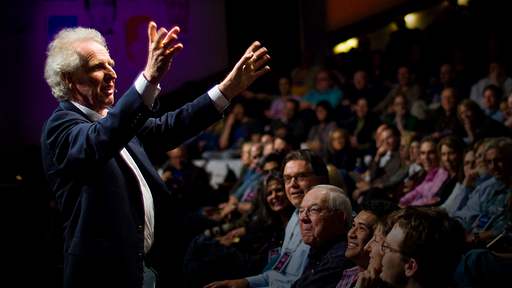
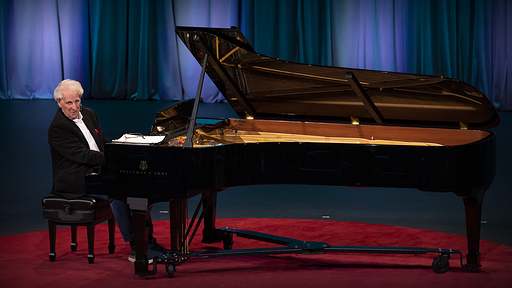
"There are people that think that classical music is dying, and others who think that we haven't seen anything yet. Rather than going into statistics of orchestras dying, we should do an experiment." He is on stage with a piano, and uses it to play Chopin and tell stories of musical learning and amazement, walking around on stage and down into the audience, and at the end of his speech, he gets the TEDsters to stand and sing Beethoven's "Ode to Joy". (They distribute the text written phonetically, but as a German speaker, I can't read it -- I'd never realized that if you speak a language, it's very difficult to read its phonetic rendering -- so I have to look up the original text: "Freude, schöner Götterfunken...")


