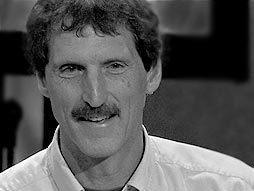
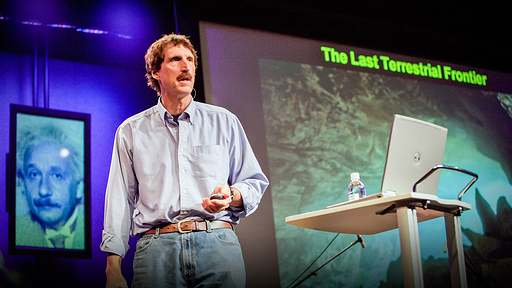
Engineer and daredevil caver Bill Stone pushes the frontier -- through flooded tunnels, the remotest depths of the Earth and the limits of human endurance. Next up, he’s planning to mine moon ice by 2015 and build an autonomous robot to visit the icebound sea of Jupiter’s moon Europa.
Why you should listen to him:
Engineer and daredevil explorer Bill Stone is obsessed with discovery. After years of crawling through the deepest unexplored caves on the planet, he’s building robots to go where he can’t. His company Stone Aerospace built DepthX, an autonomous robot, which descended 1,099 feet down Mexico’s deepest watery sinkhole. By 2008 he’ll send an enhanced machine through the ice of Lake Bonney in the Antarctic. But that’s just a test for the real mission, building a probe with Nasa to bore through miles of ice on Jupiter’s moon Europa, then swim through the buried Europan sea in search of alien life.
He’s also hoping to singlehandedly jump-start commercial human space exploration by offering spacefarers affordable fuels and consumables extracted from the moon. His new Shackleton Energy Company, or SEC, intends to raise $15 billion (as he points out, this is about the cost of a North Sea oil production platform complex) to mine ice thought to be trapped on the moon's southern pole at Shackleton Crater, and to sell derived products (including propellants and other consumables) on the moon and in low earth orbit (LEO) to international consumers. If all goes well, SEC will be open for business as early as 2015 as an international energy company.
"With a doctorate in structural engineering and 11 patents to his credit, Stone is the archetypal modern-day explorer, a multidisciplinary maverick constantly inventing tools in the name of discovery lust"Wired
Blog Posts on TED
-
Emily Oster: Cable television is good for women in India – August 16, 2007
University of Chicago economist Emily Oster went on stage at TED2007 to say that most of what we know about AIDS in Africa is wrong -- and proceeded to show data and graphs to make her case (watch the video of her speech -- or read the summary). Now she's applied her atypical lens to the effect of the introduction of cable television on gender attitudes in rural India, coming up again with surprising results.
In a recent draft paper (full text in PDF) that she wrote with Robert Jensen of Brown University after a three-year study, she argues that "the introduction of cable television is associated with improvements in women's status" and finds "significant increases in reported autonomy, decreases in the reported acceptability of beating and decreases in reported son preferences", this last point being about sex-selective abortions (rural families prefer boys). They also found "increases in female school enrollment and decreases in fertility (primarily via increased birth spacing)."
The effects are large, the two researchers argue, "equivalent in some cases to about five years of education" within the surveyed population.
These changes are "accomplished despite there being little or no direct targeted appeals" such as public-service announcements. Which brings Oster and Jensen to speculate that "it may be that cable television, with programming that features lifestyle both in urban areas and in other countries, is an effective form of persuasion, because people emulate what they perceive to be desirable behavior and attitudes".
More -
Porco awarded, Antonelli promoted – January 17, 2008
TED speaker Paola Antonelli (watch her TED 2007 talk) has been promoted to senior curator of the New York Museum of Modern Art's department of architecture and design. The promotion was announced by MoMA's director Glenn Lowry. Paola is currently preparing "Design and the Elastic Mind", an exhibition on science, design and innovation that will open at MoMA on February 24. Carolyn Porco, leader of the imaging team for the Cassini space mission to Saturn and the opening speaker at TED 2007 (watch her talk), will be the recipient of this year's Isaac Asimov Science Award, given by American Humanist Association. Porco will receive the award in June in Washington. To both, congratulations! More
-
Earth-rise and Earth-set – November 14, 2007
Consider it a bonus track to the great speech by Carolyn Porco last March at TED07, when she showed amazing images of Saturn and its moons. The Japanese Aerospace Exploration Agency (Jaxa) has just released video footage taken by the the onboard high-definition camera of their spacecraft Kaguya, showing extraordinary images of the Moon's surface and the Earth "rising" and "setting" beyond the Moon's horizon. (Clicking on the link on their page opens up a second window: let the whole video download -- it takes a while -- before watching it).
Earth-rise:

Earth-set:

(Cross-posted on LunchOverIP)
More -
A hard week for space exploration – July 27, 2007
This has been a hard week for lovers and dreamers of space travel -- a frequent topic at TED. An explosion at Burt Rutan's Scaled Composites spaceport caused three victims. It was followed by a report on issues of personal safety at NASA, part of the unfolding story there. Space exploration is an inherent high-risk endeavor. We invite you to view several talks on TED.com that can help recapture the excitement and pure imagination that has inspired generations of people to reach for the stars: Burt Rutan's own vision, Bill Stone's audacity, and cosmologist David Deutsch, who tells us that humanity's true purpose -- the reason we exist -- is to explore and learn, to gain knowledge. More
-
Jonathan Harris tells the Web's secret stories, on TED.com – July 10, 2007
Jonathan Harris wants to make sense of the infinite world on the Web -- so he builds dazzling graphic interfaces that help us visualize the data floating around out there. Here he presents "We Feel Fine," a project that scours blogs to collect the planet's emoti(c)ons, and the "Yahoo! Time Capsule," which preserves images, quotes and thoughts snapped up in 2006. And he premieres "Universe," which presents current events as constellations of words -- a tag cloud of our collective consciousness. (Recorded March 2007 in Monterey, CA. Duration: 19:37.) Read more about Jonathan Harris on TED.com.
Embed this video: Use this code to run the video on your own site:
Watch this talk on TED.com, where you can download it, rate it, comment on it and find other talks and performances. New: Download this talk in high resolution (480p) >> More
-
A taste of TED, or two – June 14, 2007
Watch here a new "taste of TED" video documentary shot at this year's conference, in March. In 7 minutes it gives a great sense of the atmosphere at TED and of the content of the conference. It is also available elsewhere on this site, and you can download it here (158 Mb).
Another documentary about TED, "The future we will create: Inside the world of TED", which was filmed at TED2006, is been shown this coming Saturday night at the Maui Film Festival. Producers Daphne Zuniga and Steven Latham got full access to the conference, and used it wisely to take the viewers behind the scenes -- on top of showing speakers ranging from Al Gore to Peter Gabriel. The full-feature documentary (74 minutes) had a premiere screening in New York a few weeks ago and later in Los Angeles. It has been released on Netflix (US only) last week.
More -
Everything we know about AIDS in Africa is wrong: Emily Oster on TED.com – July 12, 2007
Emily Oster, a University of Chicago economist, looks at the stats on AIDS in Africa -- and comes up with a stunning conclusion: Everything we know about AIDS in sub-Saharan Africa is wrong. We look for root causes such as poverty and poor health care -- but we also need to factor in, say, the price of coffee, and the routes of long-haul truckers. In short, she says, there is a lot we don't know; and our assumptions about what we do know may keep us from finding the best way to stop the disease. (Recorded March 2007 in Monterey, CA. Duration: 15:45.)
New: Download this talk in high resolution (480p)
Watch Emily Oster's talk on TED.com, where you can download it, rate it, comment on it and find other talks and performances.
Read more about Emily Oster on TED.com.
Embed this video: Use this code to run the video on your own site:
More -
Robots that are "self-aware": Hod Lipson on TED.com – October 11, 2007
Engineer Hod Lipson demonstrates and talks about a few of his cool little robots, which have the ability to learn, understand themselves and even self-replicate. At the root of this uncanny demo is a deep inquiry into the nature of how living beings learn and evolve, and how we might harness these processes to make things that learn and evolve. (Recorded March 2007 in Monterey, California. Duration: 06:29.)
Watch Hod Lipson's talk on TED.com, where you can download it, rate it, comment on it and find other talks and performances.
Read more about Hod Lipson on TED.com.
Embed this video: Use this code to run the video on your own site:
More -
Hans Rosling's jaw-dropping demo, on TED.com – June 26, 2007
In a follow-up to his now-legendary TED2006 presentation, Hans Rosling demonstrates how developing countries are pulling themselves out of poverty. He shows us the next generation of his Trendalyzer software -- which analyzes and displays data in amazingly accessible ways, allowing people to see patterns previously hidden behind mountains of stats. (Just days after this talk, he announced a deal with Google to acquire the software.) He also demos Dollar Street, a program that lets you peer in the windows of typical families worldwide living at different income levels. Be sure to watch straight through to the (literally) jaw-dropping finale. (Recorded March 2007 in Monterey, CA. Duration: 19:09) Read more about Hans Rosling on TED.com.
Embed this video: Use this code to run the video on your own site:
Watch this talk on TED.com, where you can download it, rate it, comment on it and find other talks and performances. More
-
A tour of MS Virtual Earth, on TED.com – June 21, 2007
Stephen Lawler, from Microsoft, takes us on a tour through the company's new Virtual Earth project, which is, basically, an attempt to turn the entire planet into an interface to the web. Collecting and synthesizing massive amounts of data -- bird's-eye views, street-level photos, 3D wireframes -- the Virtual Earth team are building a world of possibilities. Bonus: This talk may explain the mysterious vans with cameras on top that you might have seen cruising up and down your street. (Recorded March 2007 in Monterey, CA. Duration: 06:55) Read Stephen Lawler's profile on TED.com
Embed this video: Use this code to run the video on your own site:
Watch this talk on TED.com where you can download it, rate it, comment on it and find other talks and performances. More
-
How I got my new hip, on TED.com – July 26, 2007
TEDster Allison Hunt's five-minute talk finds humor and marketing strategy in the most unlikely of places -- her own hip-replacement surgery. As the world scrutinizes broken health-care systems, this particularly timely clip shows how getting to the front of a two-year waiting list can have an altruistic effect. (Recorded March 2007 in Monterey, CA. Duration: 5:00.)
Watch Allison Hunt's talk on TED.com, where you can download it, rate it, comment on it and find other talks and performances.
Read more about Allison Hunt on TED.com.
Embed this video: Use this code to run the video on your own site:
More -
Flying to the moons of Saturn: Carolyn Porco on TED.com – October 2, 2007
Planetary scientist Carolyn Porco says, "I'm going to take you on a journey." And does she ever. Showing breathtaking images from the Cassini voyage to Saturn, she focuses on Saturn's intriguing largest moon, Titan, with its deserts, mudflats and puzzling lakes, and on frozen Enceladus, which seems to shoot jets of ice. Could one of these places harbor water -- or life? (Recorded March 2007 in Monterey, California. Duration: 17:21.)
Watch Carolyn Porco's talk on TED.com, where you can download it, rate it, comment on it and find other talks and performances.
Read more about Carolyn Porco on TED.com.
Embed this video: Use this code to run the video on your own site:
More -
2007 TED Prize winner E.O. Wilson on TEDTalks – April 4, 2007
As E.O. Wilson accepts his 2007 TED Prize, he makes a plea on behalf of his constituents, the insects and small creatures, to learn more about our biosphere. We know so little about nature, he says, that we're still discovering tiny organisms indispensable to life; and yet we're steadily, methodically, vigorously destroying nature. Wilson identifies five grave threats to biodiversity (a term he coined), and makes his TED wish: that we will work together on the Encyclopedia of Life, a web-based compendium of data from scientists and amateurs on every aspect of the biosphere. (Recorded March 2007 in Monterey, CA. Duration: 24:21) NEW: Watch this talk in High Resolution (480P)
Download this talk: Audio (MP3) | Video (MP4) | NEW! High-rez Video (MOV)
Read the transcript
More TEDTalks: TEDTalks website | iTunes (audio) | iTunes (video)
Blog this video: Use this code to run the video on your own site:
Subscribe to TEDTalks for free, automatic updates.
More -
The center of our minds: Vilayanur Ramachandran on TED.com – October 23, 2007
Brain researcher Vilayanur Ramachandran talks about how brain damage can reveal the connection between the internal structures of the brain and the corresponding functions of the mind. He discusses three specific syndromes: phantom limb pain, synesthesia (when people hear color or smell sounds), and the Capgras delusion, when brain-damaged people believe their closest friends and family have been replaced with imposters. (Recorded March 2007 in Monterey, California. Duration: 23:46.)
Watch Vilayanur Ramachandran's talk on TED.com, where you can download it, rate it, comment on it and find other talks and performances.
Read more about Vilayanur Ramachandran on TED.com.
New: Download this talk in high resolution >>
Embed this video: Use this code to run the video on your own site:
More -
Speaker updates: Craig Venter, Jeff Han – October 8, 2007
Updates from TED speakers: After a whirlwind of media speculation over the weekend following a story by The Guardian, biologist Craig Venter (watch his TED2005 speech) will announce today at the annual meeting of his institute in San Diego that his team has built a synthetic chromosome, using lab chemicals. "A giant leap forward in the development of designer genomes", writes the newspaper. Mr Venter's autobiography, "A Life Decoded: My Genome, My Life" is scheduled to be published in two weeks. At TED2006 computer scientist Jeff Han demonstrated his prototype of a revolutionary multitouch screen (watch video). At TED2007 he brought along a larger, wall-size version that TEDsters could try out. The interactive media wall, built by Han's company Perceptive Pixel, will be sold by Nieman Marcus in the US. Price tag: $100,000 USD. More
-
Life at 30,000 feet: Richard Branson on TED.com – October 9, 2007
When Richard Branson was at school, his headmaster predicted he would wind up either a millionaire or in jail. Since then, he's done both. He talks to TED's Chris Anderson about the ups and the downs of his career, from his multibillionaire success to his multiple near-death experiences, from Virgin's line of spacecraft to the failure of the Virgin condom. He also reveals some of his (very surprising) motivations. (Recorded March 2007 in Monterey, California. Duration: 30:44.)
Watch Richard Branson's talk on TED.com, where you can download it, rate it, comment on it and find other talks and performances.
Read more about Richard Branson on TED.com.
Embed this video: Use this code to run the video on your own site:
More -
What Are Icons, Mavericks and Geniuses? – March 3, 2007
The theme for the TED 2008 conference was recently announced -- it is "The Big Questions." A worthy theme for TED, indeed, but not one I am yet prepared to ponder. Rather, as TED 2007 is literally around the corner, I find myself much more engaged in contemplating next week's theme -- "Icons. Geniuses. Mavericks." An equally worth theme, but what does it mean?
One might attempt to intuit the answer from next week's program. Presumably these amazing speakers are the icons, geniuses and mavericks of which we speak. But who is what? Is Paul Simon a genius or an icon? Is Nathan Myhrvold a maverick or a genius? Is Richard Branson an icon or a maverick? And what in the world is Tom Reilly? Clearly it was going to take more than mere deduction to appreciate the meaning of next week's theme.
Finding insufficient inspiration from TED's own website, I chose to take the very advice I give my kids when they ask me a question for which I have no answer -- "I don't know, look it up on Wikipedia." So off to Wikipedia I went, while contemplating whether TEDster Jimmy Wales would be described as an icon, maverick or genius? Thankfully, Jimmy spoke at TEDglobal2005 for which no categorization was required; instead, Jimmy needed only to share "Ideas Big Enough to Change the World." Given his druthers, Jimmy may have opted for categorization over the lofty requirement of world-changing ideas. Nonetheless, a theme's a theme and Jimmy was not an "icon, genius or maverick," but rather a speaker of "ideas big enough to change the world." I remained hopeful that Jimmy's big idea -- Wikipedia -- would be able to help me solve my conundrum.
Unfortunately, delving into the pages of Wikipedia did not give me instant clarity as to the essence of these terms. But, as they say, a picture is worth a thousand words, and therefore I will share with you what Wikipedia did have to say about Icons, Geniuses and Mavericks.

Not a bad lineup if TED could pull it off -- Jesus, Einstein and James Garner. I've often thought what a great conference TED could create if there was time travel. Alas, next week's icons, geniuses and mavericks are going to have to come from the living to participate. Luckily, judging by the schedule, there were plenty to chose among. Since I can get no more clarity from Wikipedia on this year's TED theme, I guess I'll have to report back after the conference with my thoughts on what makes an icon, genius or maverick. Until then, I think I'll go watch some reruns of Maverick on the American Life Network.
More -
TED2007 Day Three: things that knocked my hat in the creek – March 10, 2007
Wow! Day Three at TED2007 ROCKED! A magical day which got crank-started by a truly electric presentation on the perils of Local Warming.
This was a day which just can't wait for the TEDTalks to come out. Daniel Goleman made a wonderful connection between emotional intelligence and the empathy which will be required -- by all of us -- to make more informed, broader-scope consumption and action decisions in the future. Later in the day Eames Demetrios, grandson of Charles Eames (and a true design thinker in his own right) made the same point in a different way -- humanity has got the information now; we just need to start making better choices.
Today (actually, yesterday, since once again I find myself blogging at 4 in the morning -- funny that...) was one of those classic TED days where almost everything was mind-blowing,where just about everything knocked my hat in the creek. Highlights for me were JJ Abrams and his Mystery Box; Jeff Skoll and his enlightened humanity; Deborah Scranton and her movie The War Tapes, which every global citizen must see and experience; Will Wright and his latest "game" which I couldn't help but think was the fortuitous answer to the TEDPrize wish of 2007 TEDPrize winner E.O. Wilson; Jaime Lerner as a vibrant example of the power of pure enthusiasm; Eames Demetrios for giving us the gift of previously unseen movies which exposed the vernacular power of iterative prototyping, as well as a parable of a banana leaf which pretty much sums up TED 2006+2007 in a nutshell (you MUST watch this TEDTalk when it comes out!); and of course Tracy Chapman and Isabel Allende for their artistry and authenticity.
It was a good day.
Above, all, I want to express my personal gratitude for Thomas Dolby and the musicians of the Jazz Mafia for the musical punch they give to all of TED:
More -
TED2007: Sketchblogging the conference – March 9, 2007
Lorna Herf is an illustrator and designer from Los Angeles attending TED and she's been blogging on lornamatic in a pretty original and compelling way - she's sketchblogging the conference. Check out her blog. Here are her "notes" from four speakers: Carolyn Porco (session 1), John Doerr (session 3), Ngozi Okonjo-Iweala (session 3) and Michael Pollan (session 5):
More
-
The illustrated woman: Maira Kalman on TED.com – October 16, 2007
Author and illustrator Maira Kalman talks about her life and work -- from her New Yorker covers to her children's books to her newest book for grownups, The Principles of Uncertainty. And yes, in person, she is as wonderful, as wise, and as deliciously off-kilter as her work. (Recorded March 2007 in Monterey, California. Duration: 17:42.)
Watch Maira Kalman's talk on TED.com, where you can download it, rate it, comment on it and find other talks and performances.
Read more about Maira Kalman on TED.com.
Embed this video: Use this code to run the video on your own site:
More -
Making films to make change: Jeff Skoll on TED.com – August 23, 2007
Jeff Skoll made his fortune as the first president of eBay. Now he's spending it at the movies. His company, Participant Productions, makes entertaining, issues-driven films that inspire real change -- Murderball, Syriana, An Inconvenient Truth ... Here, he talks about the people who've inspired him to do good, and about some upcoming films that will open your eyes. (Recorded March 2007 in Monterey, California. Duration: 15:45.)
Watch Jeff Skoll's talk on TED.com, where you can download it, rate it, comment on it and find other talks and performances.
Read more about Jeff Skoll on TED.com.
Embed this video: Use this code to run the video on your own site:
More -
Scenes from "The War Tapes": Deborah Scranton on TED.com – September 13, 2007
The director of the award-winning documentary The War Tapes, Deborah Scranton makes films that help people tell their own stories. She talks about making The War Tapes, her 2006 doc that put videocameras in the hands of Charlie Company, a unit of the National Guard stationed in Iraq, for one year. Their raw footage and diaries tell a powerful, unsettling story. (Recorded March 2007 in Monterey, California. Duration: 17:49.)
Watch Deborah Scranton's talk on TED.com, where you can download it, rate it, comment on it and find other talks and performances.
Read more about Deborah Scranton on TED.com.
Embed this video: Use this code to run the video on your own site:
More -
High drama inside a cell, on TED.com – July 24, 2007
David Bolinsky and his team at XVIVO illustrate scientific and medical concepts with high-drama animation. These animators are true auteurs, carefully scripting and editing the story of cellular processes to show everyone -- expert and amateur alike -- the truth and the beauty of our bodies. You've never seen the life of a cell quite like this. (Recorded March 2007 in Monterey, CA. Duration: 9:57.)
New: Download this talk in high resolution (480p)
Watch David Bolinsky's talk on TED.com, where you can download it, rate it, comment on it and find other talks and performances.
Read more about David Bolinsky on TED.com.
Embed this video: Use this code to run the video on your own site:
More -
To the depths of the Earth ... and beyond! Watch Bill Stone on TED.com – June 28, 2007
Bill Stone, the maverick cave explorer and diver -- who has invented robots and rebreathing equipment to let him plumb Earth’s deepest abysses -- talks about his efforts to build a robot to explore Jupiter’s moon Europa. The plan is to send the droid to bore through miles of ice and swim through a liquid underworld that may harbor alien life. And if that’s not enough, he’s also planning to mine ice, on Earth's own moon, by 2015. (Recorded March 2007 in Monterey, CA. Duration: 17:55) Read more about Bill Stone on TED.com.
Embed this video: Use this code to run the video on your own site:
Watch this talk on TED.com, where you can download it, rate it, comment on it and find other talks and performances. New: Download this talk in high resolution (480p) >> More
-
Quotes from the TED Salon – September 27, 2007
Last night in Manhattan, TED hosted its 2007 Salon, called "Hot Science: Radical Ideas to Combat the Climate Crisis." A detailed roundup is coming later today -- but first, a few quotes from last night: The first speaker, Michael Oppenheimer, began by saying: "I'm the depressing, immobilizing part of the talk." He went on to make this point: While Hurricane Katrina can't be directly tied to climate change, it did teach us one thing:
You can't count on the government to save you from global warming. They're still inept to this day, and half an American city is gone, and how the hell are we going to deal with this? And what are we doing instead?
He puts up a devastating slide of the hyperdevelopment on the beach at Atlantic City -- which would lose 100 feet of beachfront if global sea levels rise 1 foot, as they will.
Alternative energy expert Martin Hoffert is a staunch advocate for getting off fossil fuels altogether. He spun out one scenario:Let me say a few words about space solar power. The advantage of putting solar collectors in orbit: The sun is basically shining 24/7. We already have thousands of satellites up there -- suppose you could build a transmitting antenna in orbit that would beam energy down to collectors, beaming energy using lasers (not microwaves) from geostationary orbit? We could send it up in one launch vehicle, and power a village, maybe in Africa, to demonstrate the viability of solar power. We could do this in 3 to 5 years.
Environmental scientist David Keith talked about geoengineering -- dramatic, cheap solutions to a warming atmosphere, such as blowing a Mt. Pinatubo-size cloud of sulfur into the sky to bring the global temperature down. Such ideas seem overly dramatic, and even immoral, but they are out there, and he argues:
We should move this out of the shadows and talk about this seriously, because sooner or later we will be confronted with a decision on this. We would do [geoengineering] instead of cutting emissions, instead of mitigation, because it's cheaper. It's very cheap. It's not a GOOD idea, but that's how big the [incentive] is. That is not in dispute, though we might argue over the sanity of it ...
Russ George, the chief scientist of Planktos, offered a way to think about all the factors contributing to the larger issue of climate change:
We have a bunch of aberrant applications in this planet, jamming a lot of errors against that primary operating system, and it's threatening to reboot and give us that blue screen of death, threatening a reboot back to 16 million years ago.
Juan Enriquez (pictured above) talked about how much of our energy, such as coal and oil -- made from ancient plants -- is simply "concentrated sunlight." How can we get to the point where we grow our own energy as efficiently as we grow wheat? Looking at a photo of a pile of surplus grain, Enriquez notes:
That would probably be a good outcome for energy.
Photo of Juan Enriquez by Myrna Suarez, Condé Nast Portfolio More -
"Rock star" Ngozi Okonjo-Iweala named to World Bank – October 5, 2007
Ngozi Okonjo-Iweala (watch her TEDTalks from TED2007 and TEDGlobal07), the crusading economist and former Finance Minister of Nigeria, has been appointed a Managing Director of the World Bank.
Dr. Okonjo-Iweala will oversee the World Bank’s work in Africa, South Asia, and Europe and Central Asia. "Her commitment to the developing world is unparalleled," said Robert Zoellick, the president of the World Bank. She's been working with the Stolen Assets Recovery (StAR) initiative to help poor countries reclaim assets lost to corruption, and with Bono's DATA organization on historic debt-relief programs. Bono said of her last week, "She's the kind of leader we all want to work for." (And as Portfolio.com commented, she's as much a rock star as that Irish gentleman.)
More -
First look at Branson/Rutan's space terminal – September 6, 2007
Making private space travel possible and accessible to everyone has been a recurring topic at recent TED conferences, discussed by speakers such as Burt Rutan at TED 2006 (watch his speech), Peter Diamandis at TEDGLOBAL 2005, Richard Branson at TED 2007 and others. This week the first images of the central terminal and hangar facility at New Mexico's future private spaceport have been released:
Designed by engineering firm URS Corp and by architect Norman Foster, the structure, called Spaceport America, will serve as the operating basis for Branson's Virgin Galactic suborbital spaceliners, which are being built at Scaled Composites in California, founded by Rutan. Construction of the spaceport should begin in 2008.
Details in this story by Space.com.
More -
E.O. Wilson on PBS: Why should we care if the woodpecker goes? – July 13, 2007
The last "Bill Moyers Journal", the weekly report on PBS, featured a long interview (video - transcript) by Moyers with biologist and TED Prize 2007 winner EO Wilson. The focus was very much on Wilson's career -- "No one in our time has added more to our understanding of Earth's ecology than Ed Wilson" is how Moyers described him -- but Moyers took the opportunity to also ask questions about the Encyclopedia of Life. The EOL is Wilson's TED Prize wish (video - summary - text): It's a vast project aimed at documenting all 1.8 million named species of animals, plants, and other forms of life on Earth, and those yet to be discovered ("We're maybe today about 1/10 through the discovery of species", says Wilson). Efforts towards an EOL have been underway since January 2006, but Wilson's TED2007 speech has significantly accelerated the process, with the McArthur Foundation leading a US$ 50 million funding commitment, leading scientific institutions including Harvard University and the Smithsonian teaming up, and agency Avenue A/Razorfish creating a first design concept for the Encyclopedia and a video to explain the ambitious vision behind the initiative, using photography by Frans Lanting (watch his TED 2005 speech) and others. Moyers is a great interviewer. At a certain point, he asks Wilson: why should we care if the woodpecker goes? I mean, we've lost---how many species have we lost? Wilson: How many species going extinct or becoming very rare do you think it takes before you see something happening? We now know from experiments and theory that the more species you take out of an ecosystem like a pond, a patch of forest, a little bit of marine shallow environments, the more you take out the less stable it becomes. If you have a tsunami or a severe drought or a fire, it is less likely that that ecosystem, that body of species in that particular environment, is going to come back all the way. So it becomes less stable with fewer species. And then we also know it becomes less productive. In other words, it's not able to produce as many kilograms of new matter from photosynthesis and passage through the ecosystem. It's less productive. It sure is less interesting, though, isn't it? And more than that: we lose the services of these species. Moyers: The services of these species. Wilson: Yes, services of these species to us. Like pollination and water purification. Moyers: That we get free from nature. Wilson: Yeah. Here's an easy way to remember it.
More -
Redefining the dictionary: Erin McKean on TED.com – August 30, 2007
Is the beloved paper dictionary doomed to extinction? When does a made-up word become real? And could you use "synecdochical" in a sentence, please? In this infectiously exuberant talk, leading lexicographer Erin McKean looks at the many ways in which today's print dictionary is poised for transformation in this internet era. (Recorded March 2007 in Monterey, California. Duration: 15:41.)
Watch Erin McKean's talk on TED.com, where you can download it, rate it, comment on it and find other talks and performances.
Read more about Erin McKean on TED.com.
Embed this video: Use this code to run the video on your own site:
More -
William Kamkwamba in the Wall Street Journal – December 12, 2007

William Kamkwamba, a young Malawi man who designed and built a windmill for his family when he was 14 -- and who spoke so memorably at TEDGlobal Africa this June -- is profiled on the front page of today's Wall Street Journal in a story headined "A Young Tinkerer Builds a Windmill, Electrifying a Nation." Writer Sarah Childress adds detail to the story that Kamkwamba told onstage in Tanzania:
Mr. Kamkwamba's wind obsession started six years ago. He wasn't going to school anymore because his family couldn't afford the $80-a-year tuition.
When he wasn't helping his family farm groundnuts and soybeans, he was reading. He stumbled onto a photograph of a windmill in a text donated to the local library and started to build one himself.
There's also a great 2-minute video that shows the updates Kamkwamba has made to his family's home power system, and talks about what's next for him:
Video: Writer Sarah Childress from the Wall Street Journal talks to William Kamkwamba, a 20-year-old Malawian who built a windmill to power his family's home. Image courtesy Wall Street Journal
More -
What's your Starck factor? – March 5, 2007
One of the greatest things about TED is the opportunity to get acquainted with people who are already part of your life, even if you don't know them personally. Be it hearing them in a speech, meeting them in the audience, or catching them in a TEDTalks video, TED gives us all a chance to meet the designers, entertainers, technologists, academics, film makers, poets, architects, writers, scientists, journalists, and politicians who help shape the world we live in.
So imagine my excitement when I learned that Philippe Starck would be on the TED2007 speaker lineup. A maverick's maverick, Starck continues to exert a massive influence on our aesthetic and social landscape. As the TED2007 program states:
He is the most famous and prolific designer alive. The streamlined and organic look of his architecture, interior design and product design has influenced designers and consumers alike, and as a result he has changed the way we live.
Which made me ask, "What's my Starck factor? How much Starck is there in my day to day life?" The answer is: quite a lot, and more than I thought. Here's a quick survey -- your results may vary:
First, the Starck Gnomes. As it happens, I have a lot of meetings at work in a room staffed by these patient and sturdy little guys. I think they help bring good karma to the room, which makes some of the harder meetings a little easier:
I also occasionally hold an outdoor meeting where we end up sitting on this Starck sofa. In the spirit of full disclosure, I have to tell you that my bottom doesn't find it to be a plush sit. That's okay, though, because the comfort limitations curtail the length of those sessions, and academic studies have shown that 10-20 minute meetings are more productive than their lengthier cousins:
Above all, I like sitting in this Eros chair. It feels great to sit in and be seen in. And it helps you empathize with the olive in a martini. Fun!:
In a drawer at home I keep this incredible watch by Starck for Fossil. I love the way it looks on the wrist, like a timepiece beamed back from the future. It's my "special occasions" watch. The green readout is cool, too:
Here's one I don't have. But if I was living in a flat in Paris, I'd be riding this Aprilia Moto 6.5 whenever a pedal bike wouldn't do. Where other motorcycles get tripped up by their own macho fixations, saying "I'm going to take you for a ride," this one has a kindlier aspect. It says "Let's go for a ride -- together." And I love the orange splash. Perfect:
Another one on my "to buy" list. This clock from Oregon Scientific is extremely clever in that it beams the time up on to the ceiling, so that you can read it while lying in bed. Come to think of it, that easy glance up could be useful in many situations, such as making sure that that work meeting goes no longer than 20 minutes:
That's just a brief personal inventory based on the life works of just one TED speaker. It's worth your while to browse through Starck's immense portfolio. Imagine the breadth and depth of impact across all of the TEDsters through time. What's your TED Factor?
More -
TED2007: pre-conference impressions – March 6, 2007
Minus one (day). TED2007 starts tomorrow Wednesday. The whole team is in Monterey getting things ready. Here a few impressions of today, starting with the preparation of the main stage:
Just outside, tech and decoration materials are being delivered:
Speakers' pictures are ready to be hung on the walls:
The simulcast room is being assembled:
In a separate room, the "gift bags" for the 1200 attendees are filled and stockpiled:
So we're almost ready to go:
There has been some news coverage of TED lately. One month ago CBS put online a 10-minutes video report on TED, who attends and what's discussed. This week's BusinessWeek has a story headlined "Forget Davos. I'm booked up for TED", while yesterday's New York Times describes "Where artists and investors plot to save the world". While both articles say great things about TED and compare it favorably to the Davos World Economic Forum however, it's worth pointing out that they almost contradict each other. BusinessWeek quotes a former attendee suggesting that TED has become mainly about connections with celebrities; the NY Times writes that TED is now mainly a do-good gathering discussing "photographs of genocide victims, environmentally sustainable AIDS clinics and water-purification systems".
Between glam celebrities and genocide victims, the truth is that the actual content -- the speakers and the ideas -- at TED this year promises to be more interesting than ever.
I will try to liveblog it starting tomorrow, with highlights on the TEDblog and full content on LunchOverIP. We are also planning to have daily summary podcasts. Other bloggers will be writing/podcasting from TED: check out in particular Ethan Zuckerman and Tom Guarriello. If you're blogging from the conference, leave a comment with your URL here: I will be composing a list of TED bloggers and publish it.
More -
Our cell phones, ourselves: Jan Chipchase on TED.com – October 18, 2007
Nokia researcher Jan Chipchase investigates the ways we interact with technology -- a quest that has led him from the villages of Uganda to the insides of our pockets. Along the way, he's made some unexpected discoveries: about the ways illiterate people use their mobile phones, the new roles the mobile can play in global commerce, and the deep emotional bonds we share with our phones. And he's got a surefire trick to keep you from misplacing your keys. (Recorded March 2007 in Monterey, California. Duration: 16:15.)


