
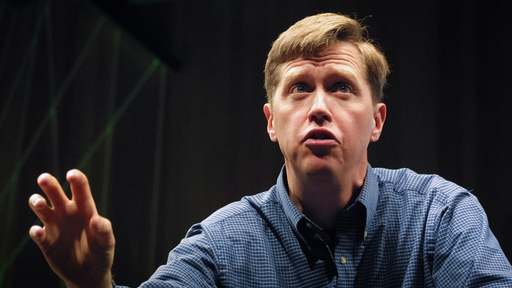
Jeff Hawkins pioneered the development of PDAs such as the Palm and Treo. Now he's trying to understand how the human brain really works, and adapt its method -- which he describes as a deep system for storing memory -- to create new kinds of computers and tools.
Why you should listen to him:
Jeff Hawkins' Palm PDA became such a widely used productivity tool during the 1990s that some fanatical users claimed it replaced their brains. But Hawkins' deepest interest was in the brain itself. So after the success of the Palm and Treo, which he brought to market at Handspring, Hawkins delved into brain research at the Redwood Center for Theoretical Neuroscience in Berkeley, Calif., and a new company called Numenta.
Hawkins' dual goal is to achieve an understanding of how the human brain actually works -- and then develop software to mimic its functionality, delivering true artificial intelligence. In his book On Intelligence (2004) he lays out his compelling, controversial theory: Contrary to popular AI wisdom, the human neocortex doesn't work like a processor; rather, it relies on a memory system that stores and plays back experiences to help us predict, intelligently, what will happen next. He thinks that "hierarchical temporal memory" computer platforms, which mimic this functionality (and which Numenta might pioneer), could enable groundbreaking new applications that could powerfully extend human intelligence.
"Even if Hawkins finds only a small sliver of the Holy Grail he seeks [in brain research], he'll add yet another industry-moving startup to his resume."BusinessWeek
Blog Posts on TED
-
Jeff Hawkins' TEDTalk on how brain science will change computing – May 23, 2007
Jeff Hawkins brought us the indispensable Palm and Treo -- now he's turned his attention to the human brain, looking to our gray matter for clues to the next generation of powerful computers and software. To date, there hasn't been an overarching theory of how the brain really works, Hawkins argues in this compelling talk -- because we still haven't defined intelligence accurately. But one thing's for sure, he says: The brain isn't like a powerful computer processor. It's more like a memory system that records everything we experience and helps us predict, intelligently, what will happen next. Bringing this new brain science to computer devices will enable powerful new applications -- and it will happen sooner than you think ... (Recorded February 2003 in Monterey, CA. Duration: 20:24) Read Jeff Hawkins's profile on TED.com
Embed this video: Use this code to run the video on your own site:
Watch this talk on TED.com where you can download it, rate it, comment on it and find other talks and performances.

